Orson Welles at One Hundred

Welles in his short-lived BBC series, Around the World with Orson Welles.
Orson Welles was born one hundred years ago today. Generally I’m not into making a big deal about birthdays, but this seems like an important one. Sure, it’s important to me because Welles had a huge impact on my life, but if you do a search on the net you’ll find that there are many others out there who think the day is worth celebrating.
Mostly these days Welles is remembered for The War of the Worlds and Citizen Kane, two early efforts that made him famous, and in some circles infamous. In reality, he had a long and varied career, starting on the stage, moving to radio, then to film and later to television.
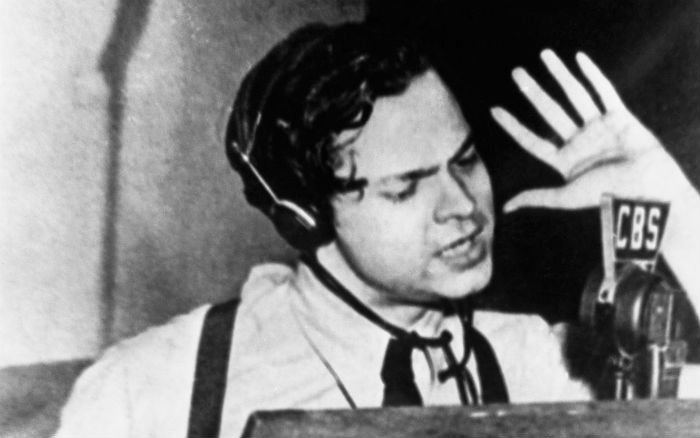
A shot of Welles during one of his radio broadcasts.
Much of his work in radio survives, but it’s ignored or forgotten. Hardly anybody talks about his brief but impressive career in television. And sadly, of the many productions he directed for the stage, all we have are photographs, reviews and anecdotes. We can only imagine what the Black Macbeth, the modern-dress Julius Caesar and Around the World in Eighty Days were like. There’s very little information about the version of King Lear that Welles staged in New York in the fifties. It only lasted for twenty one performances. And though we do have the text of Moby Dick, Rehearsed, the performance of the play is lost to us forever.
Still, even if we just look at Welles’ career in film, there’s a lot to celebrate. Citizen Kane got only a limited release at the time it was made, but it influenced a generation of filmmakers. Even in its mutilated form, The Magnificent Ambersons is a heartbreaking account of the disintegration of an American family. The Lady from Shanghai, also mangled by the studio, is still a dazzling exploration of desire and corruption.
Much of the recognition Welles received for these early films was inspired by his innovative use of sound and image. But art isn’t just about technical flash. Sure, the early stuff is thrilling. But it’s the later work where he starts digging deeper into himself, and that’s where it really gets interesting. You’ll see some virtuoso camerawork in Touch of Evil, but the heart of the story is the relationship between Quinlan and Menzies. Chimes at Midnight is one of Welles’ most straightforward films in terms of technique, but in telling the story of Falstaff and Hal he seems to be revealing more of himself than ever before. And while many view Fake? as an entertaining trifle, the film offers some profound insights on the nature of art and authorship.
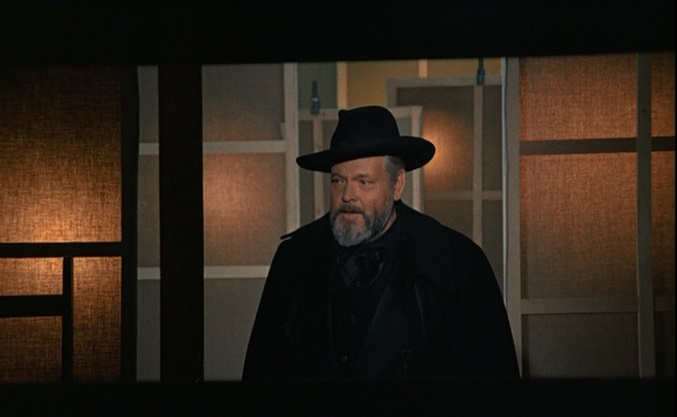
Welles as narrator, storyteller, ringmaster in Fake?
When I was younger, I used to see Welles’ career as a tragedy. Back then I tended to focus on the fact that the studios wouldn’t touch him, and it pained me to see him doing awful movies and silly commercials to finance his films. But as I’ve gotten older, my perspective has changed. Now I can’t believe what an incredible life he had. In his early twenties he was a star on the stage and on radio. At twenty five he finished his first feature. The thing that really impresses me, though, is the perseverance he showed later on in life. Things quickly went bad for him in Hollywood. Working in Europe in the fifties he was always scrambling to find money to make films. When he returned to LA in the sixties, the studios were even less interested than they had been twenty years before. But he kept working. And he kept making movies. And that’s why, in spite of his faults, in spite of his failures, he seems absolutely heroic to me.
Happy birthday, Orson.

Welles reading from Moby Dick.
If you live in the LA area, you have a couple options for celebrating Welles’ birthday over the next few days. Tonight and tomorrow the New Beverly is showcasing his work as an actor, screening Treasure Island and The Long, Hot Summer. On Thursday and Friday they’ll be showing Orson Welles and Me along with The Cat’s Meow. Not exactly sure why they’re showing The Cat’s Meow, since the connection to Welles’ career is pretty tenuous. But I recommend Orson Welles and Me very highly. In this moving coming of age story from Richard Linklater, a young man goes to work for the Mercury Theatre in its heyday. Christian McKay is fabulous as the young Orson Welles, a brilliant, arrogant, charming monster, alternately seducing and terrorizing his company.
At its Aero Theatre in Santa Monica, the American Cinematheque kicks off its Welles celebration on Thursday with The Lady from Shanghai, and wraps it up on Sunday with Touch of Evil. Every night is worth checking out, but on Saturday they’re screening a couple of films that don’t show up in theatres very often. Many of Welles’ admirers, including me, think Chimes at Midnight is his most personal and most powerful film. His reworking of the story of Prince Hal and Falstaff is both beautiful and heartbreaking. On the same bill is the director’s version of Othello from the fifties. It may not be up there with Welles’ best work, but it’s breathtakingly beautiful, both in terms of image and sound.
Links for both theatres are below. Have fun.
De noche vienes, Esmeralda [Esmeralda Comes by Night] (1997)

María Rojo and Tito Vasconcelos
Elena Poniatowska’s work is part of the fabric of modern Mexico. In her non-fiction she’s dealt with the traumatic events that have shaped the nation, and in her fiction she’s been a sharp critic of her country’s culture. Her short story De noche vienes is a humorous attack on the hypocrisy surrounding sex and marriage in Mexico (and elsewhere). A woman is charged with bigamy when it’s discovered that she has five husbands. The official interrogating her is shocked at her behavior, insisting that her actions are an attack the very foundation of civilized society. What shocks him most, though, is the fact that she feels no shame about marrying five different men. They love her. She loves them. She accepted their proposals because they all seemed to need her.
Jaime Humberto Hermosillo’s film, De noche vienes, Esmeralda, expands on Poniatowska’s short story, filling out the characters, embroidering the situations, but staying close to the author’s original intent. He makes it a modern day fairy tale, and at the center is the innocent heroine, whose only sin is that she doesn’t feel guilty about sleeping with five men. Hermosillo does alter Esmeralda’s motivation. In Poniatowska’s story, she feels it’s her duty to help those in need. Getting married five times is her way of helping these five needy men. In the film, Hermosillo explains Esmeralda’s behavior by making her a product of the culture she lives in. Since childhood she’s been led to believe that sex without marriage is a sin. When she opens her closet we see the door is covered with photos from her weddings, and in each picture she’s dressed in immaculate white.
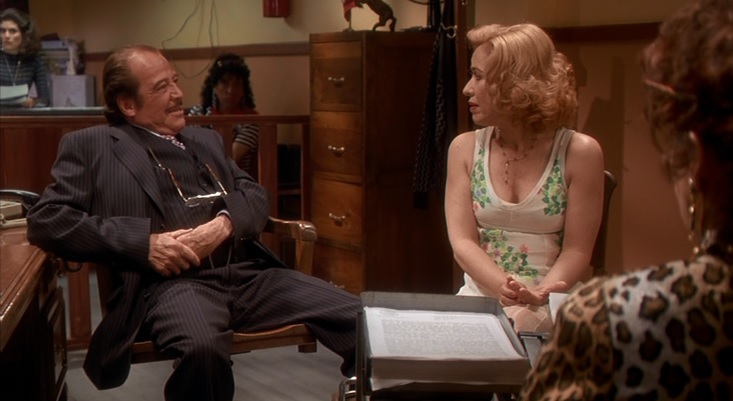
Claudio Obregón and María Rojo
The other thing Hermosillo does is expand on the theme of sexual freedom. The original story stays with Esmeralda and the judge, and we never get to meet her husbands. In the movie we meet all five of them, and we learn that most of them are pretty open-minded about sex. The first husband is an older man who knows he can’t keep up with her in bed, so he accepts that he’s not the only man in her life. The second is a musician, and Esmeralda realizes early on that he’s sleeping around. Another is gay, and in this case she’s helping him hide that fact from his mother. The judge may see her behavior as promiscuity, but it’s really just generosity.
The premise may seem far-fetched, but María Rojo acts the part of Esmeralda with such conviction that the character is completely believable. She doesn’t just play innocence, she radiates it. The judge does everything he can to shame her, and she seems oblivious. She answers his questions with total honesty, a beatific smile spreading across her face when she thinks of how much she loves her husbands. Rojo gives the character such warmth that she wins us over completely.
Claudio Obregón has the difficult job of making us believe that the cranky, uptight judge could slowly melt into one more of Esmeralda’s smitten suitors. He makes the transition totally convincing. Martha Navarro and Antonio Crestani both give ingratiating performances as court employees who quickly find themselves on Esmeralda’s side. Roberto Cobo brings a wonderful sweetness to the role of the aging poet that Esmeralda married on what seemed to be his death bed. And Tito Vasconceles is a joy to watch, popping up over and over again in numerous guises as Esmeralda’s guardian angel.

Martha Navarro, María Rojo and Tito Vasconcelos
Hermosillo doesn’t create images so much as he creates scenes. He tends to use long takes, allowing the actors to develop a situation, and the camera slowly roams around them. For the most part, this relaxed, leisurely approach works well, but there are times when I think the structure could be tighter, and that Hermosillo could provide more focus. On the plus side, by not cutting to impose his own pace on the scenes, the director allows the actors to really get into their roles. They can find their own rhythm, and develop relationships in their own way.
The director references Juana de Asbaje and Frida Kahlo, two Mexican women who also broke the rules, and it might be tempting to see the film as an argument for women’s liberation. Certainly you could see Poniatowska’s story that way. But Hermosillo is after something broader. He wants to liberate everybody. In his mind the whole world is held prisoner by guilt and shame. And his message is, you have nothing to lose but your chains. At the end of the film, the judge confesses his love for Esmeralda, and after she encourages his advances, he goes dancing down the street in the rain. He’s let go of his hang-ups. He’s a free man.

The bride on her way to the alter.
The Masseurs and a Woman (1938)

Shinichi Himori and Shin Tokudaiji
We see two blind men walking along a country road. They’re travelling to a resort in the hills where they’ll ply their trade as masseurs, serving clients in the local spas. The way they talk, joke and argue together, we get the sense that they’ve known each other for a long time. In fact, they’ve made this trip together many times, spending their winters working in the south of Japan and travelling north in summer.
This hillside resort, a place where travellers come and go, is the perfect setting for The Masseurs and a Woman, Hiroshi Shimizu’s story of people who have no home. There are the two masseurs, who migrate according to the seasons. There is the young boy whose parents have died, leaving him no choice but to live with his uncle. And there is the woman from Tokyo, travelling alone, unsure of where she’s headed next. Shimizu’s films often focus on people who have no roots. He seems to feel the isolation and loneliness of people who can’t go home.
In The Masseurs and a Woman, Shimizu’s camera roams through the resort, following the various characters as they meet each other, form relationships, and finally drift apart. He moves his camera a lot, but so unobtrusively that you’re hardly aware of it. He stages scenes to create a sense of space, often with actors placed in the foreground and the background, cutting only when necessary. This gentle, unforced approach allows us to observe these people as they eat, drink, walk and talk, and gradually we get to know them.
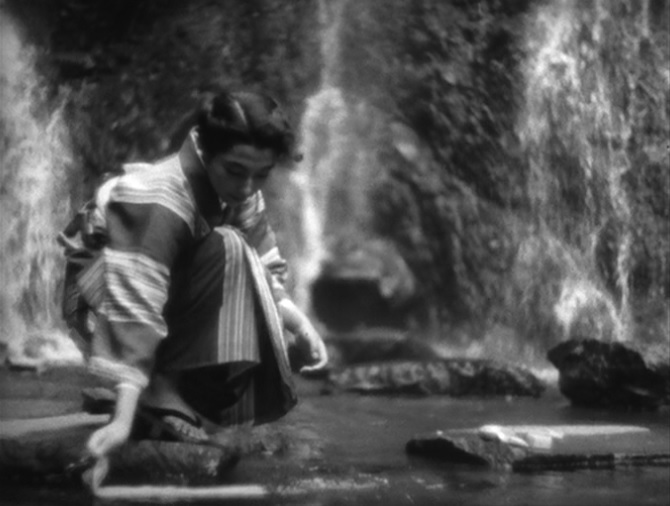
Mieko Takamine
Shimizu’s characters want to connect with each other, they want companionship, friendship, love, but somehow these things prove elusive. Sometimes they try too hard. Sometimes their insecurity gets the better of them. And sometimes it’s just not in the cards. It’s sad enough that one of the masseurs falls in love with the woman from Tokyo, when there’s no chance they’ll get together. But even sadder is the tension this creates with his longtime friend. They may never again be as close as they were.
The Masseurs and a Woman seems lighthearted to start with, but as the story goes on, and we realize how lonely these people are, the film is slowly infused with a deep sadness. The score, by Senji Itô, also expresses this change in tone. Itô’s music for the opening credits starts the film off with a jaunty feeling. Later he gives us a lilting melody that echoes the quiet beauty of the Japanese countryside. And at the end, the haunting final cue underscores the loneliness that weighs these people down.
The film ends as it began, on the road, but things have changed dramatically. At the beginning, we walked with the two masseurs as they marched along, chatting amiably to pass the time. At the end, we see one of the masseurs running desperately to catch a last “glimpse” of the woman from Tokyo as a cab carries her away. His friend stands by himself at a distance. Shimizu does nothing to lighten the sense of loss. These people are on their own.

Wandering down the endless road.
The Business of Strangers (2001)
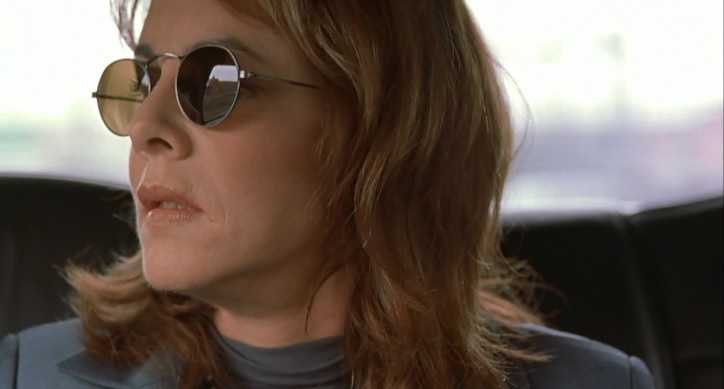
Stockard Channing
Two women, one young, one middle-aged, sit in a sauna, relaxing after a workout. The older one starts talking about the first time she had a hot flash, in a football stadium, surrounded by men, on a freezing cold day. And it wasn’t until she’d taken off most of her clothes that she figured out what was happening. She tells the younger woman, “It’s like suddenly realizing you’ve been made a different person, and no one’s ever asked you.”
The older woman is Julie. She’s worked in the corporate world for years, struggling to build a career. Early on we learn that she’s just been made CEO of the company she works for. But her reaction on hearing the news is decidedly muted. She seems to be at a loss. Where most people would start imagining their glowing future, Julie starts thinking about her past. She can’t help wondering what her life’s been about.
The Business of Strangers follows Julie as she thinks about the choices she’s made. And the younger woman, Paula, is there to make her think hard. They start off on the wrong foot when Paula, an employee, blows a big meeting. After learning that she’s become the CEO, Julie is feeling generous and tries to make peace, but it’s not easy. In many ways these two are complete opposites. The one way they’re alike is that they both want to be in control.

Julia Stiles
But their increasingly twisted relationship isn’t just about clashing egos, it’s not just a struggle for power. They need to be in control because they’ve spent so much of their lives being controlled by men. They both understand how hard it is for women to get power. They live in a man’s world, and they’ve had to fight to maintain their independence, Julie in boardrooms and Paula in bars. The younger woman is a footloose bohemian who both resents and respects the older woman’s discipline. Paula will complement Julie, at the same time as she’s looking for chinks in the armor.
Writer/director Patrick Stettner shows how much you can do with a limited budget and couple of actors. Not only has he created two fascinating characters, but the look and sound of the setting they’re placed in extends the emotional tone of the film. Most of the movie takes place in the arid landscape of a chain hotel. The bland, pastel décor and the eerily silent hallways are the perfect backdrop for Julie’s moody ruminations on her empty life. This world of sterile comfort only highlights the fact that she’s really homeless. Stettner’s subtle use of sound emphasizes the hollowness of the environment. We hear the dull buzz of conversation in the bar, the muffled padding of footsteps in a carpeted corridor. And he’s not afraid to use silence. As the film goes on, the passages with no dialogue are filled with more and more tension. Alex Lasarenko’s score is an important part of the sound design. The low-key percussive patterns he lays down in the background create a sense of quiet unease.

Paula and Julie, living in man’s world.
Then there are the performances. Julia Stiles shows how far she can go as an actress, playing Paula with shadings that you don’t even catch until the second or third viewing. While in some films Stiles’ face has seemed like a barrier, here it seems like a mask, and you’re never quite sure what’s going on underneath. You’re always a little afraid of what she might do next. Anybody who’s seen Stockard Channing before knows how far she can go as an actress, but she rarely gets roles this good. One of her greatest gifts is that she never seems to be acting. You never feel like there’s any distance between her and the character. She’s very direct, very straightforward, but she adds subtle layers of emotion. With the slightest change of expression or an offhand gesture she lets you see right into character.
At the end, nothing is resolved. Julie and Paula are back at the airport, sitting in the lounge, killing time before they go their separate ways. Paula will go off to find some new situation where she can explore the dark side of human nature. Julie will slide into the role of CEO, running meetings and reading sales reports. She may not be satisfied with her situation, but she’s accepted it. She’s realized that her work is who she is, and that all she can do is keep moving forward.

A different approach to dealing with men.
Stranger at My Door (1956)
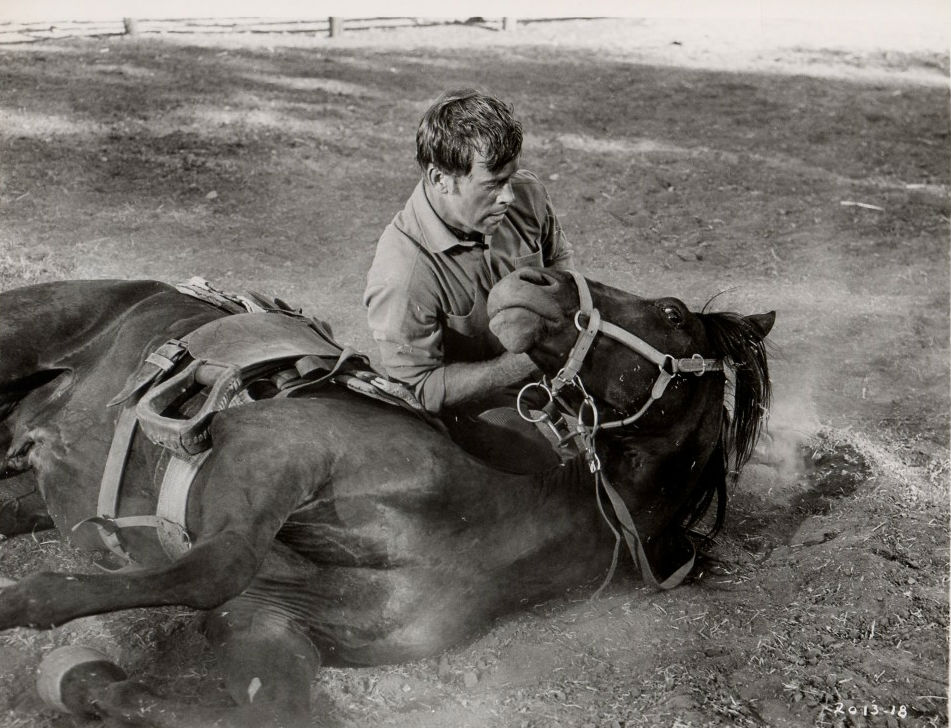
Skip Homeier
William Witney was a workhorse. The list of his credits includes over sixty movies, and dozens of TV shows. Witney used his considerable skill as a craftsman to jump from one genre to the other, starting with serials, moving into features with westerns, taking on crime films, JD flicks and even fantasy. While many of the films he directed are routine action movies, they’re generally made with a smooth professionalism that could transform paper thin scripts into solid entertainment. And when he got hold of a good script, he knew how to run with it.
Barry Shipman’s screenplay for Stranger at My Door may be the best material Witney ever got ahold of, and he shows how far he could go. On most of the projects he directed, Witney was a hired hand. But apparently he felt a special connection to westerns, and this connection is palpable in Stranger. One of the things that made the genre so appealing to audiences was a straightforward morality that boiled everything down to clear cut choices between right and wrong. You always knew who to root for. But the script for Stranger goes deeper than that. It shows how hard making that choice can be.
The movie kicks off with a bang, throwing us into the middle of a small town bank robbery and the ensuing gunfight. The outlaws ride their horses past the city limits, divvy up the loot and then scatter. But after the others ride off, the leader discovers his horse is lame. There’s no way he can make a speedy getaway.
He runs into a boy who helps him with his horse and invites him home, where the boy’s stepmother welcomes the stranger warmly. But when the father returns, he quickly realizes who their guest is, and this is where it gets interesting. The father is a preacher, and he lets the outlaw stay, promising not to reveal his identity. You see, the preacher is determined to save this man’s soul.
At this point you might be thinking that the film was going to be a moralistic drag, and you’d be so wrong. This is where Witney goes beyond craftsmanship into artistry. His approach is so straightforward, he stages each scene with such graceful simplicity, that the film never feels anything less than honest. Instead of trying to jack up the tension with histrionics, for the most part he keeps the actors under a tight rein. In a genre that was largely built on melodramatic cliches, these people seem real, their emotions ring true.
As the outlaw, Skip Homeier starts out a little shaky. But his performance comes together, and by the end he’s completely convincing. Macdonald Carey is excellent as the preacher who is determined to save this man’s soul, though he slowly comes to realizes how great the cost could be to himself and his loved ones. Child actors can sometimes be unbearably cute, but Stephen Wooton does a good job as the pastor’s young son. The standout performance, though, is Patricia Medina as the stepmother. As a woman in a western, she’s given a wider range of emotions than the men, who mostly play it close to the vest. When the situation starts spinning out of control, the stepmother is the only one who’s allowed to let herself go, to raise her voice and let the world know that she’s angry and afraid. Unlike many westerns, the script lets her express her emotions without becoming an irritating cliche. Medina plays it to the hilt without going over the top. She loves her husband, but she’s both bewildered and angered by his obsession with saving this outlaw’s soul. She can’t believe he’s willing to put his wife and child at risk to offer a thief a chance at redemption.
Cinematographer Bud Thackery’s low-key naturalism makes the settings seem as real as the performances. Witney tends to film the scenes in long shot, moving the camera in a fluid, unobtrusive way to follow the action or re-frame the composition. This movie is beautifully understated, never pushing the drama at us, instead allowing us to watch it unfold.
It will come as no surprise that the outlaw does find salvation at the end. And in the tradition of the best westerns, the movie shows it through action instead of explaining it in words. Fatally wounded, this man who fought all attempts to save his soul mounts his horse and rides to the church that the preacher has been building. Arriving at the site, he staggers inside and dies beneath the cross. Is it subtle? No. Is it powerful? Yes. Witney takes advantage of the genre’s chief virtue, which is that you can say things simply and directly, without having to apologize. When an artist creates a film this honest, this true, no apologies are necessary.
*
Usually the image I post for a film is a screen shot taken from a DVD. In this case, I watched the film on a VHS tape from Eddie Brandt’s in North Hollywood, so the image used here is one of the few stills available on the net. I didn’t think Stranger at My Door was on DVD, but I just found out you can get it from TCM. This is good news, because Witney’s work is little seen, and not always easy to obtain. He deserves to be better known.
Cosmopolis (2012)
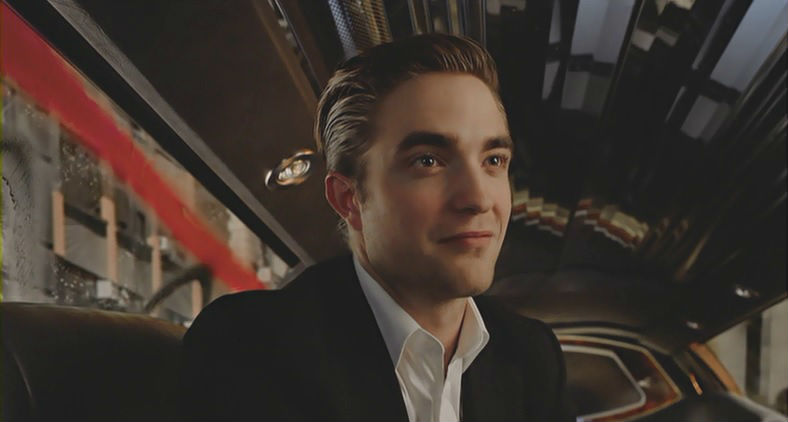
Robert Pattinson
David Cronenberg is fascinated by altered states of consciousness. His characters’ view of the world may be shaped by technology (Existenz) or drugs (Naked Lunch) or mental illness (Spider). Throughout his career, Cronenberg has made films about people who perceive reality in different ways, and he seems completely uninterested in making judgments. In fact, at times he may be asking if their perception of the world might not be valid. In Crash a man and a woman who survive an auto accident find themselves irresistibly drawn toward the violence of car culture. The hero of Eastern Promises has to walk a tightrope between the demands of a Russian crime syndicate and an American law enforcement agency, trying to survive in the space between the two. But survival isn’t always a priority for Cronenberg’s characters. Sometimes they just surrender to their fate.
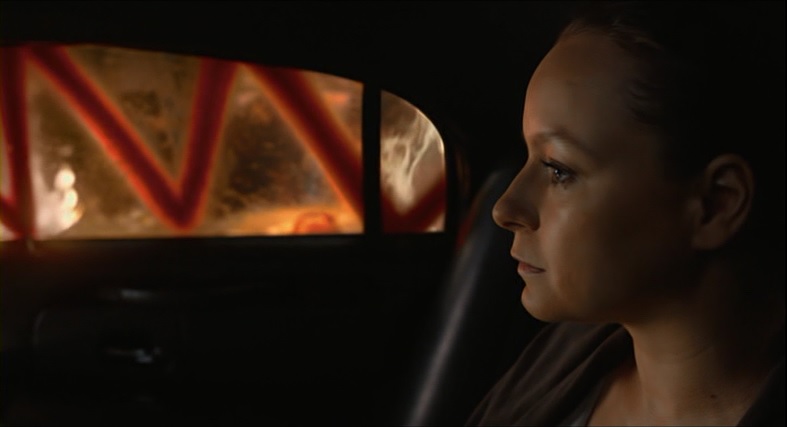
In Cosmopolis, Eric Packer lives in a universe shaped by the ceaseless flow of cyber-capital. He spends most of the day riding through Manhattan, the financial center of the US, in a gleaming white limousine. It glides along the streets in sleek, soundproof isolation. While he can see what’s happening outside, he barely hears it when protesters are banging their fists against his window. We meet this brilliant young billionaire on the day when his financial empire is quickly imploding. Instead of freaking out, he ponders his misfortune with an odd detachment. Not only is he unruffled by the loss of his millions, he’s amazingly calm about the fact that an assassin is trying to kill him. He takes almost everything with an unsettling calm, and he insists on driving across Manhattan in spite of all the obstacles. “We need a haircut,” he tells his chauffer/bodyguard. Nothing will keep him from that goal.

Samantha Morton and Robert Pattinson
Robert Pattinson gives a beautifully focussed performance as Packer, riding across Manhattan, consumed in melancholy meditation of a reality that appears to be coming apart at the seams. He’s a control freak who realizes that he’s losing control, and rather than screaming and crying, he seems fascinated by the circumstances of his downfall. In the course of his journey he picks up various visitors who accompany him part of the way. Juliette Binoche does a funny, raunchy turn as the art dealer who shows up to have savage sex with Packer, and then discuss the purchase of a painting by Rothko. Samantha Morton maintains an eerie serenity, a disturbing clarity, in her role as the financial philosopher who carefully breaks down the way money is changing our perception of time. She rides along in the limo, cradling her drink, talking calmly about how our reality is altered by the massive pressures of the markets. Morton plays this difficult role with perfect ease, staring off into space with shining eyes, an intellectual entranced by the beauty and the violence of capital. Abdul Ayoola gives a quietly moving performance as the chauffer who takes Packer on the last leg of his journey. And Paul Giamatti has just the right presence to play the grimy loner who wants to kill Packer. Though he’s filled with rage at the way the world has treated him, he seems unnerved when he finally comes face to face with his prey.
I haven’t read Don DeLillo’s book, but I’d really like to. Published not too long after the dot com bubble burst, the author was obviously exploring the new ways in which the markets were changing our world. The film was released in two thousand twelve, and I’m sure many people read it as a comment on the more recent financial meltdown. But Cosmpolis isn’t a morality play about the soulless rich. Packer’s problem isn’t that he has no soul, it’s that his soul is starved. He’s a brilliant young man who spends his days analyzing the ebb and flow of markets, riding waves of currency. Existing almost completely in this alternate universe, this gleaming, abstract future created by the endless flow of capital, he begins to realize that he’s living in a vacuum. We see that there are plenty of women who want to have sex with him, but the one woman he really wants to have sex with, his wife, is out of reach. The bodyguard he’s hired to protect him becomes a nuisance to overcome, an obstacle that keeps him from experiencing the world. And when he finally arrives at the barbershop, we realize it’s not the haircut he needed, but the amiable grin of the guy who gives it to him, a man who knew his father. This chatty old man may be his only friend.
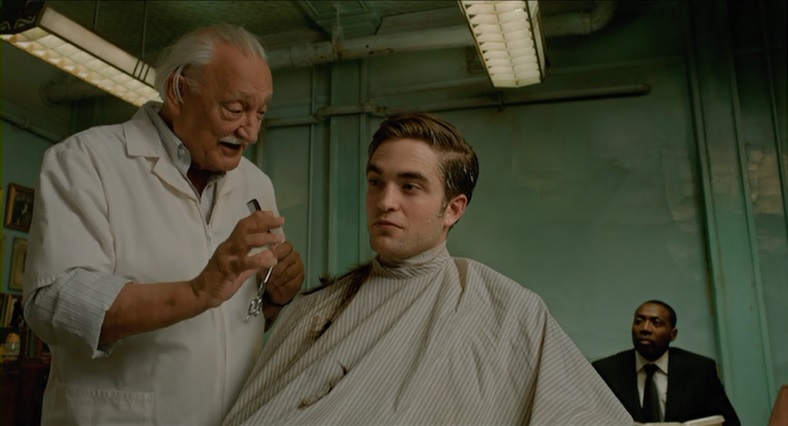
George Touliatos, Robert Pattinson and Abdul Ayoola
Composer Howard Shore has been working with Cronenberg so long they seem to understand each other perfectly. The director doesn’t care about drama, or driving his points home. In Cosmopolis the narrative moves forward on its own terms, relying on its own logic, and the music reflects this. Instead of a conventional film score with its dramatic highs and lows, Shore gives us an abstract soundscape that hovers in the background. Relying largely on color and texture, he creates a shifting sonic fabric that echoes the main character’s zoned-out state of mind.
Packer realizes that he’s come to inhabit the world of capital so completely that he’s estranged from simple, physical experience. He turns homicidal, then suicidal. He’s desperate to connect with somebody, even somebody who’s trying to kill him. But through all of this, Cronenberg avoids making judgments. He doesn’t care about putting Packer on trial. He’s more interested in getting inside this boy’s head.
“The present is harder to find. It is being sucked out of the world to make way for the future.”
Summer of Sam (1999)

John Leguizamo, Jennifer Esposito and Adrian Brody
Spike Lee is a New Yorker. That’s who he is. The city is the lens he uses to look at the world. In Summer of Sam he gives us a sweeping panorama of New York in the seventies. At the center of the movie is the series of murders committed by David Berkowitz, who called himself the Son of Sam, but this is really just the catalyst for the story that the director wants to tell. Lee uses the killings as a way to explore paranoia, pop culture, racial tension and sex. Especially sex.
Summer of Sam delves deep into the currents of sexual freedom and sexual repression that were roiling the country back in the seventies. The story revolves around two couples living in a working class Italian-American neighborhood. They all come from the same background, but they end up going in wildly different directions. The movie depicts their conflicts with the world around them, with each other, and within themselves.
The first couple, Vinny and Dionna, are married. He works as a hairdresser and she works as a waitress. Vinny loves his wife, but he can’t stop chasing women. What he wants is wild, nasty sex, and because he sees his wife as a “nice girl”, he can’t bring himself to ask her to do anything out of the ordinary. She even tries to get him to loosen up in bed, and it freaks him out. His Catholic upbringing tells him you’re not supposed to do those things with your wife.
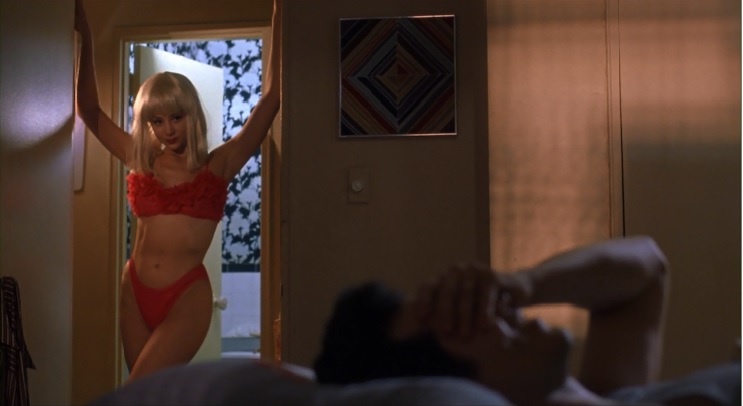
Mira Sorvino and John Leguizamo
There’s a key moment early on when Vinny takes his wife’s cousin home from a club. He makes crazy love to her in the back of the car, and after dropping her off he drives by a crime scene where he sees the Son of Sam’s latest victims. Vinny is deeply shaken. He’s convinced this is a message from God. The Catholic in him believes that God is telling him to stop messing around, or he’ll be next. In his mind it’s that simple.
At the other end of the spectrum we have Richie and Ruby. Richie comes from the same working class neighborhood as Vinny and Dionna, but he’s dying to escape. He feels irresistibly drawn to punk rock and the scene swirling around CBGB. Sporting a spiked collar and a bristling mohawk, Richie makes his money in Manhattan where he dances for men and turns tricks on the side. Even though they’re coming from the same place as Vinny and Dionna, Richie and Ruby let go of their hang-ups and live the way they want to.
But this doesn’t mean they live happily ever after. When they’re through partying in the city, they still have to go back to the same old neighborhood, and now Richie and Ruby are perceived as outsiders. Richie especially is seen as a freak to be avoided. If that were all, it might not be a big deal. But a pack of local losers have decided it’s their mission to catch the Son of Sam, and they gradually convince themselves that this weirdo with the spiky hair and the dog collar must be the killer.
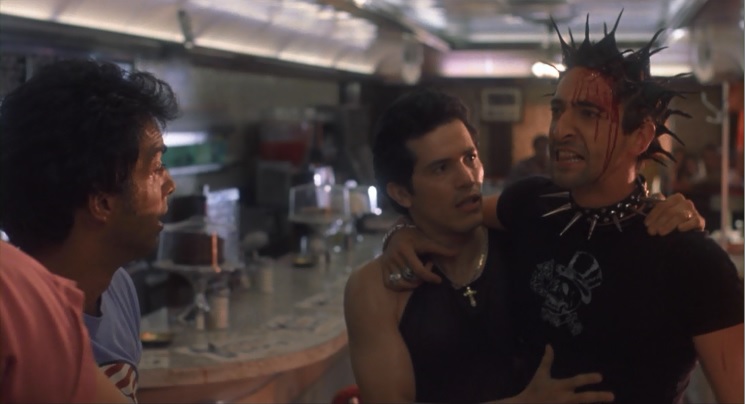
Confrontation in a coffee shop.
The script, by Victor Colicchio, Michael Imperioli and Lee, uses these two couples to explore repression and freedom, fear and desire, weaving their stories into the larger fabric of life in New York in the seventies. Punk rock, disco, the Yankees, Italian mobsters, serial murders and Jimmy Breslin are all bound together in a volatile urban landscape where repressed desire is pulsing under the surface and fear drives a spiralling cycle of violence. On the surface it may seem like a chaotic mash-up, but the film is actually a beautifully structured collage. Overlapping layers of image and sound coming rushing at us, plunging us into this feverish, overheated world. In creating Summer of Sam‘s aggressive, abrasive style, the director was helped by numerous talented collaborators. Lee has often used a range of visual textures, and here Ellen Kuras gives him everything he needs, from brassy high-contrast to gritty, low-light images. Barry Alexander Brown’s editing gives the film pace and punch. The sound is amazing, capturing the screeching, scraping, rumbling, raging vibe of the city. Out of the huge crew that worked on this facet of the film, I’ll mention supervising sound editor Kevin Lee, sound designer Blake Leyh, sound re-recording mixer Tom Fleischman and foley editor Andrew Kris, though there are probably others that deserve to be named as well.

The murderer counts his kills.
And I haven’t even gotten to the cast yet. John Leguizamo and Mira Sorvino both seem to be living their roles from the inside out. Adrian Brody and Jennifer Esposito play their parts with a convincing mix of toughness and tenderness. But getting beyond the leads, the film has an incredible supporting cast. Bebe Neuwirth, Patti LuPone, Michael Rispoli and Ben Gazzara don’t even seem to be acting. You get the feeling they’ve been living in this neighborhood all their lives. And that same feeling extends to even the smallest supporting players. Casting director Aisha Coley deserves credit for filling the film with people who all seem to be a living part of the New York landscape.
But this film isn’t just about New York. It’s about people everywhere. As specific as Summer of Sam is to the time and place it’s set in, the conflicts these people are going through are universal. Wrestling with desire. Dealing with pressure from family and friends. And maybe most of all, searching for some kind of honesty. Once you get past the accents and the clothes and the music, you’ll find that Spike Lee isn’t just talking about New York in the seventies. He’s talking about all of us.
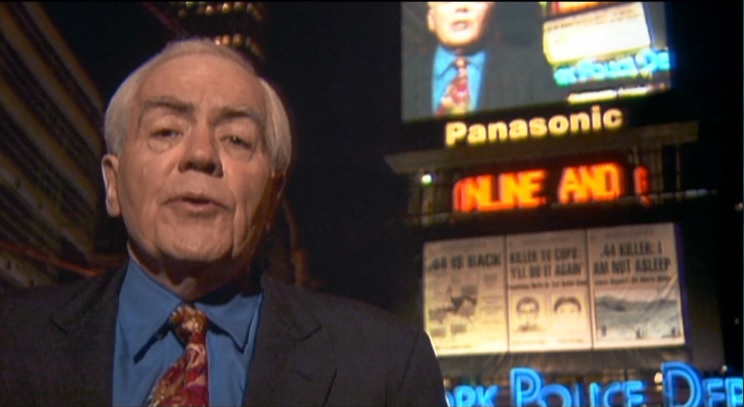
Jimmy Breslin talks about the city he loves and hates, in equal measure.
Wings (1966)
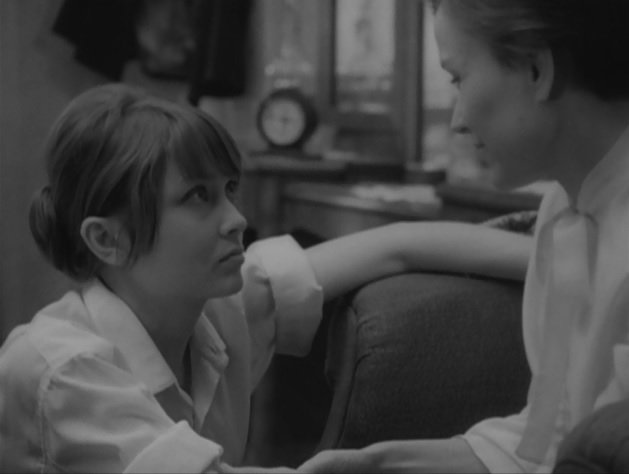
Zhanna Bolotova and Mayya Bulgakova
After the death of Joseph Stalin, the Soviet state’s iron grip on filmmakers began to loosen. Nikita Kruschev actively encouraged more freedom in the arts, and in the mid-fifties Soviet cinema began to flourish once again. Realizing that the public was weary of whitewashed historical spectacles where the noble worker always triumphed, filmmakers chose to create more intimate works that focussed on individuals.
Larisa Shepitko was one of the young filmmakers who embraced this new approach. A graduate of VGIK, the Soviet film school, Shepitko’s work places more emphasis on people than politics, though her characters’ conflicts are played out against the background of the world they live in. Wings is the story of Nadezhda, once a celebrated pilot in the Russian Air Force, now headmistress at a school. She’s intelligent, dedicated and hardworking, but she can’t escape the feeling that her life is empty. In the opening shot we see a tailor measuring her for a coat, and this slow, methodical process sums up the monotony that characterizes her life.
The screenplay, by Valentin Ezhov and Natalya Ryazantseva, digs deep into the mind and spirit of this complicated woman. We see that she’s a smart, capable administrator, but she can’t relate to the young people who surround her at the school. We see her spending time with a male friend who obviously adores her, but she seems faintly bored by his company. The most important thing in her life is her relationship with her daughter, Tanya. Nadezhda desperately wants to be close to Tanya. But the mother is so judgmental, so controlling, that she’s continually pushing her daughter away.
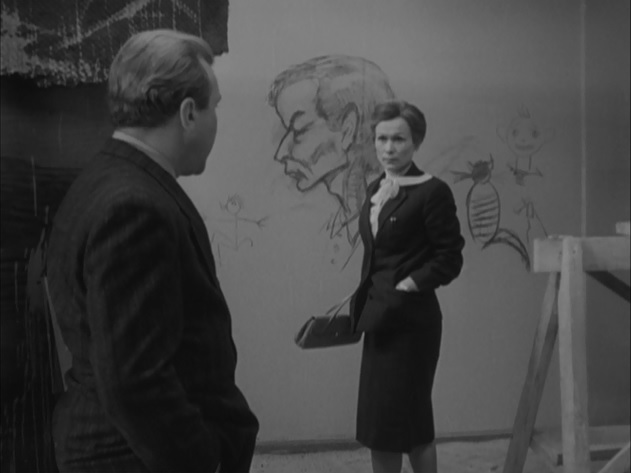
The headmistress discovers an unflattering caricature.
It’s not that Nadezhda can’t feel love, or even that she can’t show love. Throughout the film she tries to connect with the people around her, but in the end she always insists that they adhere to her standards. What makes it even harder to bear is that she knows this. Nadezhda sees what she’s doing, and still can’t stop herself. And so there’s a constant tension inside of her. She’s always feeling the need to reach out and it’s always trumped by the need to maintain control.
The only moments where we see her relax, where we see her step outside of herself, are the wistful reveries where she imagines herself flying again. In these lovely, lyrical sequences, we’re floating with her through the air, gliding peacefully past billowing, white clouds. The only sound we hear is a sad, lilting motif played on strings that underscores her longing for the freedom she felt soaring through the sky.
While Shepitko uses music sparingly, it’s an important part of the film’s emotional fabric. The composer, Roman Ledenyov, shows an intuitive understanding of what’s needed. It’s a small scale score, well suited to this intimate exploration of a woman’s life. A quiet conversation is accompanied by an airy passage played on celeste. As Nadezhda rides a crowded bus we hear woodwinds playing a vague, dissonant cue. The only time when the score seems to open up is when she remembers the freedom of flying through the skies. The short, ethereal phrases played by the strings in these sequences suggest a sense of peace, but also a heavy melancholy.
In the final sequence, Nadezhda visits the airfield she knows from her days as a pilot. As a lark, some of the young people who are learning to fly put her in the cockpit of a small plane and push it across the field. They mean it as an affectionate joke. For her, knowing that they see her as an old woman, past her prime, it’s humiliating. So just before they roll her plane into the hangar, she starts the engine, taxis down the runway and takes off into the sky. It’s a brief escape. When she returns to earth again, all her burdens will be as heavy as before. But for a while she can remember what it’s like to soar above the clouds. For a moment, she’s free again.
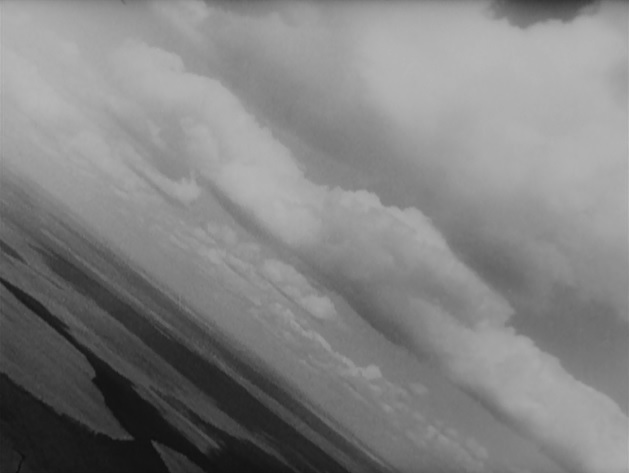
Longing for the freedom of the sky.
Down Time
As usual, I’m taking a winter break. While blogging can be fun, it can also be exhausting. I’ll probably start posting again around the end of January.
And once again, I’d like to give a shout out to the National Film Preservation Foundation. They’ve been responsible for restoring and preserving numerous films thought to be lost, and just this last year rescued the footage Orson Welles shot for Too Much Johnson. That alone would make me eternally grateful to the NFPF, but they’ve done so much more.
If you haven’t been to their web site, a link is below. And if you care about film, I urge you to consider making a donation.
The Other Side of the Wind
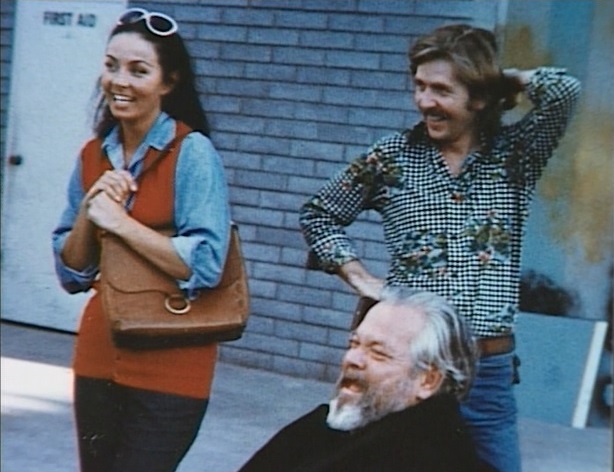
Oja Kodar, Orson Welles and Gary Graver
Citizen Kane was one of the movies that made me aware of movies. I’d seen hundreds of them, but I’d never really thought about who made them. I’d never really thought about what those words “directed by” meant. Suddenly all that mattered was the director. And Orson Welles was the director that mattered most to me.
Not too long after watching Kane, I was talking to a friend and mentioned that I’d seen it. She said she had a book on Welles, and offered to give it to me. I was thrilled. I hope I thanked her profusely. It was Joseph McBride’s critical study, simply titled Orson Welles. I took it home and started reading it immediately.
One of the most interesting chapters in McBride’s book is the one where he describes his first encounter with Welles. They met for lunch one day, and the next thing McBride knew he was acting in the director’s latest project, a film called The Other Side of the Wind. The details were sparse, but I was thrilled to know that Welles had something in the works. I couldn’t wait til the day when The Other Side of the Wind would be released.
That was around 1972. Welles died in 1985. At the time of his death, The Other Side of the Wind was still unfinished.
I’ve been dying to see this movie for decades. Every so often something would happen to raise my hopes, but nothing ever materialized. Welles recieved an award from the AFI in 1975, and it seemed like his luck might be turning. During the program they actually screened clips from The Other Side of the Wind. I was knocked out. A few years later I saw Welles in person at the DGA, and he showed some more footage. I’m sure he was hoping that one of the industry insiders in the audience would come forward with financing. Didn’t happen. Then after Welles’ death, I’d read things from time to time about how someone was trying to rescue the film, about the bizarre legal tangle that it was ensnared in, conflicting accounts about how much of the footage Welles had actually assembled before his death. It was all very discouraging.
Finally, earlier this year, it was announced that a deal had been made. Royal Road Entertainment had obtained the rights to the footage. Peter Bogdanovich and Frank Marshall would be involved in producing a final cut. Initially, I was ecstatic. My enthusiasm dissipated as I read more, because I realized that Welles had only managed to complete about forty five minutes of a work print. Bogdanovich and Marshall were going to try to assemble the rest.
I don’t mean to say that I don’t trust these guys. They’re both intelligent men with years of experience in the industry, and they both worked with Welles during the filming of The Other Side of the Wind. In fact, Bogdanovich plays a leading role. They’ve also shown their dedication to this project by pursuing the footage for years.
But Welles had an extremely individual approach to editing. In fact, there’s no one else you can even compare him to. The cutting in Citizen Kane looks pretty sophisticated for 1941, but it was only the beginning. If you look at Fake?, which the director made toward the end of his career, you’ll see that Welles had developed an extremely intricate approach to editing. In bringing together footage from a number of different sources, he gleefully plays with space and time, creating a vivid and witty collage. In the clips I’ve seen from The Other Side of the Wind, Welles seems to be continuing in a similar vein, a style you might call fluid fragmentation.
My point being, Welles had a totally unique approach to editing. To make it even more challenging, there was no final shooting script for The Other Side of the Wind. McBride quotes Welles saying that he had written a script that would run for nine hours. He ended up discarding it, and decided to improvise based on what he knew about the characters, This doesn’t mean he had no idea where he was going. I’m sure Welles had the arc of the story clearly laid out in his own mind. But, as close as they were to the director, Bogdanovich and Marshall don’t know what was going on in his head. And while they apparently have access to a script Welles wrote, it’s apparently not the kind of shooting script that would give specific guidance.
And even if they had something that specific to guide them in dealing with the visual side of the film, there’s still the aural dimension. Welles was unique among filmmakers, because before he ever set foot in Hollywood, he’d spent years in radio. In terms of sound, Citizen Kane was by far the most intricate and innovative film Hollywood had made at that time. In later films like Touch of Evil, The Trial, and (even with it’s technical deficiencies) Chimes at Midnight, the use of sound is incredibly subtle and expressive. Approximating a Welles soundtrack would be difficult enough under the best circumstances. But the director relied heavily on looping during post-production, and this requires having actors available for re-recording dialogue. Many of the actors who appear in The Other Side of the Wind, including the star, John Huston, are dead.
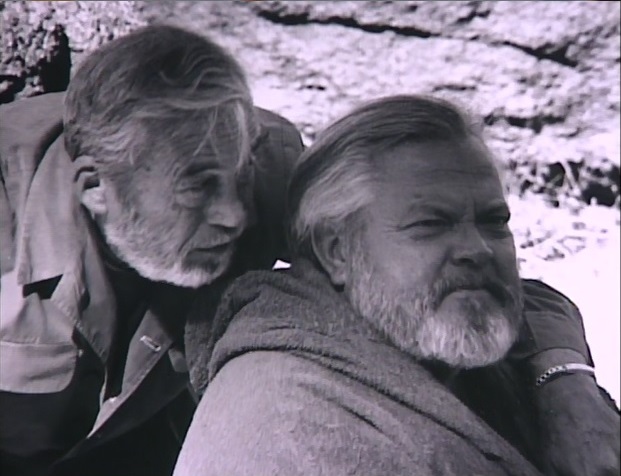
John Huston and Orson Welles
I realize now that I’m never going to see the film that Welles envisioned. At best, I’m going to see an approximation. While I know that Bogdanovich and Marshall will do everything they can to honor the director’s conception, whatever they come up with will be their best guess. This isn’t meant to be a criticism. I’m really grateful to them both. It’s just a fact. As talented as they are, they’re not Orson Welles.
I read that Royal Road is planning to have the film ready by the one hundredth anniversary of Welles’ birth, which will be in May, 2015. This sounds like a nice idea, but honestly, I think it’s completely unrealistic. Lacking a shooting script, it could take months for them just to construct an outline to guide their work. Editing the footage in a style that approximates Welles’ approach will be a daunting, time-consuming task. And assembling a soundtrack that comes anywhere near the richness and complexity of the director’s work will be incredibly challenging. We have to remember that Welles usually spent months, sometimes years, editing his work. With all respect to Bogdanovich and Marshall, the idea that they could complete their work by next May seems difficult to believe. While I can certainly understand the desire to have the film ready by Welles’ one hundredth birthday, it seems like it might be better to let them take whatever time is needed to get it right.
I was also wondering if anyone had spoken to Walter Murch. Having worked on the reconstruction of Touch of Evil, Murch has had hands-on experience in assembling Welles’ work. He not only understands images, he understands sound. As an editor with decades of experience, it seems to me his assistance would be invaluable.
Even with all my reservations about this project, I don’t mean to be cynical, and I wish everyone involved all the best as they undertake this monumental task. I’m sure everybody agrees that the most important thing here is to honor Welles’ intentions. I’m really glad this is moving forward, and I know there a thousands of people like me who were rejoicing at the news that a deal had been signed. Here’s a link to the New York Times article that appeared just after the announcement was made.
Orson Welles’ Last Film May Finally Be Released
Profuse thanks to Royal Road, Peter Bogdanovich, Frank Marshall and everyone else involved in the long, difficult struggle to bring The Other Side of the Wind to the Screen. Whatever they come up with, I will be standing in line to see it.

Orson Welles, photographed by Gary Graver
 Reality Is Scary