Taking Some Time Off
I need to take a break. There’s been so much going on the past year or so, it’s gotten hard to find the time to post on a regular basis. I’m thinking I’ll take about six months off, and maybe get back into the blogging thing some time in the summer. There are plenty of movies I’d like to write about, so hopefully after a little time off I’ll be ready to dive back in.
I do have another project I’m working on. I’ve been writing for over thirty years, both fiction and non-fiction, and very little of it’s been published. In the not too distant future I hope to launch a web site where I can post some of the longer stuff I’ve written. It’s still in the works, and it might take a while, so I won’t make any promises. But if I can get it off the ground, I’ll post the link on this site.
Thanks to those of you who have been following the blog. Looking forward to reconnecting this summer.
Keeping Film Alive

A friend of mine sent me this post, and I thought it was worth sharing. It’s written by a twenty two year old guy in North Carolina who’s interested in the dying art of projecting movies on film. When he heard that Tarantino was arranging to have The Hateful Eight screened in 70mm at some theatres, he wanted to be involved, and ended up flying out to California on less than a day’s notice to offer his services. I really enjoyed reading about his experience, but beyond that, I was grateful to know there’s somebody under forty who’s actually excited about working with film.
I don’t want to get into an argument about film vs. digital. I’m not an expert, and aside from the inherent qualities of each format, what you end up seeing and hearing at any screening depends on the equipment being used and the theatre you’re in. But the fact is, the first hundred years of cinema history exist on film. DVD, Blu-ray, and 4K restorations are all fine, but if you want to see Lawrence of Arabia the way it was meant to be seen, you need to go to a theatre and see it in 70mm. Digital cinema is great, but it isn’t film. I can get on the net and track down a high-resolution scan of a painting by Van Gogh. It’s still not the same as going to a museum and seeing the actual painting by Van Gogh.
So it’s encouraging that this guy has invested the time and energy to learn how to run film through a projector. Future generations who really want to experience Sunrise, The Magnificent Ambersons or Do the Right Thing will be relying on people like this, people who are truly dedicated to the medium. They’re keeping film alive.
So anyway, here’s the link. And if you feel like I do, it couldn’t hurt to post a comment so he knows his efforts are appreciated.
The Weight of Water (2000)

Kathryn Bigelow’s film The Weight of Water, based on the book by Anita Shreve, was released in 2000. The movie had been held back by the studio for over a year, and when it finally made it into theatres it sank like a stone. The few critics who reviewed it weren’t impressed. I remember that the night I first saw the movie the audience numbered less than ten. In fact, it might have been less than five.
So why did Bigelow, after directing a series of audacious and offbeat action flicks, decide to switch gears and film a very intimate novel about two women trapped in suffocating marriages? It’s a question worth asking, and I think there are probably a few answers.
One answer might be that she felt like a change of pace. Directors, like actors, can be afraid of getting type cast, and it may be that Bigelow wanted people to know she could do other things besides make action movies. Beyond that, though, it may be that she needed to do something that took her outside the confines of commercial formulas. While she’d managed to test the limits of the action genre, and even subvert some of its most basic rules, Bigelow understood that she still had to deliver what audiences wanted. Playing with the public’s expectations can keep them from showing up at the box office. Near Dark had been a modest critical and commercial success, but after that she ran into trouble. Nobody knew what to make of Blue Steel. Point Break made money but got trashed by critics. Strange Days got some enthusiastic reviews, but audiences stayed away. So Bigelow may have been wondering if she needed to take a break from action movies and try something different.
Another factor may have been the fact that Bigelow is a woman. I mostly avoid bringing up gender in writing about movies, because I think too often we fall back on easy stereotypes, sticking people in categories based on their sex. There’s no reason women shouldn’t be able to make action films, and Bigelow had proven her skill in the genre. But it’s a fact that the audiences for that kind of flick are mostly men, and those men have very specific expectations. I think the biggest reason her early features didn’t always go over well is that she was deliberately turning the genre on its head. A thriller centered on a female cop? Commonplace these days, but not back in the eighties. An FBI agent seeking spiritual fulfillment? Shouldn’t he just focus on shooting people? The audiences that flocked to Die Hard didn’t want movies to play with their expectations. They wanted massive explosions and a high body count. Bigelow may have gotten tired of trying to deliver what the boys were looking for.
But most important of all, I think Bigelow felt a powerful, personal connection to Shreve’s novel. It tells two parallel stories about women who are isolated and frustrated, angry and alone. Given the fact that Bigelow was one of the few female directors in Hollywood back in the nineties, it seems likely that she was experiencing all of the above. On top of everything, though, she was married to a director who also acted as producer on two of her films. Given that James Cameron was one of the most commercially successful filmmakers of the time, this might seem like a tremendous advantage. Really, I don’t think Bigelow saw it that way. At all.
It’s always dangerous to make connections between an artist’s work and their personal life. However close the parallels may seem, we have to remember that the work is fiction, not fact. Because of what we know about Woody Allen’s personal life, we may be tempted think that at times he’s actually presenting scenes from his life on the screen. This is a big mistake. Even if the episodes he’s acting out seem to echo incidents we’ve read about, we should never be so lazy as to think what we’re seeing is the “truth”. Art inevitably transforms reality. Allen may be incorporating autobiographical elements in Annie Hall, but Annie Hall is not an autobiography.
On the other hand, for me, a work of art is only worthwhile if the artist reveals something of his or her self. This may sound like a paradox, but it’s not. Who cares if the details depicted in a movie reflect the details of the filmmaker’s life. All that’s really important is that artists are honest about the way they see the world, the way they feel about themselves. We can speculate forever about possible parallels between Orson Welles’ actual life and the storyline of Chimes at Midnight, but in the end, none of that matters. What does matter is that when Hal says to Falstaff, “I know thee not old man,” we can feel the pain that’s crushing the new king’s former friend, and we know Welles felt that pain, too.
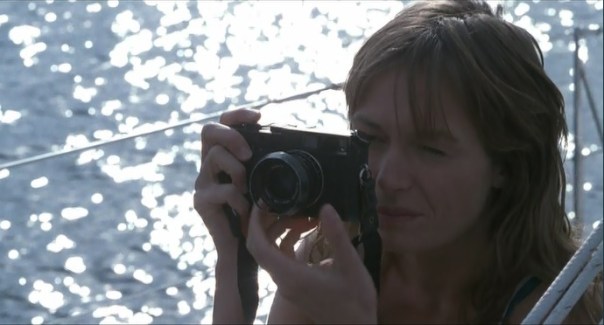
Catherine McCormack
Anita Shreve’s novel The Weight of Water was inspired by a double murder that took place on a barren island off the Atlantic Coast at the end of the nineteenth century. A man was convicted and hanged for the crime, but speculation persists to this day that the jury sent the wrong person to their death. The book tells two stories, that of a young woman, a Norwegian immigrant, who relates the events leading up to the murders, and a modern story which focusses on a photojournalist who has come to the island to document the scene of the crime. Both the period story and the modern story are about relationships, both are centered on women trapped in unhappy marriages.
While Shreve’s book relates the known facts of the case, she makes it clear in a brief preface that it’s a work of fiction. The author creates a journal in which a young Norwegian woman named Maren talks about her youth, the pressures that forced her to take a husband, and the brutal challenges she faced after migrating to America, where she and her family are isolated on a remote, rocky island. The story that takes place in the present is centered on Jean, a photojournalist married to a famous poet. She loves her husband, but realizes his attention is straying, and the knowledge is slowly crushing her. As she investigates the Smuttynose murders, Jean finds Maren’s journal, and it’s clear she relates to the young immigrant’s desperation. They’re both just looking for a little affection, a little understanding.
Bigelow takes the fiction even further. Her film spends less time detailing the facts of the case and more time extending Shreve’s view of Maren as a deeply lonely, bitterly angry woman. In the book, the description of the actual killing is fairly brief. In the movie, the murders are crucial, and they are shown in terrifying detail. Like any filmmaker who uses historic fact as the basis for their work, Bigelow takes liberties to shape the story she wants to tell. Up to a point, I can accept that, but I’m not comfortable with showing a reenactment of a murder that’s based more on speculation than on evidence. Yeah, the film does offer a disclaimer, but it’s at the end, after we’ve seen a graphic depiction of Maren Hontvedt killing two family members. In reality, nobody knows who commited the crime.
It’s possible that the movie’s more visceral, graphic approach was the result of commercial considerations, but I doubt it. While I believe that Bigelow related to Shreve’s novel on a very personal level, as artists these two women are almost polar opposites. Shreve is a very careful, thorough writer who maintains a rigorous objectivity in her work. I have to say that I had trouble getting into the novel at first because the tone is so restrained. Gradually I was drawn into the world the author had created, both by her insight into human nature and the austere beauty of her prose. The book is really very moving, but Shreve always maintains a careful objectivity. She always keeps us at a distance from her characters.
Bigelow doesn’t keep her distance. As an artist and a filmmaker, she dives right into the world and drags us along with her. In her early films she used sound and image to create a voluptuous, kinetic experience, and at her best she pulled us right into the middle of it. Her characters were often thrown into situations where boundaries disappeared, and they’d find themselves caught between terror and euphoria. Though The Weight of Water is by no means an action film, again Bigelow’s protagonists find themselves pushed to their limits and beyond. In this case, though, the limits are less physical than psychological.
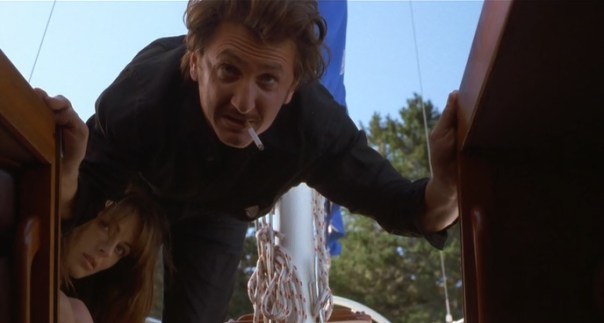
Elizabeth Hurley and Sean Penn
Here Bigelow uses her gifts to bring us into the characters’ state of mind. Jean sits on the deck of the yacht surrounded by placid blue water and crystalline vistas. The beauty and serenity of her surroundings are at odds with the tension that’s eating away at her. She watches her husband glancing furtively at the other woman on board the boat. She watches the other woman sliding a piece of ice down the length of her body. Seeing all this through Jean’s eyes, we know she’s just barely managing to hold herself together. The world Maren lives in, on the other hand, seems to be an expression of the melancholy she feels. The inside of her home is claustrophobic and dark. Within its oppressive quiet every small sound, the groan of the floorboards, the creak of a chair, is clearly heard. Even when Maren leaves the house, she’s still a prisoner on a barren island. There is no escape.
The script is extremely intricate, balancing the two stories against each other and weaving them together using deft, often abrupt, transitions. There are sudden shifts that may seem arbitrary, but actually the various threads are woven together with tremendous skill. Screenwriters Alice Arlen and Christopher Kyle make Jean’s investigation of the murders an exploration of her own troubled marriage. The more she learns about the case, the more she’s convinced that Maren is the killer, and the more she understands Maren’s motives.
And Maren’s motives are complicated. She goes about her chores dutifully, sticking to the routine that keeps her sane, but inside she’s drowning in a sea of conflicting emotions. She seems to have accepted her life of lonely drudgery, but the arrival of her brother and his wife creates new turmoil. The presence of Maren’s jealous, vindictive sister Karen makes life even more unbearable. Maren’s family isn’t a source of comfort. It’s a prison.
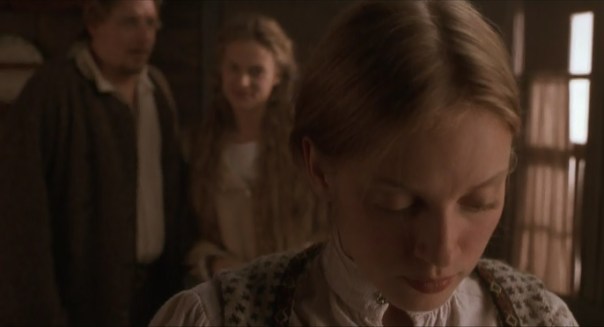
Anders W. Berthelsen, Vinessa Shaw and Sarah Polley
Bigelow is not credited as a writer, but I wonder how much input she had on the screenplay. The film sticks to the general outline of Shreve’s novel, but there are a number of alterations, some of them important. One change that strikes me as crucial is the fate of Jean’s husband, Thomas. At the climax of both the book and the film, the boat they’re on is battered by a terrible storm. In the book, Thomas survives. In the film, he dies. In my mind, I can’t help associating this choice with the break-up of Bigelow’s marriage to James Cameron.
And here I may be making the kind of assumption that I was criticizing earlier. How can I justify drawing a connection between something that was happening in the director’s personal life with a fictional event that she depicts on the screen? But honestly, I’m not trying to tell you that Bigelow wanted Cameron dead. And I’m not even trying to tell you that Thomas is a surrogate for Cameron. The way I see it, his death has a broader and a deeper meaning.
Earlier I talked about the fact that Bigelow was one of the few women directing films back in the nineties. While she had a few female allies in Hollywood, for the most part she was trapped in a system controlled by men. And whatever her personal relationship with Cameron was like, it had to be difficult making movies with your husband acting as producer. I think Bigelow’s choice to make The Weight of Water, at least in part, came out of a desire to change both the course of her career and the course of her life, to break away from the action genre and the limitations imposed by a male-dominated studio system. I think killing Thomas was a symbolic way of setting herself free, of burying the past. The more I think about The Weight of Water, the more it seems to me that the film is an exorcism. A way of casting out the demons.
While Bigelow’s earlier work had a spiritual dimension, it was usually in the background, easy to miss amid the shootouts and high-speed chases. In The Weight of Water, spirituality is right in the forground. In her misery, Maren feels cut off from God, and wonders why God has imposed this harsh, loveless existence on her. And while Shreve’s book outlines Maren’s religious beliefs in a general way, the film explicitly embraces a Christian perspective. The cross is used as a symbol throughout the movie, sliding across the screen in the title sequence, worn as a necklace by one of the women on the boat, cast as a shadow on a wall in Maren’s home. Bigelow is clearly exploring the Christian themes of suffering and salvation, asking difficult questions, and not necessarily expecting any answers.
The Weight of Water came and went very quickly. While Bigelow has enjoyed greater recognition than ever in recent years, this movie is pretty much forgotten. It’s certainly not for everybody, but it doesn’t deserve its obscurity. No question the film is a grim, sometimes harrowing, journey into the souls of two women who feel completely, desperately lost. But it’s also one of the director’s most passionate and personal works. Near the end of the movie Maren says, “I believe that in the darkest hour God may restore faith and offer salvation.” The Weight of Water is Kathryn Bigelow’s statement of faith.

Detour (1945)

Tom Neal
The movie Detour has long been considered a film noir classic. Reams have been written about director Edgar Ulmer’s amazingly terse, unnervingly intense exploration of alienation and despair on the lonely stretches of the American highway. Ulmer was certainly a gifted filmmaker, and Detour is one of the high points of his career, but it’s odd that in the seventy years since it was made, almost nobody has talked about the novel it was based on.
The novel Detour was published at the end of the thirties, and in many ways seems to be a distillation of the period it was written in, the tail end of the Depression. Like Alex Roth, the luckless musician at the center of the story, author Martin Goldsmith had spent some time hitchhiking, no doubt getting well acquainted with hunger and hardship. The film’s screenplay is also by Goldsmith, and almost everything in it comes directly from the book. It’s an unusually faithful adaptation.
There are some major differences. In turning his slender novel into a surprisingly spare film, Goldsmith cut one of his characters almost entirely. While the book is framed by Alex’s story, starting and ending with him, the chapters he narrates alternate with chapters narrated by his girlfriend, Sue. The two met and fell in love working at a club in New York. Determined to become an actress, Sue left for Hollywood, postponing their marriage indefinitely. Desperately lonely, Alex decided to hitchhike to LA so he could rejoin his girlfriend. The book goes back and forth between the two of them, giving us an intricate portrait of their tangled relationship.
While Alex and Sue are basically decent people, they’re both driven to degrading acts by loneliness and lack of money. Goldsmith lets them explain themselves in their own words, and their stories are a mix of desperate self-deception and brutal honesty. Alex knows he’s basically a bum, but he can’t let go of the idea that some day he’ll become a successful musician. Sue realizes she’s just another star-struck fool scraping by as a waitress, but she keeps telling herself that somehow she’ll break through in Hollywood. They’ve both done things they’re not proud of and spend a good deal of time trying to justify their actions. Bottom line, neither one of them is perfect, and they know it all too well.
In the movie Sue is pretty much gone after the first reel. The screenplay gets her out of the way to focus on the poisonous relationship between Alex and Vera. This makes sense for a commercial feature, but it also makes the movie more conventional. Part of what makes Goldsmith’s book so interesting is the audacity of using a pulp thriller to dig into the maddening contradictions inherent in most relationships. Making Vera the central female figure brings the movie much more in line with the classic pulp framework, a more or less innocent guy dragged down by a scheming femme fatale.
Another interesting aspect of Goldsmith’s adaptation is the fact that he cuts out all of his rants about Hollywood. In the movie, pretty much all we see of Tinseltown is a series of rear projection shots, and the characters only refer to it in passing. In the book, the author spends pages describing his characters’ reactions to film capitol, and gives us a fairly detailed account of what it was like to live in the community at the end of the thirties. Goldsmith was living in Hollywood when he wrote Detour, and it’s clear that he was both horrified and fascinated by the place. His characters have wildly different reactions to what they see there. Alex arrives in Hollywood and likes it right away, describing how clean and sunny everything looks, admiring the people who look so healthy and tanned. But Sue, who works as a waitress because she’s had no luck with the studios, is bitterly angry that she was foolish enough to believe the hype. “I had arrived so thoroughly read-up on the misinformation of the fan magazines that it took me a full week before I realized that the ‘Mecca’ was no more than a jerkwater suburb which publicity had sliced from Los Angeles….”
The movie is just as relentlessly cynical as the book, but in a different way. Born in Vienna at the beginning of the twentieth century, Edgar Ulmer was steeped in the northern European traditions of romanticism and expressionism. Before he started his career as a director, he had worked as a designer in stage and film, assisting Max Reinhardt, Fritz Lang and F. W. Murnau. In making a film out of Detour, he brings a significant shift in emphasis. Goldsmith’s book is rooted in gritty reality, and in their moments of honesty the characters acknowledge that their lives were shaped by the choices they made. In contrast, Ulmer’s movie is about an innocent man whose life is completely derailed by fate. He has no choice. And there is no escape.
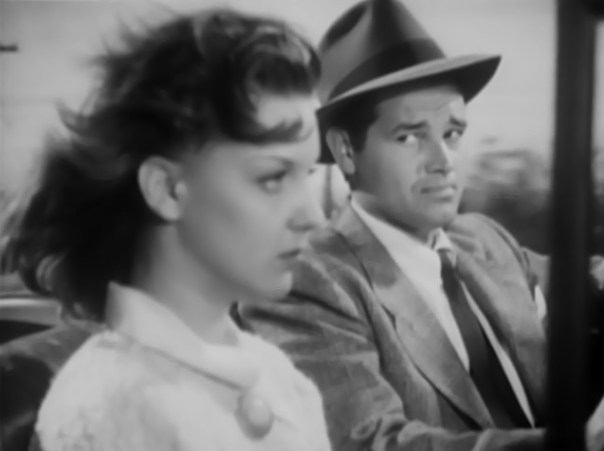
Ann Savage and Tom Neal
Ulmer spent most of his career working on low-budget and no-budget productions. At the time he made Detour he was under contract at PRC, possibly the cheapest outfit in Hollywood at the time. Most of PRC’s output was shot in six days and cut in one, an outrageously short schedule for making a feature film. In spite of these extreme limitations, Ulmer charges the movie with powerful imagery, making the visuals more striking and expressive than almost anything the major studios were doing at the time. Whether hitching a ride through the burning desert or brooding over a cup of coffee in a tiny diner, Al Roberts* is travelling through a dark psychological landscape. It often feels like the movie is taking place in his mind. Al is briefly enraged by a jukebox song that reminds him of his girlfriend. When he calms down again, the camera dollys in quickly to a tight close-up and the frame suddenly grows dim except for a small patch of light illuminating his eyes. Ulmer has no qualms about using a blatantly artificial effect to show the character’s emotional state. When Al stands over Vera’s corpse on the hotel bed, we see the room from his perspective, the camera panning slowly over various random objects, bringing them briefly into sharp focus, then allowing them to go hazy. We’re brought into the room with him, we share his feeling of stunned disbelief.
Another major difference in the movie is the way Vera dies. In Goldmsith’s novel, Al is so maddened by anger and fear that he strangles her when she tries to call the cops. It may not have been premeditated, but it’s definitely murder, and while Al is shocked by what he’s done, he doesn’t spend much time mourning. He runs. In the movie Vera’s death is definitely accidental. Having decided to call the cops, she grabs the phone, runs into the hotel bedroom and locks the door behind her. In total panic, Al grabs the cord and pulls with all his might, hoping to rip it out of the phone. Then he breaks down the bedroom door and finds Vera dead, the phone cord wound around her neck. There’s no knowing how this change came about. Did Goldsmith alter the scene on his own? Did Ulmer ask for something different? Was the production code a consideration? Whatever the reasons for the change, it definitely alters our perception of Al’s story. In the first version, he’s a murderer, even if he didn’t consciously choose to kill Vera. In the second version, he’s a helpless victim of forces beyond his control. After Haskell’s sudden death, Al’s chance encounter with Vera, and then her death in a freak accident, there’s no question that fate has taken a hand. He can run but he can’t hide. It’s only a matter of time before the darkness closes in.
Tom Neal has a forlorn charm that’s perfect for Al, an ordinary guy who’s trapped by an extraordinary set of circumstances. He just wants to get by, and at first he thinks everything will be okay if he just plays it cool. As things get worse and the pressure grows, Neal shows us Al’s nerves go from ragged to raw. He goes from ranting and raging to bargaining and begging, desperately trying to claw his way out of the mess he’s in. As Vera, Ann Savage burns a hole in the screen. It’s easy to believe that Al’s afraid of her. She’s a bottomless pit of anger and bitterness, and her intensity is scorching. But unlike the book, the movie gives us brief glimpses of another side of Vera. In her own way, she’s just as lost as Al. Vera’s led a hard life and probably doesn’t have long to live. In the few moments that Savage lets us see flashes of insecurity and desperation, it makes the character more than just another femme fatale. She seems vividly, pathetically human.
In the book, Alex manages to evade the law, but he can’t go home and he can’t go back to his girlfriend. He’s haunted by the memory of Sue, and tormented by the fact that his musical career has ended before it began. Goldsmith leaves Al stuck in limbo, bumming rides from one small town to another, earning a buck whenever he can. Still, he keeps moving forward. Life goes on. Ulmer’s ending is much more bleak. Al may have momentarily slipped free of the hangman’s noose, but he knows it’s only a matter of time before he’s caught. It’s not just bad luck that’s sent him on this detour. A mysterious force has singled him out, and there is no escape. When the highway patrol car pulls up alongside him at the end, he doesn’t struggle or try to run. He meekly steps inside. Because he knows it isn’t the police taking him down.
It’s fate.
——————————————————————-
*
In the book the character’s name is Alex Roth, but in the movie it’s changed to Al Roberts, no doubt because nice “normal” Anglo names were always preferred for Hollywood heroes.
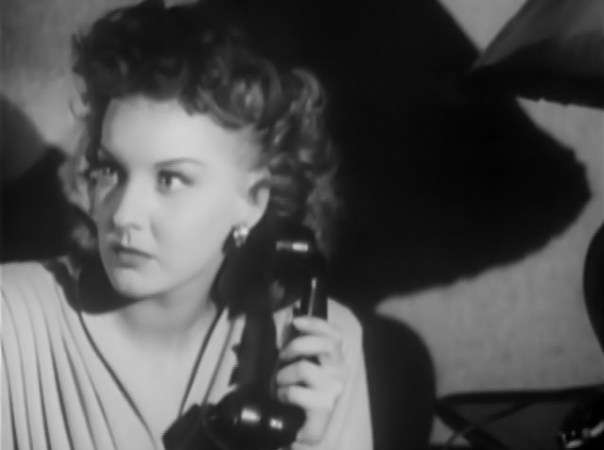
Getting ready to drop a dime.
Women in Hollywood
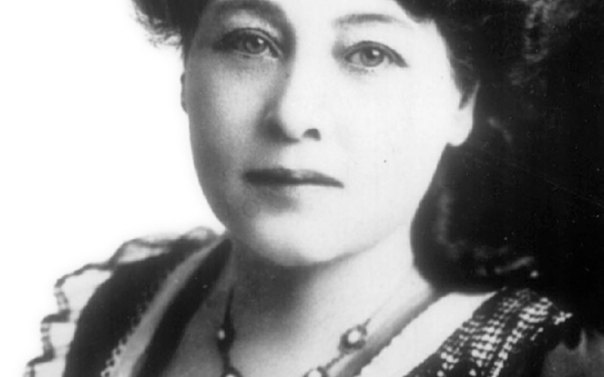
Alice Guy
In April of this year and again in November, the LA Weekly ran a two-part article on the way Hollywood treats women like second-class citizens. The author goes into detail describing the various ways that male studio execs stifle women’s voices. She interviews a number of women, and some men, all of whom confirm that women have a much harder time landing directing gigs, getting scripts produced, and even getting equal pay for work.
It’s pretty depressing, but hardly surprising. Just like every other corporate culture around the globe, Hollywood is dominated by highly-competitive men who see no reason to share power unless they’re forced to. I’d love to see this change, but I doubt that the solutions that are being debated will have any lasting impact. You’re going to shame these guys into sharing power? Good luck. They have no shame. If you don’t believe me, just take a look at the endless parade of stupid, empty action films that the studios churn out. Sue the studios? They have lawyers who can drag these things out for years. Even if a settlement offered some concessions, who’s going to enforce them?
So what’s my solution? Let’s take a look at Alice Guy, a pioneering filmmaker who started her career in the nineteenth century. Guy is one of the first people to ever shoot a movie, and after a successful directing career she started her own studio, the Solax Company, in 1910. Acting as a producer and director, Guy made hundreds of films for Solax, and while the studio eventually collapsed, for years Guy was one of the most powerful people in the industry.
I think women filmmakers need to follow Guy’s example. Don’t wait around for the alpha males in Hollywood to change the situation. The change has to come from outside. I realize that building a movie studio takes years, and that there are plenty of roadblocks. Finding financing, getting distribution, putting together a production schedule, all those things are major hurdles. But there are thousands of women in Hollywood who have the intelligence and talent to make it happen, and many of them would probably be willing to give up some compensation for a chance to make movies they believed in.
Hollywood has always been dominated by men, and as long as the billions keep rolling in from the endless rounds of worthless blockbusters, they won’t see any reason to change. The only thing more important to these guys than money is power, and they won’t give anything up unless they have to.
Which is why I say, don’t ask for power. Take it.
*
If you’re interested in reading the Weekly articles, here are the links.
How Hollywood Keeps Out the Stories of Women and Girls
And if you don’t know about Alice Guy, I urge you to read up on this phenomenal woman. I’m including two links below. There are many gaps in our knowledge of her career, and you’ll find the articles offer conflicting information. What is undisputed is that she was one of the earliest film pioneers, she made one of the first narrative films, and she experimented with sound and color long before Hollywood even existed.
Scarecrow (1973)

Gene Hackman and Al Pacino
In the seventies, Hollywood was trying to figure out what to do next. The major studios had pretty much collapsed in the sixties. High-profile movies with big stars were bombing at the box office, while low-budget films that ignored all the accepted rules were raking in millions. Realizing that the old formulas weren’t working any more, but clueless as to what the younger generation wanted, studio execs greenlighted a number of offbeat projects in the hope they’d get lucky. It was a heady time. Sure, the studios still put our plenty of bland rubbish, but for a while when you went to the movies you knew there was a chance you’d see something new and different.
Scarecrow was definitely different. From the opening scene with two guys standing on opposite sides of a lonely country road, not speaking a word of dialogue, you can tell this movie has a rhythm all its own. For the most part, Scarecrow just follows these two rootless men, Max and Lion, as they hitch across the country. In place of a plot, you just have people, and the film takes it’s own sweet time, letting you get to know each of the people these two guys encounter.
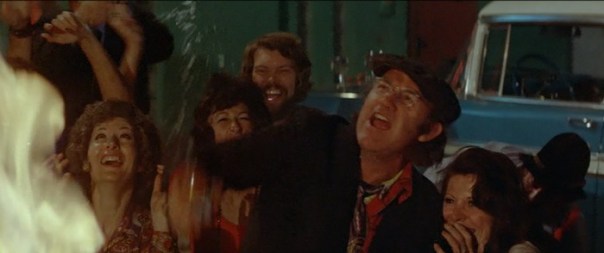
Cutting loose at the local bar.
Max has just gotten out of jail, and plans to open a car wash with the money he saved while he was doing time. Lion has been away at sea, but now he’s decided he has to go back home and try to connect with the child he fathered but hasn’t seen. At first, the two don’t have much in common, aside from the fact that they’re heading in the same general direction. But over time they become fast friends, and we realize that one thing they do have in common is that they’re both terribly naive. They may be grown men, but in many ways they’re as innocent as children. Neither one really understands the world around them.
As Max, Gene Hackman shows what made him such a unique and compelling actor. He has an unselfconscious openness, a fuzzy looseness that makes him seem completely accessible, but he also has a presence that holds your attention and an energy that’s a little scary. You’re always a little afraid of what he might do. Al Pacino plays Lion, and he still has the freshness of a young actor who’s willing to take chances. Lion is kind of shy, unsure of himself and of the world around him, and his reactions often seem as spontaneous as a child’s.
But the whole cast is wonderful. Eileen Brennan just has a small part as an irascible barfly, and still makes an impression in the short time she’s on screen. Dorothy Tristan radiates an easy warmth as an old friend that Max decides to drop in on. She never says a word when he starts flirting with her partner Frenchy, but you can see the twinge of jealousy in her eyes. Ann Wedgeworth plays Frenchy with an unabashed openness that’s totally winning. She immediately falls for Max, and she can’t stop flashing her huge smile, just waiting for him to make a move.

Dorothy Tristan and Al Pacino
It’s not just that the actors are in fine form. Director Jerry Schatzberg knows how to use them. Again, this movie is primarily about people, and Schatzberg shapes each scene to bring us closer to the characters. Screenwriter Garry Michael White gives him a lot to work with. You have to wonder if White didn’t spend some time hitchhiking himself. He seems to know these people and their world well. The cinematography, by Vilmos Zsigmond, slowly unfolds a panorama of the American landscape. This movie was shot in the bars and coffee shops, cheap hotels and bus stations that line this country’s rural highways. Zsigmond shows us the worn and wasted beauty in all of it without ever making us aware there’s someone behind the camera. Editor Evan Lottman is completely in tune with the movie’s vibe, throwing away the rule book and letting the people and the places determine the pace.
Max keeps talking about his car wash. Lion keeps thinking about the day he’ll get to see his child. What makes their story sad is that both of them are going nowhere. What makes it beautiful is that at least they’re going there together.
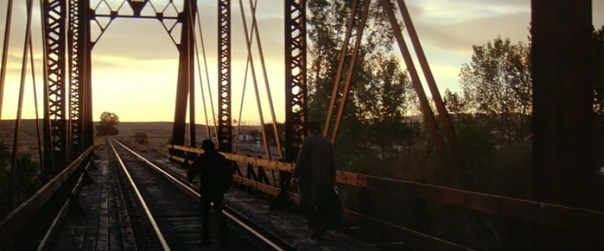
Bright Star (2009)

Abbie Cornish and Ben Whishaw
Jane Campion has had her ups and downs. First getting attention as an independent filmmaker in Australia, she broke into Hollywood with an offbeat fairy tale, The Piano. Her much anticipated follow-up, Portrait of a Lady, tanked at the box office and didn’t appeal to critics. Nobody knew what to do with the lovely and disturbing Holy Smoke, and In the Cut, a modern day noir, was a little too twisted for mainstream audiences.
With Bright Star, Campion went back to making small films for small audiences. But maybe intimate is a better word than small. This quiet, introspective movie may have been shot on a limited budget, but it has more weight than almost anything made for mainstream audiences. If Campion has turned away from Hollywood, it’s only so she could embrace the bristling honesty that’s at the core of her work.
Bright Star tells the story of the romance between Fanny Brawne and John Keats. Brawne was an independent-minded young woman in love with the art of making clothes. Keats was a willful, brilliant young man obsessed with the art of making poetry. Their relationship was a slow, deliberate dance that started with them circling each other cautiously and ended with them embracing each other rapturously. It’s easy to see why the material appealed to Campion. She’s always been fascinated by relationships. And in speaking about Bright Star, she’s said that she was interested in telling a story about people who talked.
Words are crucial to this movie. The words spoken by these people are full of meaning. The characters write letters, read aloud, quote from memory. These people take words seriously, sometimes too seriously. An offhand opinion can start an argument. A light remark may cut someone deeply. In part this is because these lovers, at times so supremely confident, are also terribly insecure. If they burn others with their scorn, it’s probably because they feel they’re burning inside themselves.
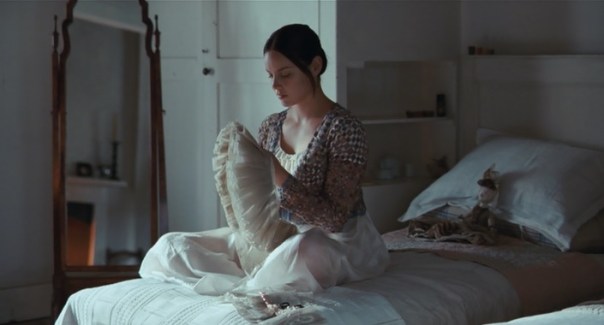
A young woman completely absorbed in her work.
Bright Star is a period piece, but Campion doesn’t just take us back to another time, she immerses us in it. This film is so sensually rich you can feel the crisp fabrics and smell the freshly cut flowers. Image and sound are carefully woven together, allowing us to experience the pace and feel of this vanished world. We see the way light falls across a finished hardwood floor or filters down through a grove of trees in spring, courtesy of cinematographer Greig Fraser. We hear the faint rustle of stiff skirts bustling down a dark hallway and the hushed chatter of birds drifting on the ether of a lazy afternoon. I wish I had a better idea of who to congratulate for the ravishing sound design, but in this area the credits are complex and not always easy to decipher. I hope that I’m not too far off in singling out sound effects designer Craig Butters, production sound mixer John Midgley, and sound effects editor Sean O’Reilly. My apologies to those others whose names I haven’t mentioned.
Campion credits Janet Patterson, who designed the costumes, for bringing an organic approach to her work, finding clothes that fit the actors rather than dressing them in fashions drawn on a page. Fanny’s dresses, hats, and shoes all show the meticulous care she takes in everything she wears. John’s clothes, on the other hand, show how little he thinks about his wardrobe. His mind is on other things. Patterson also served as production designer, and she shows the same care in creating the settings. The rooms these people occupy feel lived in, the poets lounging in their dusky library surrounded by stacks of books, the Brawnes busying themselves about the house in their tidy, joyful domesticity.
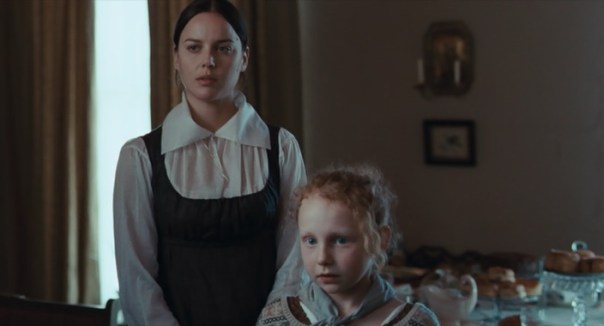
Abbie Cornish and Edie Martin
Campion’s technique is more simple and direct here than in her previous films, but her insights are a complex as ever. She seems to have relaxed into a kind of serene classicism. In Bright Star she chooses set-ups that are more or less straightforward, finding compositions that catch what’s happening between the characters without driving it home. This puts the focus on the actors, and the leads deliver wonderfully nuanced performances. Abbie Cornish uses the slightest changes in her expression to register sudden, sometimes violent, changes in Fanny’s mood. As played by Ben Whishaw, John may seem distracted, disengaged, but it slowly becomes apparent that he’s keenly aware of the world around him and painfully sensitive to it. Paul Schneider is excellent as John’s zealously devoted and very jealous friend. Thomas Brodie-Sangster doesn’t have much dialogue, but he plays Fanny’s brother Samuel with an easy grace. And I have to say that Edie Martin has a kind of magical charm as Toots.
It’s not easy for directors like Campion to get films made. A project like this is clearly not going to make it with mainstream audiences, which means running down the money often takes longer than making the movie. I hope she’s done with Hollywood, because I’ve seen so many filmmakers get beaten up trying to play that game. But going the independent route isn’t easy either. It usually means more control, but it also means working like a dog to get funding, and a lot less attention when your work finally gets shown. It’s a tough gig. We should do everything we can to support her, and all those like her.
City Lights (1931)

Charlie Chaplin and Virginia Cherrill
In the twenties, Charlie Chaplin was sitting on top of the world. An international star and owner of his own studio, he had complete control over the films he made. Chaplin worked at his own pace, taking as much time as he needed to get things right. He might spend days on a single scene, and if later he decided it wasn’t right, he’d go back and shoot it all over again. If he felt like he needed a break in the middle of shooting, he’d shut the production down and go back to it when he was ready to resume. I can’t think of another commercial filmmaker who had the same freedom.
Chaplin started out making shorts in the teens. His early efforts were rough, but by 1920 he’d mastered the medium, and it’s important to understand what the medium was in those days. In the silent era, commercial filmmaking relied on characters that were easily recognizable stereotypes, and stories that were told in the clearest possible terms. Without dialogue to help define more complex characters and situations, filmmakers had to use a visual language that was simple and direct.
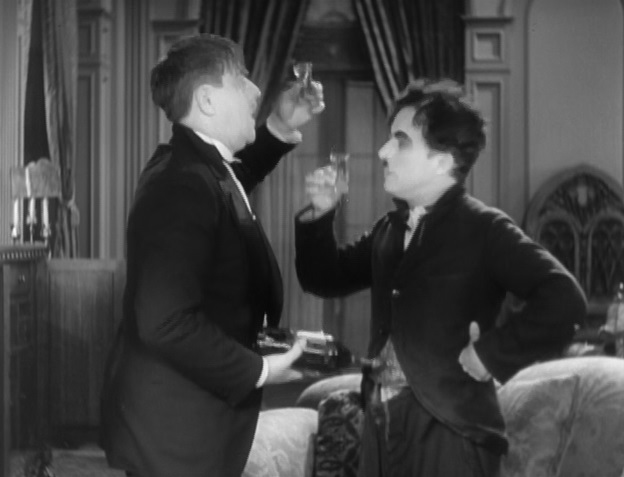
Harry Myers and Charlie Chaplin
When Chaplin came on screen as the Tramp, audiences recognized the character immediately. He was the little guy, the ordinary fellow who didn’t want any trouble, and spent most of his time just trying to get by. Put him next to a burly roughneck or an elegant society woman and the situation was clear right away. Without a word being spoken, it was easy to see he was either dealing with an antagonist or an aristocrat, and audiences would naturally be rooting for Chaplin, the underdog. The plots were just as simple, setting up blunt contrasts between love and hate, kindness and cruelty, selfishness and self-sacrifice. They appealed to the audience’s most basic emotions, and at their best, the silent films of the studio era had a primal power that was irresistible.
City Lights is one of the prime examples of this kind of filmmaking. The story is real simple. The Tramp falls in love with the Blind Girl who sells flowers on the street. When he finds out she needs money, he (sort of) steals the cash to help her out, but ends up going to prison for the crime. You can’t get much more melodramatic than that, but Chaplin uses this soap opera storyline to create a film that’s funny, beautiful, and sometimes heartbreaking.
These days there are lots of people who complain that Chaplin’s work is too sentimental, and even in his own time there were critics who held that view. All I can say is, it works for me. If I thought that he wasn’t sincere, that he was just trying to manipulate the audience, then I’d be angry at this fraud who was tugging at my heartstrings. But I think Chaplin absolutely believed in the world he created on the screen. Not to say that he believed it was realistic, because he certainly knew that his movies relied heavily on artifice. The reality he was reaching for was an emotional one. Even if the situations were sheer fantasy, Chaplin tried to make the emotions ring true.
One of the reasons Chaplin was so good at putting us in touch with his characters’ feelings is that he understood the relationship between the performer and the camera. For his comic scenes, he spent endless hours shooting rehearsals so that he could fine tune every gesture, making it fit precisely within the frame. The sequence where we see him gazing at the statue in the store window is a classic example. The whole thing is shot from one angle, but it’s absolutely the right angle. Chaplin shot reel after reel of rehearsals, slowly working out a subtle choreography that can wring laughs out of the smallest gesture. In the scene where he meets the Flower Girl, played by Virginia Cherrill, it starts out sweetly charming, then there’s a sense of wistful longing, and suddenly we’re laughing at a slapstick gag. Chaplin accomplishes all this with the simplest set-ups, but he always makes sure that the camera is positioned to pick up everything the actors are doing. It’s not just the expressions on their faces, it’s the way they stand, the way they walk, the way they move their hands. The storyline may be pure melodrama, but scenes like this are a subtle, complex dance.
City Lights shows how completely Chaplin understood silent filmmaking, but he never figured out how to deal with sound. His art was built on the poetry of popular melodrama. The images were so simple you didn’t need words. When he finally started making films with dialogue, the words seemed like excess baggage, weighing everything down. He certainly has some interesting things to say in movies like The Great Dictator and Monsieur Verdoux, but in those later efforts it seems like he’s trying to explain himself, rather than trusting us to understand. In City Lights he doesn’t need to explain anything. We don’t have to hear what Chaplin is saying. We can feel it.
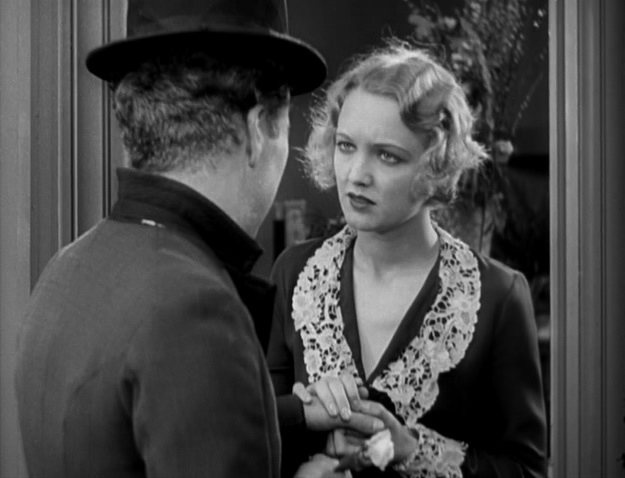
The moment of recognition.
What’s Opera, Doc? (1957)
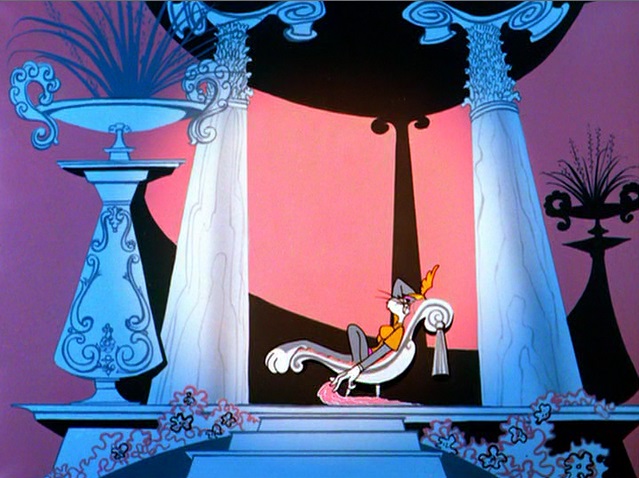
The animation of the studio era settled early on into a comfortable pattern. These short cartoons usually showed funny animals doing crazy things. While you might find a few examples of verbal humor, for the most part the comedy was intensely physical, with characters chasing each other, hitting each other, and sometimes blowing each other up. You really wouldn’t use the word “subtle” in talking about the cartoons of that time.
Until Chuck Jones came along. Jones started out in the early thirties on the bottom rung of the animation ladder, but by the end of the decade he’d become a director, working under Leon Schlesinger at Warners. His early efforts were uneven, with just a few hints of his personality showing through. It wasn’t until after WWII that he really hit his stride, but by 1950 he had created a style that was completely his own.
Every director who worked in the Warner Bros. animation department had their own take on the stock company of characters. Bugs Bunny imagined by Bob Clampett was not the same as Bugs Bunny imagined by Friz Freleng. But Bugs Bunny imagined by Chuck Jones was something else altogether. Instead of relying mostly on madcap slapstick, Jones imbued his work with subtle shadings you didn’t see in other cartoons. Daffy’s wild ranting would suddenly melt into a pathetic display of helpless incomprehension. Jones would take a moment between gags to show us Porky cock his eyebrow in a small gesture of weary disdain. In the split second before a bomb went off, we’d see the Coyote overwhelmed by total despair.
Jones reshaped the Warners stock company to create his own, very personal, fantasy world. His way of drawing the characters was distinct from the other directors at Warners. Instead of the crisp, sharp lines that previously defined Bugs, Porky and Daffy, Jones’ lines could be fragile, sinuous, twisted, eccentric. In the course of a seven minute short, Jones would take you from displays of raging hysteria to scenes that were oddly touching.
What’s Opera, Doc? is one of Jones most complete efforts. It’s certainly not the first time cartoons parodied the world of opera, but in Jones hands’ it’s not just a parody. Sure, he’s making fun of the mythic heroes and doomed romances, but with its vast landscapes and dramatic vistas, this short cartoon revels in the gorgeous excess of opera. Jones is in love with the very thing he’s satirizing.

In the first scene we see a warrior’s majestic shadow cast on the side of a towering cliff. Then the camera descends to show us that the shadow belongs to Elmer Fudd, decked out like Siegfried in Wagner’s Ring cycle. In this case, Elmer’s not out to destroy the evil dragon Fafnir, but to hunt down Bugs Bunny. The story is the same one we’ve seen in dozens of other shorts that feature these two characters. The comedy comes from seeing them play out the same routines against the extravagant backdrop of grand opera. Instead of hunting Bugs with a shotgun, Elmer now summons the destructive forces of the storm to hunt his prey. When Bugs goes into his familiar drag routine, this time he’s not just a sexy vixen, he’s Brünnhilde, lying on a divan in an elegant pavillion.
In animation, everything we see on the screen has to be created from scratch, and the best animation directors have always relied on teams of talented people who make this happen. On What’s Opera, Doc? Jones had top-notch crew, all of whom had worked with him for years. It’s worth mentioning them all by name. The story comes from long-time Jones associate Michael Maltese. The animation was the work of Ken Harris, Abe Levitow and Richard Thompson, with Maurice Noble doing the layouts and Philip DeGuard taking care of the backgrounds. Editing and sound are by Treg Brown. Milt Franklyn did an excellent job of condensing the music from Wagner’s massive Ring cycle into just about seven minutes. Elmer’s voice is by Arthur Q. Bryan, and of course, Bugs’ voice is provided by the incredible Mel Blanc.
What’s Opera, Doc? came toward the end of Jones’ tenure at Warners. The studios that had animation departments were shutting them down, and it wasn’t long before Jones and his crew were shown the door. It’s a shame, but it was inevitable. Over the course of three decades the animators at Warners created an incredible body of work, turning out some of the most imaginative cartoons you’ll ever see. But making those cartoons was becoming increasingly expensive, and after 1950 the studios were doing everything they could to cut costs. Jones went on to some excellent work on television, but the golden age of studio animation was over.
As Porky would say, “That’s all, folks.”

“Well, what did you expect in an opera? A happy ending?”
Baadasssss! (2003)
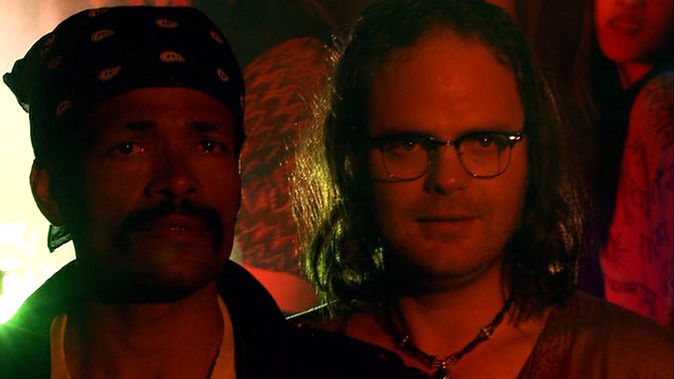
Mario Van Peebles and Rainn Wilson
Can we ever understand our parents? Probably not. When we’re young they seem impossibly clueless and unfair. As we get older, as life starts beating us down the way it did them, we may start to empathize with them. We may begin to get some insight into why they were so angry and frustrated. But we can’t ever really understand what they went through because we can’t ever understand the times they lived through. Inevitably, their world is different from ours.
Still, we have to try to put ourselves in their shoes, if only to understand ourselves better. When we’re young, we see ourselves as the center of the universe and the setbacks we suffer seem horribly traumatic. When we get older, hopefully we start to realize that other people have suffered, too, and that when we put it all in perspective, the difficulties we’ve experienced often pale in comparison.
Sweet Sweetback’s Baadasssss Song is generally credited with starting the blaxploitation cycle that flourished in the seventies. Certainly it made Hollywood aware of the fact that there was money to be made off black audiences, but the film itself has little to do with the routine genre flicks that followed. Melvin Van Peebles made Sweetback because he wanted to create a hero for an audience that didn’t have any movie heroes. He was sick of having his community misrepresented, when it wasn’t being completely ignored, by Hollywood. And so he decided to make a movie that would inspire Blacks. The movie he came up with was cheap, raw, and ragged, but it was also lively, imaginative and burning with anger. Black audiences had never seen anything like it, and they flocked to the theatres where it played.

A moment of inspiration.
I’m a little skeptical of Mario Van Peebles’ claim that he initially didn’t want to play his father in Baadasssss!, the story of the making of Sweet Sweetback’s Baadasssss Song. To my mind, he’s the only one who could’ve played the part. There were probably other actors who could have done a fine job with the role, but no one else could’ve brought the same intense commitment to it. Maybe the idea scared him at first, but whatever his reservations, I’m glad he took the part. Seeing the son play the father sets up a resonance that vibrates throughout the movie. This isn’t just another film inspired by true events. This is Mario Van Peebles conjuring up the demons that possessed his father.
And his father was possessed by many demons. A smart, proud, angry man, he was determined to make Sweetback no matter what it cost him, and it cost him a lot. We’re not just talking about money, either. Melvin’s obsession with putting the story on the screen put a tremendous strain on his family, especially his son. In Baadasssss!, we see Mario being recruited by his father to play the young Sweetback, and how the boy’s initial enthusiasm turns to extreme discomfort. He wants to be a part of what’s going on, but he’s obviously freaked out when his dad asks him to play a pretty explicit love scene with an older woman. When Melvin makes Mario go through with it, it’s clear the boy is wounded. And the film’s strange reflexive quality makes the sequence especially poignant. This is Mario, playing Melvin, telling his own story within his father’s story.

Khleo Thomas and Mario Van Peebles
But I don’t want to make Baadasssss! sound like some depressing psychodrama. It’s actually really entertaining. This improbable story of how an outsider with no money made a hugely successful independent film is totally engaging. The script, by Mario Van Peebles and Dennis Haggerty, is full of outrageous episodes, all of which are apparently based on the actual facts. The early scenes, where Melvin and his friend Bill are trying to raise the money they need, are very funny. We’re introduced to a huge cast of characters, and it’s a sign of Van Peebles’ skill as a director that he not only makes them all distinct individuals but he also shows us how the relationships between them develop. When the shooting begins, everybody’s excited and enthusiastic. By the time they wrap it up, they’re all completely fried, ground down by the grueling schedule and the overwhelming obstacles they’ve had to face. But the ones who stick it out have all grown from the experience. None of them will ever be the same after having taken this journey.
I think it’s a journey Mario Van Peebles had to take. Watching the movie, it’s clear that being the son of a rebellious iconoclast like Melvin Van Peebles could be really tough. But watching the movie it’s also clear that Mario has a growing awareness of the fact that his father’s intensity and anger were a reflection of the era. As a child, Mario must have thought at times that his dad was completely crazy. But then, he never could have made Sweetback if he’d been completely sane.
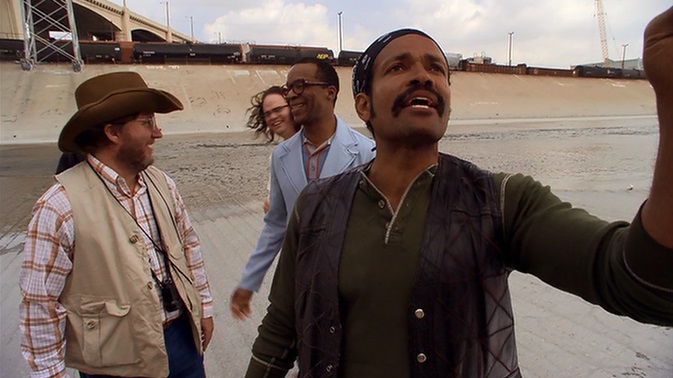
Scouting the LA River.
 Reality Is Scary