Category Archives: Uncategorized
O Lucky Man (1973)

Malcolm McDowell and Arthur Lowe
In 1968, screenwriter David Sherwin and director Lindsay Anderson made If…., a savage and surreal film about a small band of rebels at a British public school. Malcolm McDowell plays Mick Travis, a brash teenager who won’t accept the status quo. The whole film is a brazen assault on Kipling’s England, the bastion of tradition, held together by sadistic violence, the church, and a rigid class structure.
But that was the sixties. In 1973 Sherwin and Anderson brought Mick back in O Lucky Man, but he’d changed quite a bit in the course of five years. No longer the brash rebel, now Mick wants nothing more than to fit into the system, and to be as successful as possible. Starting off as a coffee salesman, he ends up roaming over the whole of England looking for the things he thinks will make him happy. Not surprisingly, those things are harder to find than he thought.
Both films are subversive, but in completely different ways. In O Lucky Man, the self-righteous anger that energizes If…. is gone. Now the attitude is a kind of amused detachment. British society is so strangely unreal that all Sherwin can do is laugh at it. And Anderson, the cynical idealist, joins in the laughter. He simply stands back and observes as policemen and politicians, scientists and financiers, complacently go about their business, lying, cheating, and stealing. And Mick is always at the ready, eagerly waiting for his chance to jump into the thick of things.
As terrifying as some of Mick’s adventures are, we can laugh along with Sherwin and Anderson, in part because they keep reminding us that we’re watching a movie. In fact, O Lucky Man begins with a film within a film. We see a brief silent prologue in grainy black and white. McDowell plays a peasant working on a coffee plantation. When he’s caught stealing a handful of coffee beans, the word “unlucky” flashes on the screen. Just as the authorities hand down a horrifying punishment, the screen goes black and the word “NOW” announces that we’re jumping into the present.
Playwright Bertolt Brecht wanted the audience to be aware that they were watching a story unfold, and in the sixties a number of British filmmakers embraced this approach. Writing about film in the fifties, Anderson insisted that the polished productions coming out of British studios encouraged the audience to become numb and complacent. He wanted to shake things up, and to create a cinema that put people in touch with the real world. He wanted to make movies that would push the audience to question the status quo.
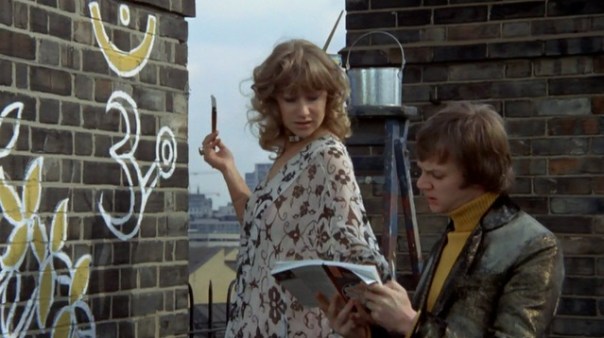
Helen Mirren and Malcolm McDowell
O Lucky Man is all about questioning the status quo. We see Mick stumble into one situation after another, and he’s willing to go along with anything if he thinks it will get him what he wants. He’s so blinded by the shiny objects he’s chasing that he doesn’t bother to question anything. As a result, he’s tricked, beaten, tortured, and finally jailed.
Prison changes him. Sort of. Determined to live a better life, he’s spent his time behind bars reading and thinking. Having studied the great philosophers, he’s realized that happiness doesn’t come from chasing wealth. Mick has decided to renounce worldly possessions and devote his life to helping people. He thinks he’s found the answer. He doesn’t realize he’s just chasing a different shiny object.
The backdrop to Mick’s dizzying journey is a sweeping panorama of England, and I’m not just talking about the landscape. He gets to dine with the fabulously wealthy and serve soup to the desperately poor. He watches porn with local politicians and staggers into the sanctuary of a country church. One of his sales calls takes him to a large factory where he finds that no one there will need his coffee, since the entire workforce has been laid off. As he waits in the reception room of a corporate high-rise, he’s horrified to see one of the employees jump out the window and plunge to his death. At first he tries to master the world, meeting it with cocky self-assurance. Next he tries to serve the world, wearing a mantle of abject humility. But somehow the world doesn’t seem to appreciate his efforts.

Waking up to a new day.
McDowell radiates a beatific optimism as he wanders through the battlefield of life. Over and over again he gets hammered, and each time he bounces back, ready to take on the world. Not quite thirty when he played the part, McDowell has a freshness and openness that make him seem truly innocent. He makes one horrific blunder after another, but we can’t condemn him because he really doesn’t seem to know any better. In his wanderings he runs into a wonderful cast of supporting actors, who magically turn up over and over again in different roles. It’s a tribute to the talents of Rachel Roberts, Mary MacLeod, and Arthur Lowe, that even though we recognize their faces, they’re still completely believable in each new incarnation. Young as she is in this film, Helen Mirren already appears to be completely at ease as an actress. She seems to fill the screen without even trying. And of course, there’s the incomparable Ralph Richardson, always oddly askew and strangely compelling.

Malcolm McDowell and Ralph Richardson
The score is by Alan Price, who wrote a beautiful set of songs for the film. Once again reminding you that you’re watching a movie, Anderson uses Price and his band like a kind of Greek chorus, commenting on the action as Mick goes through each new adventure. At first the director cuts away from the action to show the band performing in a studio. But halfway through the film, as Mick is making a desperate escape from another harrowing situation, Price and the band show up in a white van and offer him a ride to London. The story and the mechanisms being used to tell it flow together. Unlike most filmmakers who hide the mechanics, Sherwin and Anderson put them right up front for all to see.
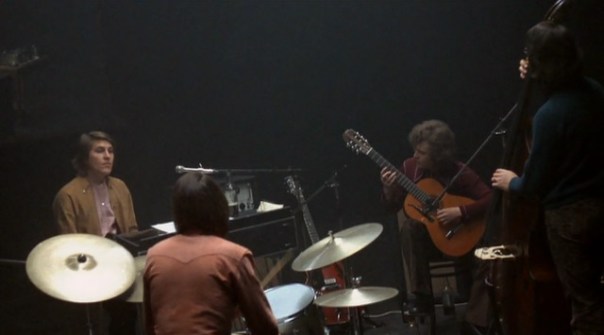
Alan Price, keyboards, vocals; Colin Green, guitar; Clive Thacker, drums; Dave Markee, bass
This approach reaches its logical conclusion where Mick, dazed and disoriented, wanders into the casting call for a film entitled O Lucky Man. Director Lindsay Anderson spots him, decides he’s worth a test, and has him stand in front of a white backdrop as a photographer snaps pictures. The jaded director gives monosyllabic orders to his crew, while the photographer shoots Mick in different poses. And then Anderson says to Mick,
“Smile.”
Mick asks,
“Why?”
Anderson insists.
“Just do it.”
Mick refuses.
“What’s there to smile about?”
Finally the director loses patience, and whacks Mick with his script.
The next shot is a close-up of Mick, set against the white background. For a long moment, his expression is blank. And then, slowly, almost imperceptibly, we see his mouth curl into a smile.
Is this the beginning of wisdom?

A hug from the director.
Dead Presidents (1995)
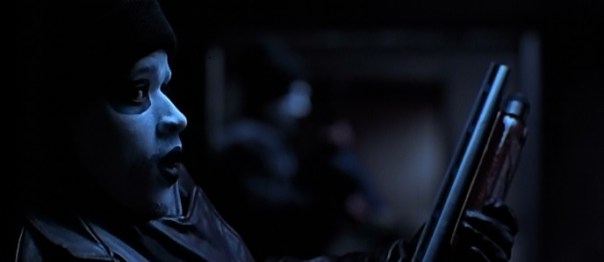
Larenz Tate
I’ve heard people complain that Dead Presidents tries to do too many things. Some see it as an unsatisfying cross between a gangster flick and a war movie. Others see it as an ambitious but unsuccessful attempt to chronicle the Black experience in America. Many people complain that it goes on too long and has no focus.
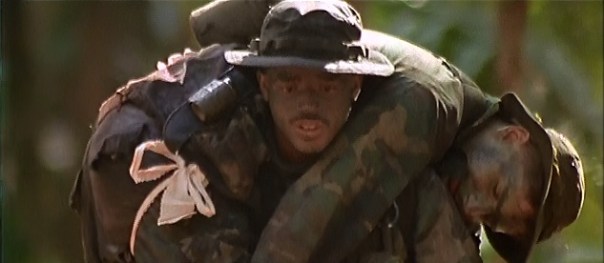
Personally I don’t feel like Dead Presidents falls into any one category. Though directors Allen and Albert Hughes have made genre films, this is one case where I think they were reaching for something different. And this may be part of the reason why some people don’t respond to it. Dead Presidents doesn’t follow the usual dramatic arc. It’s more open ended. The story follows a young Black man named Anthony Curtis as his life unfolds. We first see him as a young man from a comfortable, middle-class home in the Bronx, then as a soldier in Vietnam, and finally as a vet dealing with poverty and alcoholism.
The Hughes Brothers are talking about America here, and there’s no doubt they see the system as destructive. But this isn’t a social tract and they don’t make Anthony a helpless victim. It’s more complicated than that. We see that as a young man Anthony could have gone to college and he decided to enlist instead. We see how black men were used as fodder during the Vietnam War, but the film makes it clear that blacks weren’t the only ones who were traumatized and crippled by the violence. We see Anthony come back home to a family he’s totally unprepared for, and how instead of dealing with the situation he gradually shuts down.
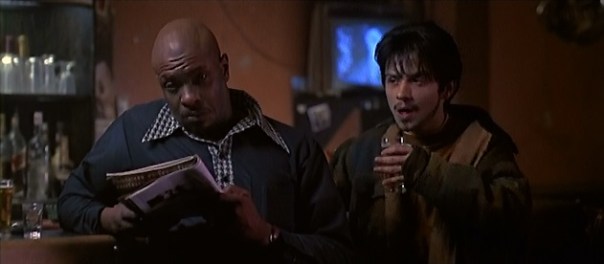
Keith David and Freddy Rodriguez
No doubt the Hughes Brothers could have jacked up the drama by giving us a bad guy to blame. But that also would have simplified things, and in Dead Presidents the directors are aiming for something more complex. They give us a sweeping view of a society where the deck is stacked. The country is always fighting a war somewhere, poverty is a prison that few can escape, and drugs are readily available for those who want an easy way to kill the pain.
Larenz Tate gives a moving performance in the leading role. Anthony is an average guy, a decent guy. Even as he sinks deeper into depression and bitterness, Tate keeps us with him. We can see that this young man could have done so much better, which makes it even harder to watch his downhill slide. Keith David plays Kirby, who lost a leg in the Korean War and now runs a local bar. Kirby is kind of a father figure to Anthony, and David plays the role with a touching mix of toughness and affection. The older man wants to help his young friend, but he’s caught in the same trap. Juanita is the mother of Anthony’s child, and she knows she’s caught in a trap. Rose Jackson’s nuanced performance shows us that even though Juanita loves her man, she can’t hide her mounting frustration. She wants to build a better life, and she won’t wait around forever.
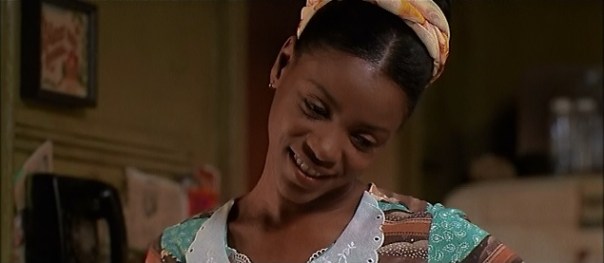
Rose Jackson
Desperation finally drives Anthony to desperate measures. He and Kirby plan to rob an armored car. The heist goes horribly wrong. In the end, Anthony, Kirby and their accomplices all end up under arrest or six feet under. When Anthony is in court waiting for sentencing, he’s given a chance to speak and mentions his service in Vietnam. The judge, a WWII vet, is outraged, and tells the prisoner that Vietnam wasn’t even a “real war”. Then he hands down a sentence of fifteen years to life.
And the last we see of Anthony, he’s on a bus heading for prison.
The Prestige (2006)
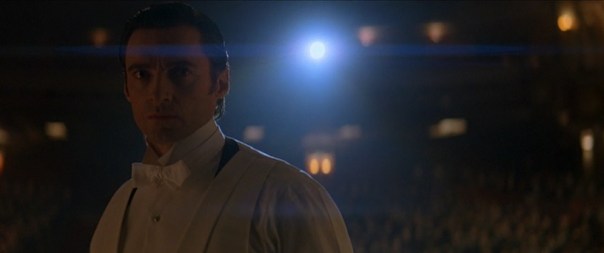
Hugh Jackman
A hand reaches into a cage and grasps a small bird. An elderly man is performing a magic trick to amuse a small girl. As he goes through the motions of making the bird disappear, we hear a voiceover explaining that there are three parts to a trick, the pledge, the turn, and the prestige. Basically, the magician shows you something ordinary, and then makes something extraordinary happen. The voice goes on to tell us that even though we may think we’re trying to figure out the secret, we’ll never find it.
“Because, of course, you’re not really looking. You don’t really wanna know.”
Christopher Nolan likes to explore the way we perceive things. And beyond that, he’s interested in why we perceive things the way we do. Memento seems to be about a man who suffers from a rare memory disorder that keeps him from understanding his own life. By the end of the film, it appears that the disorder may be his way of coping with a past he can’t bear to face. Inception follows its main character as he dives into peoples’ unconscious minds to unlock their secrets. But as the story progresses we realize that his quests always end up bringing him face to face with his own demons.
Nolan never dug deeper than he did in The Prestige, a story about two magicians who spend their lives playing with the audience’s perceptions. Robert Angier and Alfred Borden are constantly competing with each other, both onstage and off. Angier is a showman, a natural performer who knows how to dazzle audiences. Borden is a thinker, always analyzing what he sees, living his life mostly inside his head. In different ways, both men make huge sacrifices in order to achieve the acclaim they seek. They both want to astound the world. But their rivalry isn’t just a contest between two ambitious performers. It’s wound up tightly with a bitter personal feud. Angier blames Borden for the death of his wife, and is determined to take revenge. Their battle goes far beyond competitive one-upmanship, starting with violent, vengeful pranks, and evolving into maddeningly elaborate mind games.
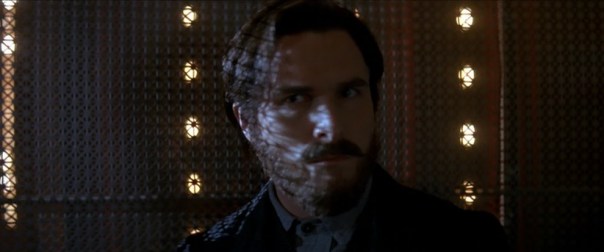
Christian Bale
While all this is going on, the film is also playing some mind games with us. The Prestige is a dazzling, extended display of cinematic sleight of hand. There are plenty of films that keep stringing us along with twist after twist, and while they’re sometimes fun, they usually don’t have much going on beneath the surface. In The Prestige, Nolan uses these twists to make us question the way we see things, and asks why we see things the way we do.
The movie is based on the book of the same name by Christopher Priest.* Nolan wrote the screenplay with his brother Jonathan, and I gather they made some significant changes both in terms of plot and perspective. In the film, the Nolans seem to be making the case that magic isn’t so much a matter of creating an illusion as it is playing with perception. The magician prepares the audience by setting up a certain frame of reference, and then the audience is astonished to see something that doesn’t conform to their expectations. What they’re actually witnessing may not be so remarkable in itself, but because of the way they’ve been led to perceive things, it seems like a miracle.

Michael Caine
It’s a sign of how the good a performance is when it’s hard to imagine anyone else playing the part. And it’s a sign of how good the casting is when all the performers seem absolutely right in their roles. Before I get into talking about the actors, I’d like to give credit to casting director John Papsidera. He found exactly the right person for every part, starting with Hugh Jackman and Christian Bale. Jackman’s Angier has the looks and the charm, the arrogance and the insecurity of a popular performer who’s desperate for the audience’s approval. He shows us how an ambitious young man is gradually consumed by an obsession he can’t control. Bale was the perfect choice for Borden. The actor often seems a little distant onscreen, a little withdrawn. This is absolutely right for Borden, who is always on guard, always protecting his secrets. He may have a wife and a child and a mistress, but he doesn’t give himself fully to any of them. Bale’s reserve makes it clear that Borden doesn’t quite connect with the world around him. His mind is always on magic.

Christian Bale and Rebecca Hall
But as I said, the whole cast is impressive. Rebecca Hall plays Borden’s wife Sarah with a tender sweetness, which makes it all the more awful to see her slowly broken by the misery of trying to share her life with a man who can’t share his. Scarlett Johanson has a striking assurance as Olivia Wenscombe, Angier’s on-stage assistant. This is a woman who’s smart enough and tough enough to survive in a world run by men. Michael Caine is obviously a favorite of Nolan’s, but the director has never given Caine a part as rich and complex as this one. Caine’s performance as Cutter, the aging sorcerer’s apprentice, is a reminder of how gifted the actor is. Cutter is part father, part hustler, part counselor, part con artist. He starts off as a mentor to both Angier and Borden, a crusty old pro teaching them the tricks of the trade. As time goes on, he gets drawn into and ground down by their rivalry. Caine plays the part with a straightforward simplicity, and at the same time brings a thousand subtle shadings that make the character absolutely real.
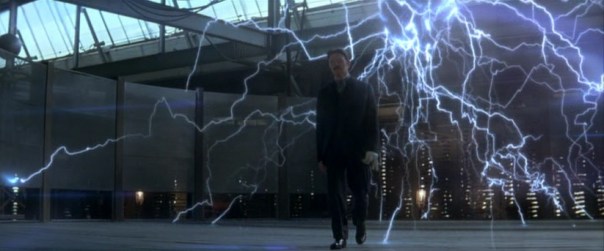
David Bowie makes an entrance.
And then there’s David Bowie as Nikola Tesla. While Bowie painstakingly assumes the courtly manner and the measured speech of the legendary scientist, he brings a presence that gives his performance a powerful resonance. Tesla is something of a mythical figure. A brilliant inventor who played a major part in shaping twentieth century technology, he’s largely forgotten today. Of course, his part in the film is fictionalized, but it doesn’t seem far fetched to portray him as a man who stands at the nexus of science and the supernatural. And though we may think of Bowie as a flamboyant rock star, in reality he was a thoughtful, sensitive, orderly man, who spent much of his life exploring the overlapping worlds of art and technology. The two men may not be as different as they seem. Bowie brings a quiet intensity and a deep melancholy to the role of Tesla, a scientist who understands all too well that his inventions have the potential to cause terrible destruction.

Bowie as Tesla
While Borden and Angier perform their tricks in brightly lit theatres, much of the actual work they do takes place in dimly lit backstage areas and dingy workshops, away from public view. They take their bows in the spotlight, but they live in a world of shadows. That world in which they work their dark magic was carefully created for the film by production designer Nathan Crowley and art director Kevin Kavanaugh. Cinematographer Wally Pfister’s richly detailed images capture a million subtle shades of grey, brown and black. David Julyan’s dense, brooding orchestral progressions reinforce the feeling that we’re exploring a psychological and moral netherworld. And as I said earlier, the film relies on cinematic sleight of hand to work its own disturbing magic, jumping back and forth in time and using misdirection to shape the way we see things. Lee Smith’s deft, expert editing makes it all appear seamless.

Scarlett Johansson
Since The Prestige, Nolan has focussed on making big budget action flicks, which he does pretty well. I think he’s tried in those films to push the boundaries, but in the end they always seem to fall back on familiar Hollywood formulas. When the producers are gambling a hundred million or more on a feature, they generally want the director to give the audience what it’s expecting. The Prestige doesn’t do that. Instead, it plays with the audience’s expectations. It challenges viewers to look for answers, not just to the superficial puzzles posed by the plot, but to deeper questions about who we are and how we see the world. And at the same time, it asks us why we spend our lives searching for answers.
“Because, of course, you’re not really looking. You don’t really wanna know.”
—————————————————————————-
*
While surfing the net for info to write this post, I came across the web site maintained by the author of The Prestige, Christopher Priest. Apparently he published a whole book about the making of the film, which he called The Magic. And on his site he posted a brief summary of his thoughts on the movie, both positive and negative. I don’t agree with everything he has to say, but it’s fascinating to get his take on the film adaptation. You can read it yourself by clicking on the link below.
Christopher Priest on the Film Version of The Prestige
Taking Some Time Off
I need to take a break. There’s been so much going on the past year or so, it’s gotten hard to find the time to post on a regular basis. I’m thinking I’ll take about six months off, and maybe get back into the blogging thing some time in the summer. There are plenty of movies I’d like to write about, so hopefully after a little time off I’ll be ready to dive back in.
I do have another project I’m working on. I’ve been writing for over thirty years, both fiction and non-fiction, and very little of it’s been published. In the not too distant future I hope to launch a web site where I can post some of the longer stuff I’ve written. It’s still in the works, and it might take a while, so I won’t make any promises. But if I can get it off the ground, I’ll post the link on this site.
Thanks to those of you who have been following the blog. Looking forward to reconnecting this summer.
Women in Hollywood
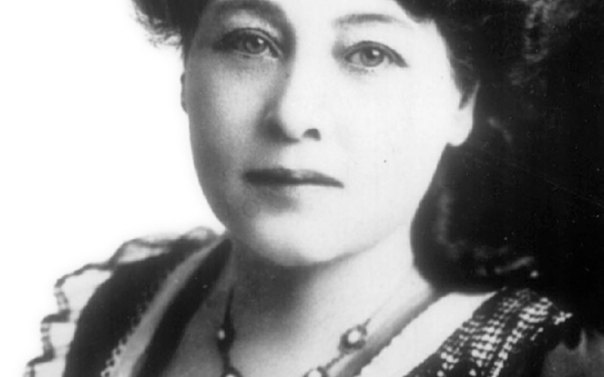
Alice Guy
In April of this year and again in November, the LA Weekly ran a two-part article on the way Hollywood treats women like second-class citizens. The author goes into detail describing the various ways that male studio execs stifle women’s voices. She interviews a number of women, and some men, all of whom confirm that women have a much harder time landing directing gigs, getting scripts produced, and even getting equal pay for work.
It’s pretty depressing, but hardly surprising. Just like every other corporate culture around the globe, Hollywood is dominated by highly-competitive men who see no reason to share power unless they’re forced to. I’d love to see this change, but I doubt that the solutions that are being debated will have any lasting impact. You’re going to shame these guys into sharing power? Good luck. They have no shame. If you don’t believe me, just take a look at the endless parade of stupid, empty action films that the studios churn out. Sue the studios? They have lawyers who can drag these things out for years. Even if a settlement offered some concessions, who’s going to enforce them?
So what’s my solution? Let’s take a look at Alice Guy, a pioneering filmmaker who started her career in the nineteenth century. Guy is one of the first people to ever shoot a movie, and after a successful directing career she started her own studio, the Solax Company, in 1910. Acting as a producer and director, Guy made hundreds of films for Solax, and while the studio eventually collapsed, for years Guy was one of the most powerful people in the industry.
I think women filmmakers need to follow Guy’s example. Don’t wait around for the alpha males in Hollywood to change the situation. The change has to come from outside. I realize that building a movie studio takes years, and that there are plenty of roadblocks. Finding financing, getting distribution, putting together a production schedule, all those things are major hurdles. But there are thousands of women in Hollywood who have the intelligence and talent to make it happen, and many of them would probably be willing to give up some compensation for a chance to make movies they believed in.
Hollywood has always been dominated by men, and as long as the billions keep rolling in from the endless rounds of worthless blockbusters, they won’t see any reason to change. The only thing more important to these guys than money is power, and they won’t give anything up unless they have to.
Which is why I say, don’t ask for power. Take it.
*
If you’re interested in reading the Weekly articles, here are the links.
How Hollywood Keeps Out the Stories of Women and Girls
And if you don’t know about Alice Guy, I urge you to read up on this phenomenal woman. I’m including two links below. There are many gaps in our knowledge of her career, and you’ll find the articles offer conflicting information. What is undisputed is that she was one of the earliest film pioneers, she made one of the first narrative films, and she experimented with sound and color long before Hollywood even existed.
Scarecrow (1973)

Gene Hackman and Al Pacino
In the seventies, Hollywood was trying to figure out what to do next. The major studios had pretty much collapsed in the sixties. High-profile movies with big stars were bombing at the box office, while low-budget films that ignored all the accepted rules were raking in millions. Realizing that the old formulas weren’t working any more, but clueless as to what the younger generation wanted, studio execs greenlighted a number of offbeat projects in the hope they’d get lucky. It was a heady time. Sure, the studios still put our plenty of bland rubbish, but for a while when you went to the movies you knew there was a chance you’d see something new and different.
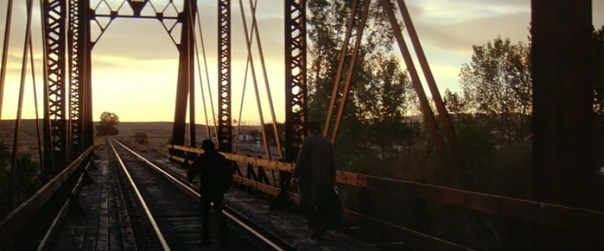
Scarecrow was definitely different. From the opening scene with two guys standing on opposite sides of a lonely country road, not speaking a word of dialogue, you can tell this movie has a rhythm all its own. For the most part, Scarecrow just follows these two rootless men, Max and Lion, as they hitch across the country. In place of a plot, you just have people, and the film takes it’s own sweet time, letting you get to know each of the people these two guys encounter.
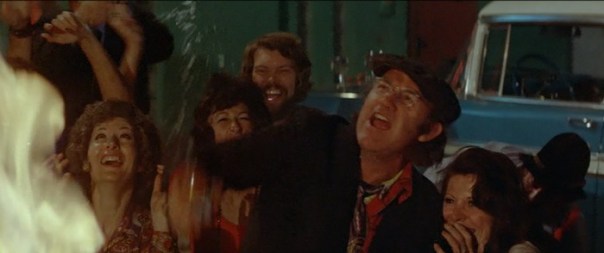
Cutting loose at the local bar.
Max has just gotten out of jail, and plans to open a car wash with the money he saved while he was doing time. Lion has been away at sea, but now he’s decided he has to go back home and try to connect with the child he fathered but hasn’t seen. At first, the two don’t have much in common, aside from the fact that they’re heading in the same general direction. But over time they become fast friends, and we realize that one thing they do have in common is that they’re both terribly naive. They may be grown men, but in many ways they’re as innocent as children. Neither one really understands the world around them.
As Max, Gene Hackman shows what made him such a unique and compelling actor. He has an unselfconscious openness, a fuzzy looseness that makes him seem completely accessible, but he also has a presence that holds your attention and an energy that’s a little scary. You’re always a little afraid of what he might do. Al Pacino plays Lion, and he still has the freshness of a young actor who’s willing to take chances. Lion is kind of shy, unsure of himself and of the world around him, and his reactions often seem as spontaneous as a child’s.
But the whole cast is wonderful. Eileen Brennan just has a small part as an irascible barfly, and still makes an impression in the short time she’s on screen. Dorothy Tristan radiates an easy warmth as an old friend that Max decides to drop in on. She never says a word when he starts flirting with her partner Frenchy, but you can see the twinge of jealousy in her eyes. Ann Wedgeworth plays Frenchy with an unabashed openness that’s totally winning. She immediately falls for Max, and she can’t stop flashing her huge smile, just waiting for him to make a move.

Dorothy Tristan and Al Pacino
It’s not just that the actors are in fine form. Director Jerry Schatzberg knows how to use them. Again, this movie is primarily about people, and Schatzberg shapes each scene to bring us closer to the characters. Screenwriter Garry Michael White gives him a lot to work with. You have to wonder if White didn’t spend some time hitchhiking himself. He seems to know these people and their world well. The cinematography, by Vilmos Zsigmond, slowly unfolds a panorama of the American landscape. This movie was shot in the bars and coffee shops, cheap hotels and bus stations that line this country’s rural highways. Zsigmond shows us the worn and wasted beauty in all of it without ever making us aware there’s someone behind the camera. Editor Evan Lottman is completely in tune with the movie’s vibe, throwing away the rule book and letting the people and the places determine the pace.
Max keeps talking about his car wash. Lion keeps thinking about the day he’ll get to see his child. What makes their story sad is that both of them are going nowhere. What makes it beautiful is that at least they’re going there together.
Bright Star (2009)

Abbie Cornish and Ben Whishaw
Jane Campion has had her ups and downs. First getting attention as an independent filmmaker in Australia, she broke into Hollywood with an offbeat fairy tale, The Piano. Her much anticipated follow-up, Portrait of a Lady, tanked at the box office and didn’t appeal to critics. Nobody knew what to do with the lovely and disturbing Holy Smoke, and In the Cut, a modern day noir, was a little too twisted for mainstream audiences.
With Bright Star, Campion went back to making small films for small audiences. But maybe intimate is a better word than small. This quiet, introspective movie may have been shot on a limited budget, but it has more weight than almost anything made for mainstream audiences. If Campion has turned away from Hollywood, it’s only so she could embrace the bristling honesty that’s at the core of her work.
Bright Star tells the story of the romance between Fanny Brawne and John Keats. Brawne was an independent-minded young woman in love with the art of making clothes. Keats was a willful, brilliant young man obsessed with the art of making poetry. Their relationship was a slow, deliberate dance that started with them circling each other cautiously and ended with them embracing each other rapturously. It’s easy to see why the material appealed to Campion. She’s always been fascinated by relationships. And in speaking about Bright Star, she’s said that she was interested in telling a story about people who talked.
Words are crucial to this movie. The words spoken by these people are full of meaning. The characters write letters, read aloud, quote from memory. These people take words seriously, sometimes too seriously. An offhand opinion can start an argument. A light remark may cut someone deeply. In part this is because these lovers, at times so supremely confident, are also terribly insecure. If they burn others with their scorn, it’s probably because they feel they’re burning inside themselves.
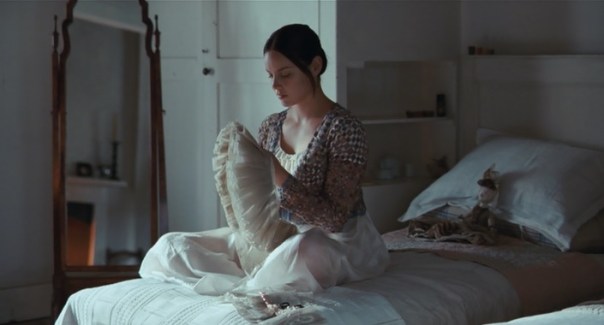
A young woman completely absorbed in her work.
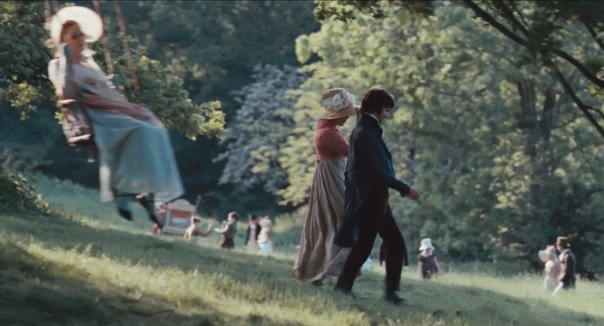
Bright Star is a period piece, but Campion doesn’t just take us back to another time, she immerses us in it. This film is so sensually rich you can feel the crisp fabrics and smell the freshly cut flowers. Image and sound are carefully woven together, allowing us to experience the pace and feel of this vanished world. We see the way light falls across a finished hardwood floor or filters down through a grove of trees in spring, courtesy of cinematographer Greig Fraser. We hear the faint rustle of stiff skirts bustling down a dark hallway and the hushed chatter of birds drifting on the ether of a lazy afternoon. I wish I had a better idea of who to congratulate for the ravishing sound design, but in this area the credits are complex and not always easy to decipher. I hope that I’m not too far off in singling out sound effects designer Craig Butters, production sound mixer John Midgley, and sound effects editor Sean O’Reilly. My apologies to those others whose names I haven’t mentioned.
Campion credits Janet Patterson, who designed the costumes, for bringing an organic approach to her work, finding clothes that fit the actors rather than dressing them in fashions drawn on a page. Fanny’s dresses, hats, and shoes all show the meticulous care she takes in everything she wears. John’s clothes, on the other hand, show how little he thinks about his wardrobe. His mind is on other things. Patterson also served as production designer, and she shows the same care in creating the settings. The rooms these people occupy feel lived in, the poets lounging in their dusky library surrounded by stacks of books, the Brawnes busying themselves about the house in their tidy, joyful domesticity.
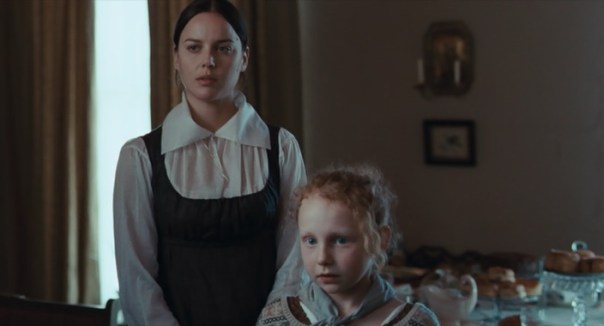
Abbie Cornish and Edie Martin
Campion’s technique is more simple and direct here than in her previous films, but her insights are a complex as ever. She seems to have relaxed into a kind of serene classicism. In Bright Star she chooses set-ups that are more or less straightforward, finding compositions that catch what’s happening between the characters without driving it home. This puts the focus on the actors, and the leads deliver wonderfully nuanced performances. Abbie Cornish uses the slightest changes in her expression to register sudden, sometimes violent, changes in Fanny’s mood. As played by Ben Whishaw, John may seem distracted, disengaged, but it slowly becomes apparent that he’s keenly aware of the world around him and painfully sensitive to it. Paul Schneider is excellent as John’s zealously devoted and very jealous friend. Thomas Brodie-Sangster doesn’t have much dialogue, but he plays Fanny’s brother Samuel with an easy grace. And I have to say that Edie Martin has a kind of magical charm as Toots.
It’s not easy for directors like Campion to get films made. A project like this is clearly not going to make it with mainstream audiences, which means running down the money often takes longer than making the movie. I hope she’s done with Hollywood, because I’ve seen so many filmmakers get beaten up trying to play that game. But going the independent route isn’t easy either. It usually means more control, but it also means working like a dog to get funding, and a lot less attention when your work finally gets shown. It’s a tough gig. We should do everything we can to support her, and all those like her.
The Departed (2006)

Leonardo DiCaprio and Jack Nicholson
When the history of America is told, it’s often portrayed as a series of movements, driven by the people, pushing this country slowly toward an ideal of justice and equality for all. I’d like to believe it was true. But really, that version doesn’t begin to tell the whole story.
At the beginning of The Departed, we see images of the violence that erupted in Boston in the seventies when the courts ordered desegregation of the city’s schools. As scenes of chaotic street clashes flash past, we hear a voice telling us how the Irish and the Italians fought to get their piece of America. The narrator’s advice to the Black community is simple.
“No one gives it to you. You have to take it.”
We may not like to think of America this way, but much of the country’s history was written by various warring factions taking power any way they could. This is how the great factories of the industrial era grew. This is how the unions got the factory owners to make concessions. It’s how the country expanded its territory from coast to coast. It’s how our cities were built. It’s nice to think that the US became a world power because of our belief in principles like freedom and democracy, but usually those principles take a back seat to ruthless self-interest.
Director Martin Scorsese has explored this territory before. While morality is crucial to his vision, he knows that high principles often get trampled underfoot in the day to day rat race. He’s fascinated by characters who struggle to survive in a corrupt world, and he doesn’t offer those characters easy choices. The issues aren’t laid out in black and white. It’s not that simple. While The Departed could be described as a story about cops and robbers, the relationship between the two is so complex and incestuous that it makes it difficult to tell the good guys from the bad guys. They’re all rolling around in the mud together.
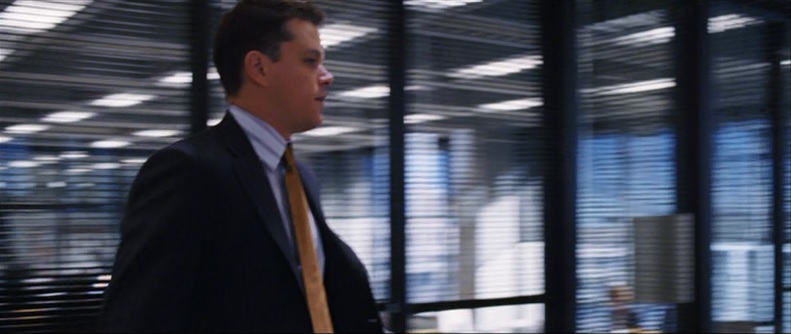
Matt Damon
It’s been widely reported that The Departed was inspired by a thriller from Hong Kong called Infernal Affairs, but there’s another source that’s also important. Much of the story is based on the real life career of crime boss Whitey Bulger, who ran most of the illegal activity in Boston for years. Being from Boston himself, screenwriter William Monohan was the perfect choice to take the earlier film’s outline and work it into this new context. And this isn’t just a matter of being familiar with the city. Monahan knows the people, he knows the culture, he knows the life.
Like any city, Boston is made up of various overlapping groups. The Irish have a long history there. And as with any ethnic group, the Irish are divided into different sub-groups. You’ve got the working class guys who live on the south side and cling ferociously to their customs and their culture. Then you’ve got the upper class guys who want to climb into the cozy world of high-end condos and pricey restaurants. And then you’ve got the guys who are stuck in between.

Determined to serve.
That’s the crux of the conflict in The Departed. It starts with two young men brought up on the south side, both of them desperate to get out. Their escape route takes them to the state police academy, where they both graduate with high marks, but the paths they follow put them on opposite sides of the law. Colin is a mole working for crime boss Frank Costello. Bill is a straight arrow cop assigned to infiltrate Costello’s gang. This symmetrical pairing, the crook playing cop and the cop playing crook, could’ve ended up being a simplistic gimmick. But Monahan reaches deep into these characters, pulling away layer after layer, showing us what makes these two “southies” tick.
Colin is picked up by crime boss Frank Costello as a kid and groomed for the role he’s going to play. Frank is no simpleminded thug. He knows that to stay ahead of the law he needs to have inside information, so he sends Colin to school knowing that he’ll rise quickly in the state police. And Colin has no qualms about playing the role, using his intelligence and his education to build the kind of life he’s always wanted. He dresses well, dines at fine restaurants, and buys a condo that has a view of the Massachusetts State House. Colin gazes out the window at the gold dome that caps the dignified, classical structure. It symbolizes everything he wants, and he’s certain that he can have it all, if he just plays his cards right.
Bill, on the other hand, is an honest man who spends his days with thieves and murderers. He’s chosen for the job, in part, because he learned early on how to adapt to different environments. His parents’ separation meant that even as a kid he led a double life, playing the good student and dutiful son when he was with his mother, then playing the roughneck southie when he hung out with his dad. Bill joined the state police hoping to put all that behind him. He has no family and he wants to start a new life. Unfortunately, his background makes him the perfect choice to infiltrate Costello’s gang.
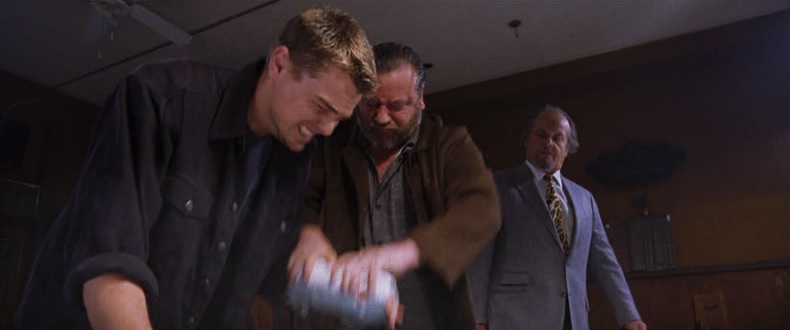
Leonardo DiCaprio, Ray Winstone and Jack Nicholson
Thrust into this role, the lawman/thug, means the conflict that’s always troubled him is now at the center of his life. Bill thinks he can handle it, he wants to do the job, but really he’s falling apart. Being from Boston, being Irish, being a man, he tries to play it tough, insisting he has nerves of steel. When he’s by himself, though, he’s popping pills to numb the pain. He has no family. No friends. Even his identity is a question mark. Only his two superiors know who he really is. When one of them dies and the other disappears, Bill is completely isolated.

Unsure about his identity.
Questions about identity are at the heart of The Departed. The two main characters are both living a lie. Bill does it from a sense of duty, but Colin does it to get what he wants. He has carefully constructed the persona he presents to the world. Smart and ambitious, he knows that he can rise through the ranks if he maintains the proper image. His boss tells him marriage is one of the keys to success, and Colin, already understanding that, zeros in on a psychologist who works with law enforcement. Does he care for her? Maybe. Will she be useful? Absolutely.
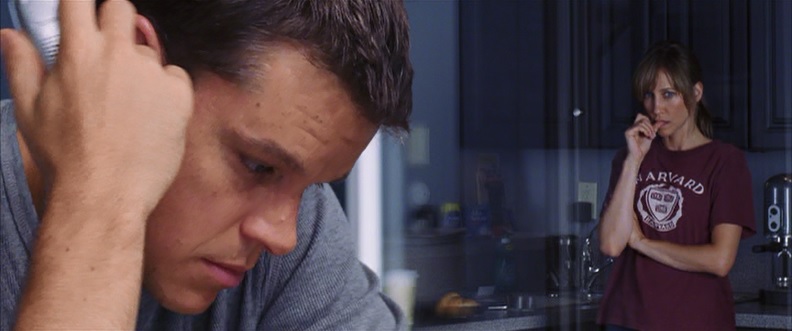
Matt Damon and Vera Farmiga
Scorsese has made gangster movies before, but The Departed is very different from Mean Streets or Goodfellas. In those earlier films he used vivid color and kinetic camerawork to pull us into the mobsters’ world. The Departed is much more subdued. Obviously, the look and feel of Boston sets the tone to a degree, but production designer Kristi Zea and art director Terri Carriker-Thayer use the city to create a world of muted colors and subtle hues. The dark wood and weathered brick of the south side is contrasted with the clean, conservative blues and greys that define the offices of the state police. This is carried further by costume designer Sandy Powell. Colin’s crisp suits show that he’s dressing for success, while Bill’s denim jackets and work boots make him fit right in on the south side. In addition, we see all the characters wearing a variety of baseball caps and sweatshirts to let us know whose side they’re taking. Cinematographer Michael Ballhaus, a veteran of several Scorsese films, seamlessly weaves all this into a coherent, unobtrusive visual fabric. Ballhaus’ cinematography is impressive in its simplicity and directness. He always finds the right tone without ever calling attention to his work.
The movie is called The Departed, and when death isn’t in the foreground it’s hovering in the background. Aside from the parade of corpses and caskets, the characters often talk about those who’ve passed away. Frank asks a man in a bar how his mother’s doing, and the man answers that she’s on her way out. “We all are,” Frank responds jovially. “Act accordingly.” In the final scenes, bodies pile up left and right. At times the killings happen so quickly it takes a minute to figure out what went down. This is one of Scorsese’s most cynical films. There are no winners. By the end of the movie, almost all of the principals are among the departed. In the final shot, the director gives us an image of a golden dome rising in the background as a rat scurries across a railing in the foreground. A symbol of human aspiration side by side with a symbol of human frailty. And in the end, it all adds up to the same thing.

Orson Welles at One Hundred

Welles in his short-lived BBC series, Around the World with Orson Welles.
Orson Welles was born one hundred years ago today. Generally I’m not into making a big deal about birthdays, but this seems like an important one. Sure, it’s important to me because Welles had a huge impact on my life, but if you do a search on the net you’ll find that there are many others out there who think the day is worth celebrating.
Mostly these days Welles is remembered for The War of the Worlds and Citizen Kane, two early efforts that made him famous, and in some circles infamous. In reality, he had a long and varied career, starting on the stage, moving to radio, then to film and later to television.
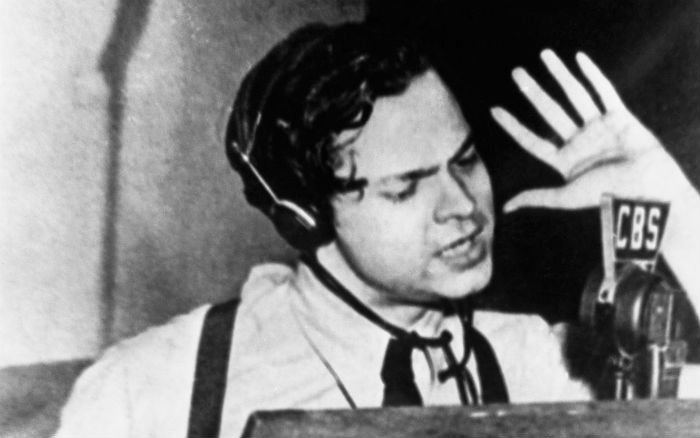
A shot of Welles during one of his radio broadcasts.
Much of his work in radio survives, but it’s ignored or forgotten. Hardly anybody talks about his brief but impressive career in television. And sadly, of the many productions he directed for the stage, all we have are photographs, reviews and anecdotes. We can only imagine what the Black Macbeth, the modern-dress Julius Caesar and Around the World in Eighty Days were like. There’s very little information about the version of King Lear that Welles staged in New York in the fifties. It only lasted for twenty one performances. And though we do have the text of Moby Dick, Rehearsed, the performance of the play is lost to us forever.
Still, even if we just look at Welles’ career in film, there’s a lot to celebrate. Citizen Kane got only a limited release at the time it was made, but it influenced a generation of filmmakers. Even in its mutilated form, The Magnificent Ambersons is a heartbreaking account of the disintegration of an American family. The Lady from Shanghai, also mangled by the studio, is still a dazzling exploration of desire and corruption.
Much of the recognition Welles received for these early films was inspired by his innovative use of sound and image. But art isn’t just about technical flash. Sure, the early stuff is thrilling. But it’s the later work where he starts digging deeper into himself, and that’s where it really gets interesting. You’ll see some virtuoso camerawork in Touch of Evil, but the heart of the story is the relationship between Quinlan and Menzies. Chimes at Midnight is one of Welles’ most straightforward films in terms of technique, but in telling the story of Falstaff and Hal he seems to be revealing more of himself than ever before. And while many view Fake? as an entertaining trifle, the film offers some profound insights on the nature of art and authorship.
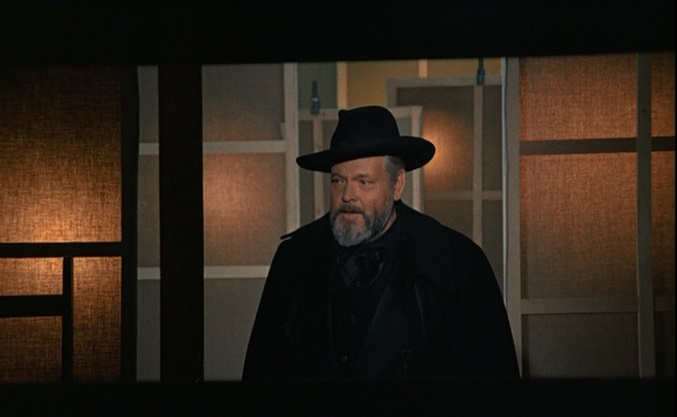
Welles as narrator, storyteller, ringmaster in Fake?
When I was younger, I used to see Welles’ career as a tragedy. Back then I tended to focus on the fact that the studios wouldn’t touch him, and it pained me to see him doing awful movies and silly commercials to finance his films. But as I’ve gotten older, my perspective has changed. Now I can’t believe what an incredible life he had. In his early twenties he was a star on the stage and on radio. At twenty five he finished his first feature. The thing that really impresses me, though, is the perseverance he showed later on in life. Things quickly went bad for him in Hollywood. Working in Europe in the fifties he was always scrambling to find money to make films. When he returned to LA in the sixties, the studios were even less interested than they had been twenty years before. But he kept working. And he kept making movies. And that’s why, in spite of his faults, in spite of his failures, he seems absolutely heroic to me.
Happy birthday, Orson.

Welles reading from Moby Dick.
If you live in the LA area, you have a couple options for celebrating Welles’ birthday over the next few days. Tonight and tomorrow the New Beverly is showcasing his work as an actor, screening Treasure Island and The Long, Hot Summer. On Thursday and Friday they’ll be showing Orson Welles and Me along with The Cat’s Meow. Not exactly sure why they’re showing The Cat’s Meow, since the connection to Welles’ career is pretty tenuous. But I recommend Orson Welles and Me very highly. In this moving coming of age story from Richard Linklater, a young man goes to work for the Mercury Theatre in its heyday. Christian McKay is fabulous as the young Orson Welles, a brilliant, arrogant, charming monster, alternately seducing and terrorizing his company.
At its Aero Theatre in Santa Monica, the American Cinematheque kicks off its Welles celebration on Thursday with The Lady from Shanghai, and wraps it up on Sunday with Touch of Evil. Every night is worth checking out, but on Saturday they’re screening a couple of films that don’t show up in theatres very often. Many of Welles’ admirers, including me, think Chimes at Midnight is his most personal and most powerful film. His reworking of the story of Prince Hal and Falstaff is both beautiful and heartbreaking. On the same bill is the director’s version of Othello from the fifties. It may not be up there with Welles’ best work, but it’s breathtakingly beautiful, both in terms of image and sound.
Links for both theatres are below. Have fun.
The Business of Strangers (2001)
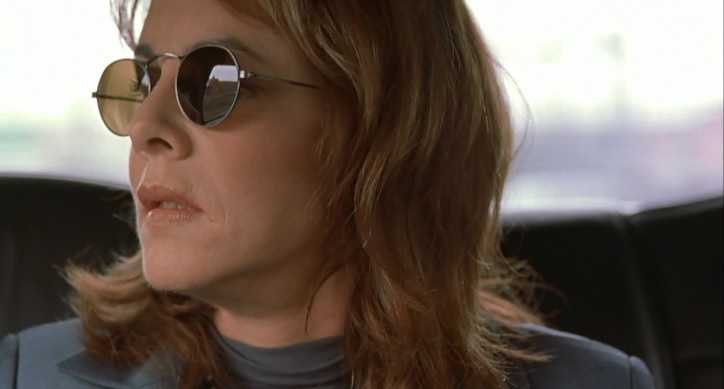
Stockard Channing
Two women, one young, one middle-aged, sit in a sauna, relaxing after a workout. The older one starts talking about the first time she had a hot flash, in a football stadium, surrounded by men, on a freezing cold day. And it wasn’t until she’d taken off most of her clothes that she figured out what was happening. She tells the younger woman, “It’s like suddenly realizing you’ve been made a different person, and no one’s ever asked you.”
The older woman is Julie. She’s worked in the corporate world for years, struggling to build a career. Early on we learn that she’s just been made CEO of the company she works for. But her reaction on hearing the news is decidedly muted. She seems to be at a loss. Where most people would start imagining their glowing future, Julie starts thinking about her past. She can’t help wondering what her life’s been about.
The Business of Strangers follows Julie as she thinks about the choices she’s made. And the younger woman, Paula, is there to make her think hard. They start off on the wrong foot when Paula, an employee, blows a big meeting. After learning that she’s become the CEO, Julie is feeling generous and tries to make peace, but it’s not easy. In many ways these two are complete opposites. The one way they’re alike is that they both want to be in control.

Julia Stiles
But their increasingly twisted relationship isn’t just about clashing egos, it’s not just a struggle for power. They need to be in control because they’ve spent so much of their lives being controlled by men. They both understand how hard it is for women to get power. They live in a man’s world, and they’ve had to fight to maintain their independence, Julie in boardrooms and Paula in bars. The younger woman is a footloose bohemian who both resents and respects the older woman’s discipline. Paula will complement Julie, at the same time as she’s looking for chinks in the armor.
Writer/director Patrick Stettner shows how much you can do with a limited budget and couple of actors. Not only has he created two fascinating characters, but the look and sound of the setting they’re placed in extends the emotional tone of the film. Most of the movie takes place in the arid landscape of a chain hotel. The bland, pastel décor and the eerily silent hallways are the perfect backdrop for Julie’s moody ruminations on her empty life. This world of sterile comfort only highlights the fact that she’s really homeless. Stettner’s subtle use of sound emphasizes the hollowness of the environment. We hear the dull buzz of conversation in the bar, the muffled padding of footsteps in a carpeted corridor. And he’s not afraid to use silence. As the film goes on, the passages with no dialogue are filled with more and more tension. Alex Lasarenko’s score is an important part of the sound design. The low-key percussive patterns he lays down in the background create a sense of quiet unease.

Paula and Julie, living in man’s world.
Then there are the performances. Julia Stiles shows how far she can go as an actress, playing Paula with shadings that you don’t even catch until the second or third viewing. While in some films Stiles’ face has seemed like a barrier, here it seems like a mask, and you’re never quite sure what’s going on underneath. You’re always a little afraid of what she might do next. Anybody who’s seen Stockard Channing before knows how far she can go as an actress, but she rarely gets roles this good. One of her greatest gifts is that she never seems to be acting. You never feel like there’s any distance between her and the character. She’s very direct, very straightforward, but she adds subtle layers of emotion. With the slightest change of expression or an offhand gesture she lets you see right into character.
At the end, nothing is resolved. Julie and Paula are back at the airport, sitting in the lounge, killing time before they go their separate ways. Paula will go off to find some new situation where she can explore the dark side of human nature. Julie will slide into the role of CEO, running meetings and reading sales reports. She may not be satisfied with her situation, but she’s accepted it. She’s realized that her work is who she is, and that all she can do is keep moving forward.

A different approach to dealing with men.
 Reality Is Scary