Category Archives: Uncategorized
Iré a Santiago [I’ll Go to Santiago] (1964)
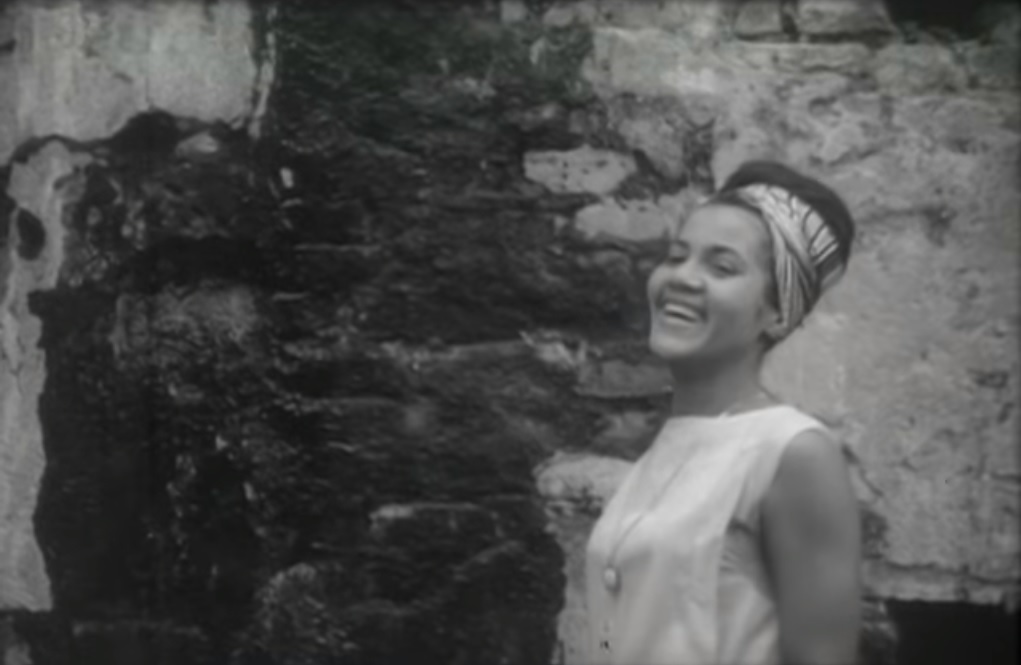
In 1959, rebel forces led by Fidel Castro overthrew Fulgencio Batista and the revolutionary government took control. The new government immediately began its efforts to transform Cuba, with the goal of rebuilding it as a Communist nation. One of the government’s key initiatives was the creation of the Instituto Cubano del Arte e Industria Cinematográficos (ICAIC). Film was seen as an important way to educate and animate the public as the country was entering a period of rapid change.
Just like the first decade of Soviet cinema, the first decade of Cuban cinema after the revolution was a time of exploration and innovation. A number of talented filmmakers came out of ICAIC, but unfortunately few of them are remembered today. One of the most gifted was Sara Gómez. Her body of work isn’t large. During the 60s and early 70s she made a number of short films. She died in 1974 before completing her only feature, De cierta manera. But the work Gómez left behind is well worth looking at.

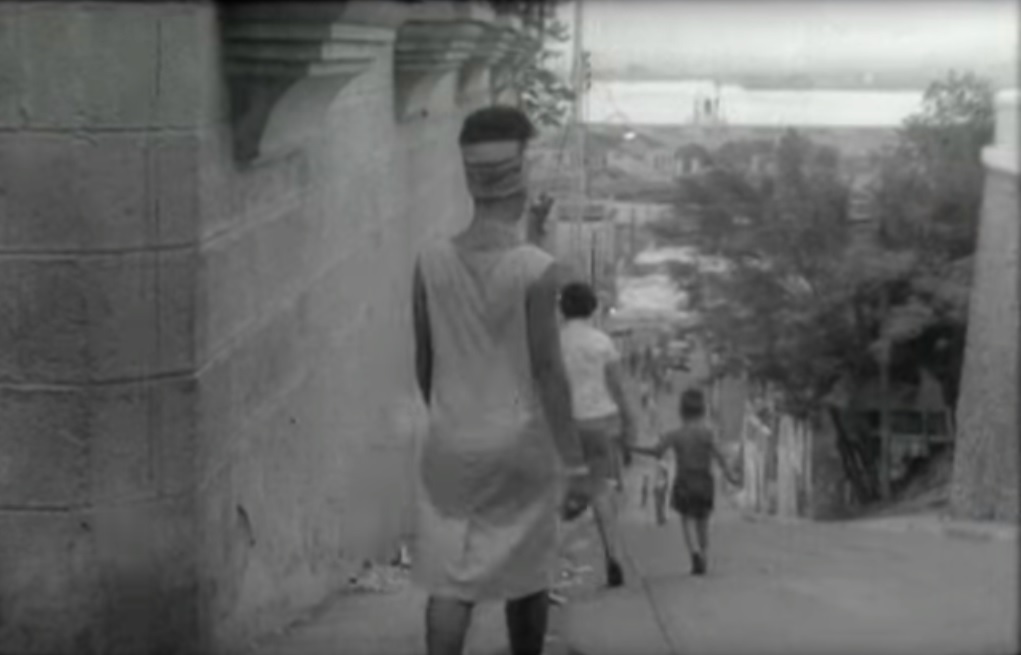
Iré a Santiago is a joyous short celebrating the people and the culture of the city named in the title. It’s loose, energetic and spontaneous, with the camera wandering through bustling neighborhoods, pausing in a street market, spying on people in a café. The photography and editing are rough, but the images Gómez captures are lively and dynamic. Unlike other documentary filmmakers, she doesn’t try to pretend that she’s standing outside of the world she’s shooting, observing it all objectively. Some people wave at the camera, others try to avoid it. One boy starts dancing when he realizes he’s being filmed. Gómez doesn’t cut these shots out. They show that the filmmakers are part of the life that’s swirling around them.
The film doesn’t have a tight structure. Gómez is interested in wandering around to see what she can find. After spending some time watching people in the streets, she moves on to the bay, and the narrator gives us some brief notes on its history, from the arrival of the Spanish to the beginning of the revolution. Then we get a quick rundown on places of interest, and end up in the middle of the carnival.

Aside from the cinematography, the other thing that energizes the movie is the music on the soundtrack. It’s an eclectic mix of sweet melodies and dense percussion. And the people move to the music. In the carnival scene at the end, we see a row of men playing congas, a horn section blowing brassy punctuation, and dancers swaying to the driving rhythms. This isn’t just a documentary, it’s a celebration.
…..
The web site ReMezcla offers a short piece on Sara Gómez. In addition to a brief bio, it has links to some of the director’s films, including Iré a Santiago. You should know that the print doesn’t have subtitles, but please don’t let stop you. If you look at the images and listen to the sounds, you’ll be getting most of what the filmmaker is trying to say.
Among the films offered is Gómez’ only feature, De cierta manera. It’s an original and complex movie, and a marvelous piece of filmmaking, but I hesitate to tell you to click the link because the print is terrible. Really what we need is to have somebody track down whatever elements still exist and do a real restoration. This is the only feature we have from one of Cuba’s most gifted filmmakers. It deserves to be seen the way Gómez envisioned it.
Jean-Luc Godard
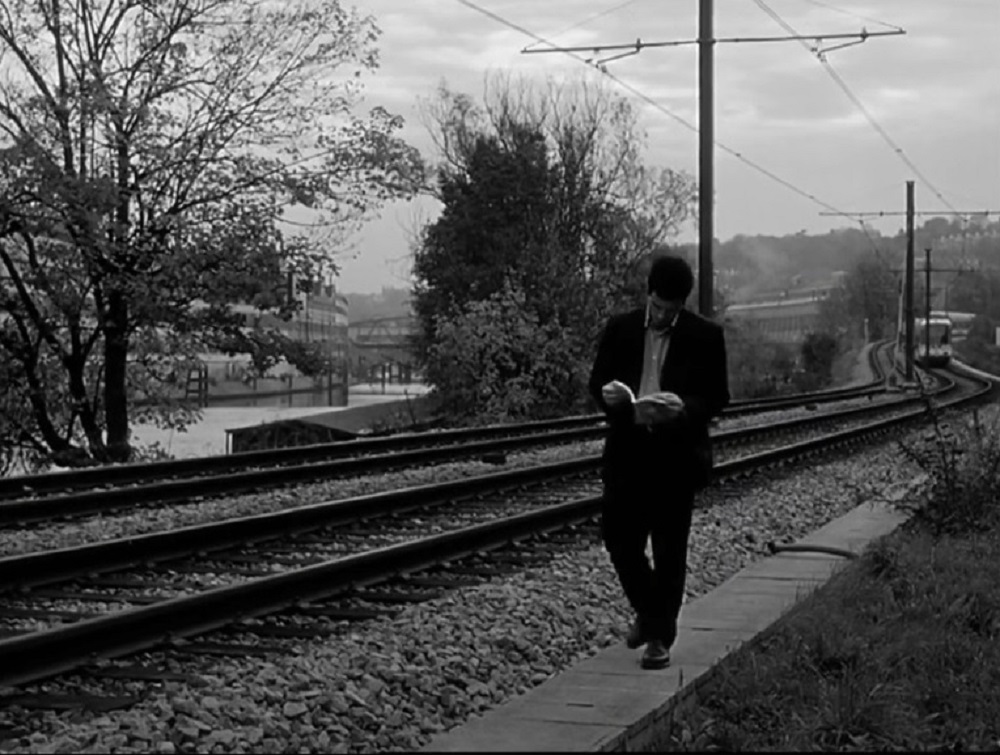
Jean-Luc Godard died on September 13, 2022. At the time, I felt I needed to write something about him, but it took a lot longer than I expected. I went back and watched some films I’d seen before, and took the time to watch others I’d never seen. I would never pretend to understand Godard, but I feel a deep connection to him and his work. Having spent over a year watching his movies and reading about his life, I feel closer to him than ever.
I’m not sure what I want to say about Jean-Luc Godard, except that I’ll miss him terribly. There are other people who are better qualified to talk about his work, and I doubt Godard would want anyone to bother with a eulogy. It’s hard to explain why I feel so sad at his passing. He lived to be more than ninety years old, and made scores of films during his lifetime. I should be glad that he had such a long, productive career, and I am, but I’ll still miss him.
I didn’t like his work to start with. I probably saw À bout de souffle for the first time when I was around twenty, and it left me cold. Une femme mariée bored the hell out me. I didn’t know what to make of Pierrot le fou. It took a few years for me to find my way into his films. I remember I loved Une femme est une femme. Masculin féminin was really compelling. And I was knocked out the first time I saw Le mépris on a big screen. This last film is definitely an outlier, an attempt by Godard to make a commercial movie with known stars, and it is, in part, a self-conscious (and at times very funny) rumination on the tension between art and commerce. But it’s also breathtakingly beautiful, with stunning cinematography by Raoul Coutard and a melancholy score by Georges Delerue.

You could say Le mépris was an early expression of the tensions that Godard would be dealing with for the rest of his life. He loved Hollywood films, but he was also deeply suspicious, often contemptuous, of commercial cinema. Le mépris follows the individuals involved in making a movie out of the Odyssey, a mythic tale, but the producer is putting the screws on the director (Fritz Lang, playing himself) to make sure it sells lots of tickets. An ancient legend becomes another commodity that must compete for attention on the open market. And of course, as in so many Godard films, there’s the main character’s struggle to maintain his relationship with the woman (he says) he loves. The movie is a critique of storytelling, a critique of commercial cinema, and a critique of relationships.
Godard is always questioning everything. In his films, a good part of the dialogue usually involves questions and answers, or questions and evasions, or questions followed by uncomfortable silence. His films question the audience. His films question themselves. He may have been the most self-conscious of filmmakers. Prenom Carmen is a riff on Prosper Mérimée’s tale of obsessive love, adapted by Anne-Marie Miéville. In this version, Carmen claims to be making a movie, and seeks help from her uncle, a filmmaker played by Godard. When she comes to visit him in the hospital, she asks, “Don’t you want to know why I came?”, to which Godard responds, “Sure. That would make for good dialogue.”

Unlike a commercial film, Prenom Carmen makes no effort to convince the audience that what they’re seeing is “real”. The bank robbery where the lovers first meet is as absurd and over-the-top as a Monty Python sketch. While gunshots are still ringing out, a cleaning lady appears with a mop and a bucket and starts wiping up the blood. At the end of the film, Carmen’s gang attempts a kidnapping, using a movie crew to make it look as though the whole thing is being staged for the camera. The director makes it clear that the story is complete fiction. What is real in a film by Godard? The ideas are real. The emotions are real.
Some people may ask what kind of “emotions” I’m talking about in Godard’s work. He generally tends to observe his characters with a cool detachment, a dispassionate gaze. But actually, Godard is one of the most passionate artists ever to work in films. The most obvious expression of this is his obsessive exploration of relationships, generally focussing on desperate, confused men who are trying to connect with women who are mostly inaccessible. In À bout de souffle, Masculin féminin and Prénom Carmen we see lovesick men obsessively pursuing women who remain largely out or reach. Hélas pour moi tells the story of a god who assumes human form to make love to a woman he desires.
Godard was passionate about music, and music plays an important role in his films. Composers Georges Delerue and Antoine Duhamel wrote achingly beautiful scores for the director, giving expression to the feelings that his characters struggled to express. Godard also used existing music, often drawing on baroque and romantic composers like Bach, Beethoven and Dvorák, and he sometimes turned to works by 20th century composers like Dmitri Shostakovich and Giya Kancheli. (He was also fond of truncating his soundtrack, abruptly cutting the music off in mid-cadence. Remember, you’re not here to listen to music. Don’t ever forget you’re watching a movie.)
Godard was passionate about movies. He dedicated his first feature to Monogram Pictures, the low-budget studio that churned out cheap gangster flicks in the 30s and 40s. Une femme est une femme is a giddy to salute to, and riotous riff on, Hollywood musicals. His 8-part series Histoire(s) du cinema is an essay on film and its interaction with society. I think in many ways you could see Godard’s career as an obsessive exploration of the possibilities in film. He believed it had the potential to change the world, but he always seemed to feel that his own efforts failed to live up to that potential.
But I think more than anything else, Godard was passionate about ideas. He was a voracious reader, burning through fiction and non-fiction. He was fascinated by history, philosophy, sociology. His films are full of ideas, but even as he states his ideas he can’t help questioning them, and in some cases he then asks if he’s asking the right questions. Godard spent his life searching for truth, but he couldn’t accept anything as true until he’d looked at it from every angle. He seemed deathly afraid of becoming complacent on any level.
There’s no better example of this than the work he produced in his collaborative/collective period of the late 60s and early 70s. By the late 60s, Godard was feeling increasingly dissatisfied with his own efforts to create a truly revolutionary cinema, and decided that it was necessary to relinquish his control as an individual director/author. The view of the director as the author of a film was in conflict with Godard’s embrace of Communism. He first tried making movies in collaboration with individual filmmakers, and then became a part of the Dziga Vertov Group, a collective dedicated to bringing about a new political consciousness through a new political cinema.
Godard appears to have thought he was suppressing his own identity in order to participate as a co-worker in the collective, but honestly, I don’t buy it. To my mind, films like British Sounds/See You At Mao, Le Vent d’est and Tout va bien, all seem to flow directly from Godard’s work of the mid to late 60s. The static compositions, text inserts, and extended tracking shots that are so much a part of these movies can all be found in films like Weekend, La Chinoise and One + One. One of the few things that does separate the work he did with the Dziga Vertov Group from his earlier work, unfortunately, is that there’s nothing to laugh at in these overtly political films. They’re grindingly serious. You can find a number of wickedly funny moments in his 60s features, but as Godard came to be increasingly contemptuous of anything that might be perceived as “entertainment”, he seems to have felt it was necessary to drain these films of spontaneity, beauty and humor.
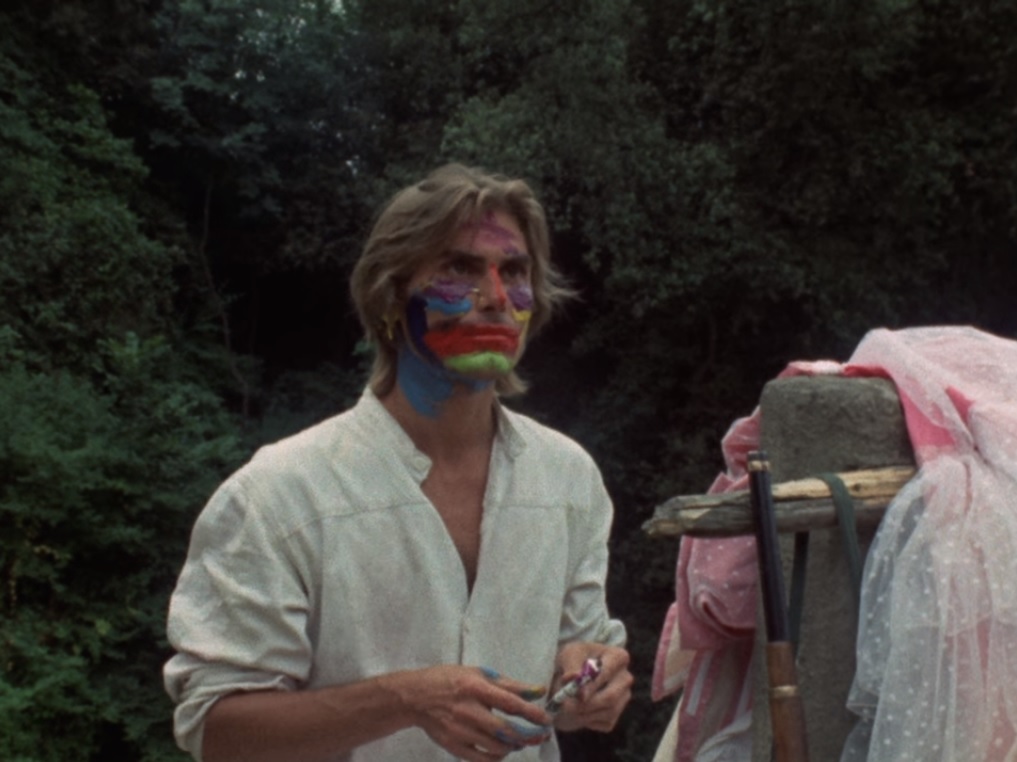
Not to say that there’s nothing interesting about these movies. In some ways I think they are truly revolutionary. Godard was trying to cut away everything that was false in movies, to get rid of phony narratives, seductive images and cheap manipulation. Instead of trying to recreate or represent reality, in these films Godard tries to put us in direct contact with the images and sounds that we encounter in the world around us. He was horrified by the “bourgeois” cinema produced by the film industry, and I think even more horrified by the possibility that he had become a participant in that industry. Unfortunately, I feel his work with the Dziga Vertov Group is often terribly dull and oppressive. The lack of visual dynamics, the absence of rhythm and the droning voiceovers would probably make them tough going for all but the most devoted admirers of Godard’s work. I respect his intentions, but I can’t follow him down this road.
Not surprisingly, Godard himself apparently became dissatisfied with this approach. As the 70s came to a close, Godard left off making overtly political films and started a new phase. Released in 1980, Sauve Qui Peut (la vie) tells the story of a filmmaker named Paul Godard who finds himself alone and afraid as his marriage falls apart. It’s a bitter, melancholy film, and it’s hard not to see it as at least partly autobiographical. But creating this new movie seemed to energize Godard, and he worked hard to promote it. He even referred to it as his “second first film”, and it seems to have been the beginning of another phase of his career.
In a way, you could say Godard had returned to the spirit of restless exploration that made his early work so exciting. He made feature and shorts, worked in film and TV, switched back and forth between fiction and non-fiction, sometimes mingling the two. He began exploring stories, sometimes recent ones, sometimes ancient ones. I want to emphasize that I’m using the word “exploring”, not “telling”, because the last thing Godard was interested in was unfolding a straightforward narrative. He wanted to take these stories apart and see what was inside them. He wanted to ponder the human needs, desires, frailties that gave rise to these stories in the first place. He wanted to see how they might relate to the world we live in. Anyone who watched Godard’s King Lear expecting an adaptation of Shakespeare’s play would be completely disappointed. Instead of adapting the play, Godard uses it as a starting point for a complex meditation on stories and the role they play in the modern world. He makes this clear in the opening sequence, where he juxtaposes “King Lear” with the words “A Study”, “An Approach”, and “A Clearing”. We follow William Shakespeare Junior the Fifth, a contemporary descendant of the playwright, as he tries to rediscover/reinvent stories in the world after the nuclear disaster at Chernobyl. The film does incorporate some quotes from Shakespeare, but it also draws on other sources, including Robert Bresson, Jean Genet, Viviane Forrester and Virginia Woolf. If you can let go of the original play, it’s a beautiful, allusive contemplation of primal mysteries. The images sketch a lovely, irrational poetry. The soundtrack is densely layered with voices, snatches of music, clattering plates and the cries of seagulls.
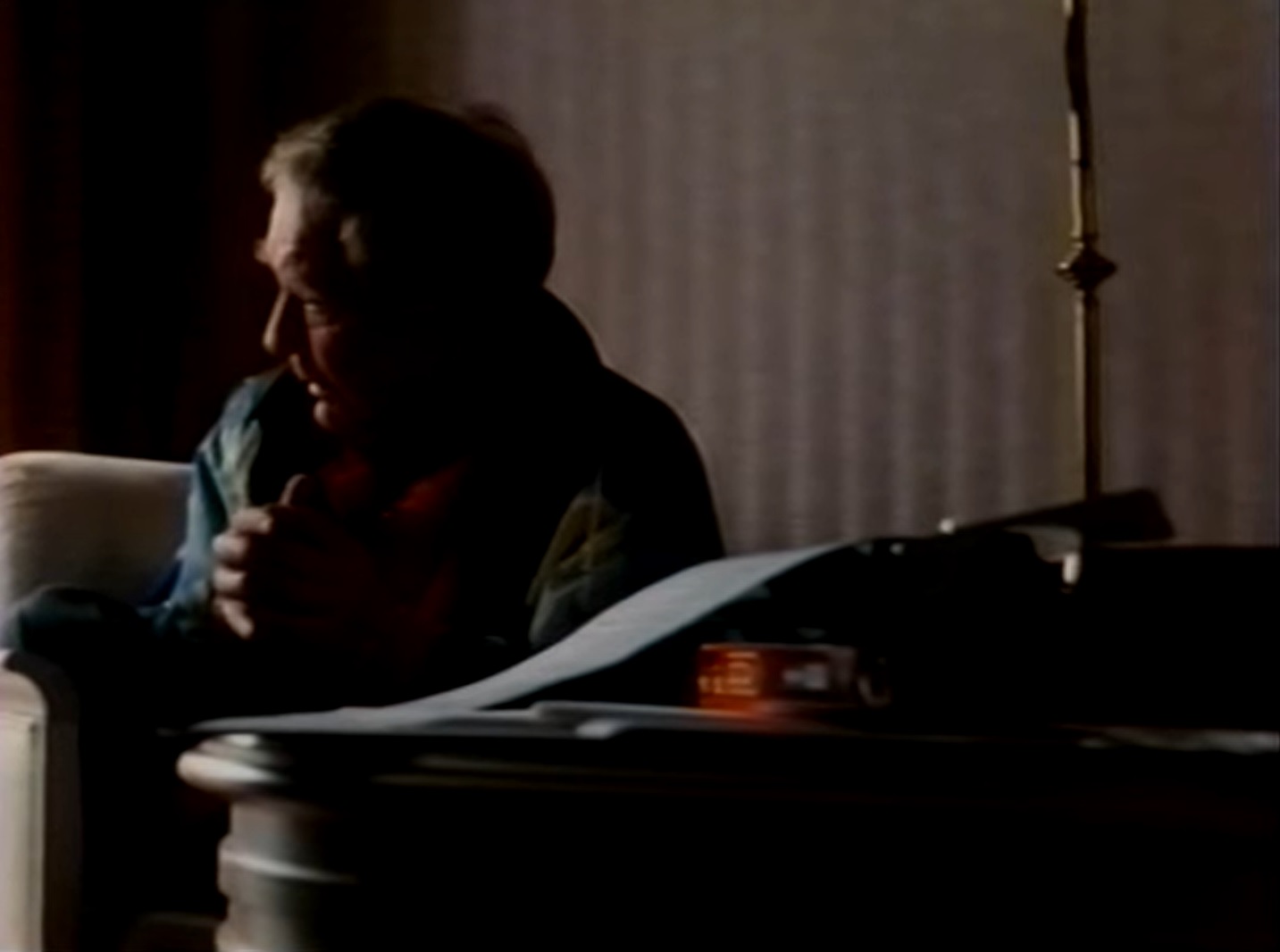
Godard’s King Lear also returns to, and expands on, the issues he explored over 20 years earlier in Le mépris. As it begins, we hear an audio recording where the film’s producer, Menahem Golan of the Cannon Group, is complaining to Godard about how long the production is taking. There apparently were a number of disruptions. Initially Norman Mailer was going to play the character based on King Lear, and he had written a script for the film. But Godard and Mailer had a falling out early on, and the author walked out on the project. Nevertheless, Godard includes a brief scene featuring Mailer, and a voice-over delivers a mocking commentary on the difficulties of dealing with “the great writer”. Apparently the screenplay was re-written by Tom Luddy and theatre director Peter Sellars, who also plays William Shakespeare Junior the Fifth. So we have a director playing the descendent of a playwright, whose mission is to rediscover stories in the modern world. In a voice-over Junior the Fifth explains that he’s working for the Cannon Cultural Division, a reference to the film’s producers. Just like Le mépris, Godard’s King Lear examines the tension between art and commerce, the problems in interpreting a text, and the relationship between a timeless story and the modern world. But in the later film, Godard piles on layer after layer of commentary, criticism and caustic wit. At this point in his career, the director seems to have given up on finding any answers, but he can’t help ruminating on the same issues that have fascinated him since the beginning of his career.
I think it’s safe to say that Godard’s later films are challenging for most viewers. They’re certainly challenging for me. Fragmented and elliptical, poetic and polemical, the later movies plunge you into situations with no explanation and overwhelm you with readings, recitations and rants. I saw Éloge de l’amour when it first came out, and while it struck me as very beautiful, I really had no idea what it was about. But watching it again recently, I found it was much easier for me to grasp the threads that Godard was weaving together. The film is a relentless exploration of the complexities of relationships, somehow merciless and tender at the same time. I was deeply moved.

Godard’s later films didn’t get widely distributed in the US, and I assume that’s at least in part because they could be so difficult for audiences. Take a look at the comments on IMDB for Godard’s later films and you’ll see that the viewers are mostly at opposite ends of the spectrum. You have the devoted fans who think his films are rich and compelling, and you have the other viewers who think the director is a pompous fraud who has nothing to say.
It’s hard to talk about “the audience” for films, because it’s not really a homogenous group of people all looking for the same thing. There are a million different audiences out there, and their tastes are constantly changing. But the films that have the greatest commercial success often seem to have two things in common: First, they’re fundamentally reassuring in some way; Second, they try to provoke a strong emotional response. Both of these things were anathema to Godard. I think he desperately wanted to connect with audiences, but he wasn’t going to tell them comforting stories and he wasn’t going to manipulate them. By refusing to play that game, he rejected the things that draw most people to movies, and made himself an eternal outsider.
We shouldn’t praise him or criticize him for this. It’s just who he was. I just said that he refused to play the game, but really, I don’t think he was capable of playing it. If you look at the writing he did before he even started making films, when he was contributing to Cahiers du Cinéma, it was clear even then that he was a stone iconoclast. As much as he loved films, he thought most of the people making them were clueless fools. I think it’s safe to say he felt that way to the very end. And as critical as he was of others, he could also be harshly critical of his own work. He didn’t cut himself any slack.
In the course of writing this, I watched a number of Godard’s movies, some that I knew well and others that I’d never seen. More than ever before, I was struck by the richness of his films and the range of ideas they explore. At times they seemed impossibly confusing and oblique. At other times they seemed incredibly beautiful and resonant. But they always impressed me as the work of an artist who was passionately in love with the medium. I think they’re also the work of a man who was obsessed with exploring the world he lived in, and who desperately needed to share what he’d found in the course of his explorations.
Like I said at the beginning, I’m glad he had a long life and that he made so many movies. But I’ll still miss him.

Bao gio cho den tháng Muoi [When the Tenth Month Comes] (1984)
When I watched Spike Lee’s Da 5 Bloods earlier this year, I was impressed. I thought it was the strongest film he’d made in a while. The script was interesting, the acting was excellent, and I felt he did a good job of using a genre movie to explore the complexity of the black experience during the Vietnam era.
Then a friend of mine, who’d also seen Da 5 Bloods, sent me an essay on the film by Viet Thanh Nguyen that appeared in the New York Times. Reading Nguyen’s piece was an eye-opener, and it made me realize how easily seduced I was by Hollywood genre tropes. He rips apart the myths that American war movies are based on, and talks about the anger he feels as a Vietnamese person watching the US mainstream media perpetuate destructive stereotypes.
Nguyen talks about the importance of Vietnamese people telling their own stories. That started me wondering. In a lifetime spent watching movies, I’d only seen one film from Vietnam. Did the country have its own cinema? If so, had it been around for any length of time? Does the country have an active film industry today?
The answer to all three questions is absolutely yes. It didn’t take me long to find out that the Vietnamese have been making films for around a hundred years, and they have a rich film culture which is still very much alive. Unfortunately, access to movies made in Vietnam is limited. Recent commercial releases are more or less easy to obtain, but many of the older films made by notable directors weren’t available to be streamed or purchased on DVD. This isn’t too surprising. Let’s face it. The US and Europe dominate film distribution in the Western hemisphere. It can be difficult, if not impossible to view films made elsewhere. (Japan being a notable exception.)
I went looking for a film about the war made by a Vietnamese filmmaker, and the title that kept coming up was When the Tenth Month Comes, directed by Dang Nhat Minh. The good news is, it’s available on YouTube. The bad news is, the quality of the digital transfer isn’t great, and the frequent commercial interruptions are maddening. Still, the movie is definitely worth watching.
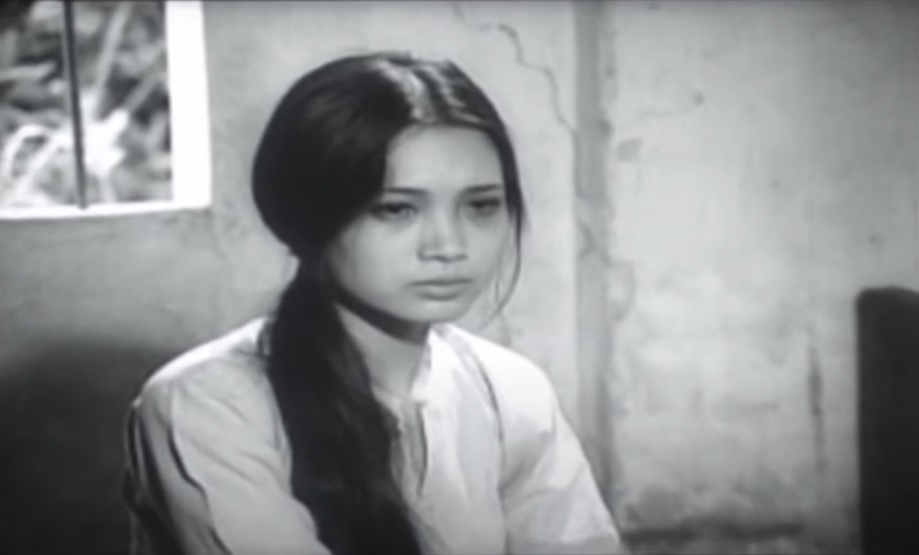
When the Tenth Month Comes isn’t actually a war movie in the usual sense. It’s not about the soldiers on the front lines. Instead, it’s a meditation on the impact the war has on a single family. Duyên is a young woman whose husband has gone off to fight. Early on she learns that he’s been killed, but she decides not to tell anyone in her village, including her family. While she’s clearly afraid of how the news will affect her father-in-law and young son, it also seems that she’s in a state of denial. It’s as though by keeping her husband’s death a secret she hopes to bury the grief that’s welling up inside of her. In order to maintain the lie, she enlists the help of a teacher, Khang, who agrees to forge letters from her dead husband.*
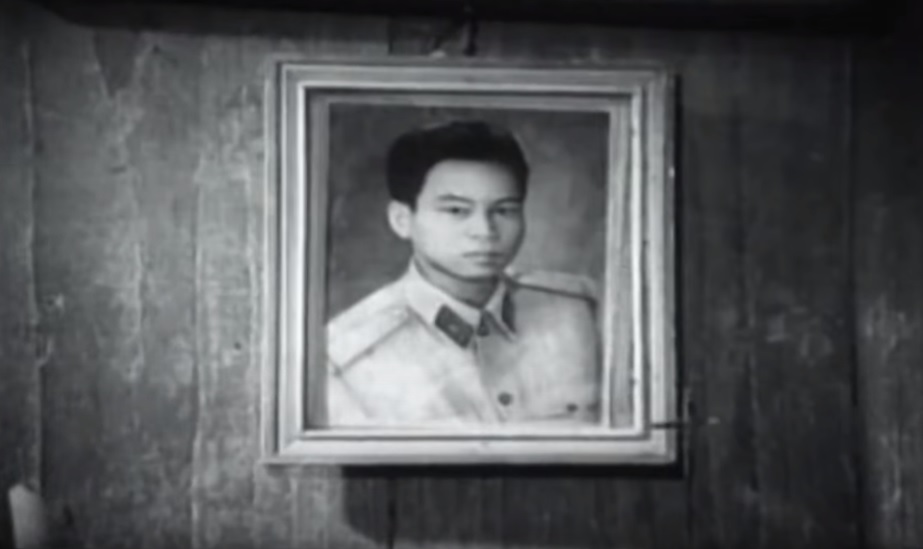
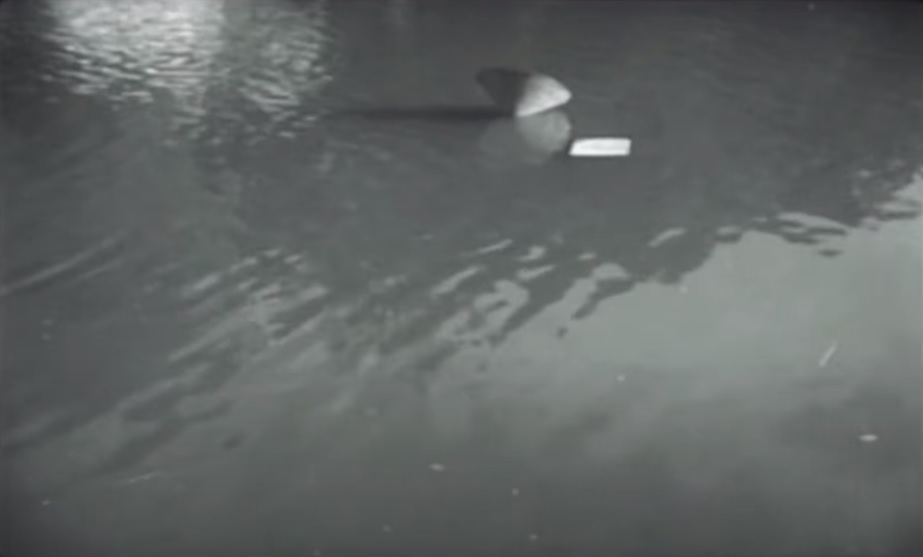
Shot on real locations, the film has a quiet naturalism that shows the people as part of the village, the village as part of the landscape. Minh lets the story unfold at its own pace, allowing the rhythm of life in the countryside to set the tempo. While the drama builds as the film progresses, he doesn’t push anything. Instead, he lets the emotional undercurrents build quietly, gradually breaking through to the surface. The performers don’t seem to be acting. Their interactions have an understated realism.
As Khang, Huu Muoi Nguyen let’s us know that the teacher’s calm, respectful manner is masking intense feelings that he’s reluctant to express. And at the heart of the movie is Lê Vân’s quietly powerful performance as Duyên. She’s also hiding fer feelings, but the actress allows us to see beneath the surface, subtly communicating the pain and confusion that she feels as wife, mother and daughter.
Again, When the Tenth Month Comes shows life in the village as an organic whole, and that includes folklore, song and theatre. Minh weaves a tapestry of rural Vietnamese culture, making the characters lives and experiences part of a continuous fabric. Rather than vanishing from the face of the earth, the dead live on as ghosts. One of the film’s most powerful moments comes when Duyên performs on stage as part of a local festival. While she can’t bear to tell her secret, she also can’t hide it completely.
Viet Thanh Nguyen is so right. The Vietnamese people need to be able to tell their own stories. The frustrating thing is, they have been telling their stories for decades, but because of the way the distribution of media is rigged, we hardly ever get to hear them. In spite of all the talk about the internet offering unprecedented access to books, films, music, etc., there’s still so much we don’t have access to. Part of this is due to greed, and part of it is due to ignorance, but another factor is our shameless laziness as insatiable consumers of pop culture. We keep getting the same thing over and over again because we keep swallowing the same thing over and over again. We won’t get anything different unless we demand it.
*
In reading about the film on-line, I found a number of different spellings for the names of the characters. In this post I went with the spellings most commonly used. If anyone who speaks Vietnamese wants to correct me, feel free to write a response to this post.
Help Small Movie Theatres Survive!
As I’m sure anybody reading this already knows, movie theatres are one of the casualties of the coronavirus outbreak. The big chains will be struggling, but the theatres that are going to be hit hardest are the small movie houses that show independent films and revival programming.
I was so glad to receive an e-mail from Criterion this morning, explaining that they were part of a campaign to help small movie houses through this tough time. Here’s an excerpt….
On Monday evening, Janus Films and the Criterion Collection contributed $25,000 each to establish the Art-House America Campaign, a fund to offer immediate assistance paying essential bills and key non-executive staff salaries. Most theaters will benefit from grants of $2,500 or more.
You can help, too. Follow the link below to contribute to the campaign. Think of the great experiences you’ve had seeing classic films on a big screen, the way they were meant to be seen. Or the amazing independent films you might have missed completely if your local art house hadn’t booked them. And then think about all the employees who work hard to keep those theatres running, and how many of them won’t be getting a paycheck until the pandemic blows over. If the theatre they work for can even reopen.
Twenty years ago there were a number of independent movie houses in LA. Now there are just a handful. Don’t let the coronavirus finish them off. Please give to the campaign.
Dirty Pretty Things (2002)
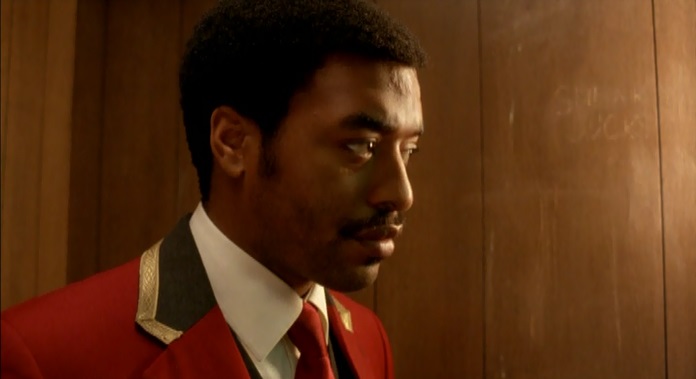
Chiwetel Ejiofor
The UN reports that we’re in the middle of the largest refugee crisis in history. All over the world people are fleeing their homes to avoid getting hit by a bullet or starving on the streets. Anyone who’s watched the news has seen the images of desperate men, women, and children waiting behind barbed wire fences or drifting on the open sea in makeshift boats.
But refugees have always been with us. Since the beginning of recorded history people have been leaving their homes behind to escape poverty or persecution. Often they gravitate to cities, where they might find a job, shelter, food. And while we don’t like to admit it, cities feed on refugees. People who are desperate to escape are easy prey. If they’re desperate enough they’ll work in sweatshops, hustle contraband or sell their bodies just to feed themselves and their families. And they better not complain, because there’s always someone ready to pick them up and send them back home.
Dirty Pretty Things is set in London in the early 2000s, and it brings us into the lives of people who are living on the fringe, working two or three jobs, renting a room illegally. Okwe is from Nigeria. He works the graveyard shift at the front desk in a hotel, and then during the day drives a taxi around picking up fares. He shares an apartment with Senay, an immigrant from Turkey, paying her cash to let him sleep on the couch. But this arrangement is illegal, because Senay’s legal status doesn’t allow her to charge rent or take a paycheck. So while she has a job cleaning rooms at the same hotel Okwe works at, she has to keep that a secret, too. These people live in constant fear of being caught breaking the rules. When immigration officials knock on the door, Okwe quickly grabs his few belongings and leaps out the window. Neither of them can afford a run-in with the law.
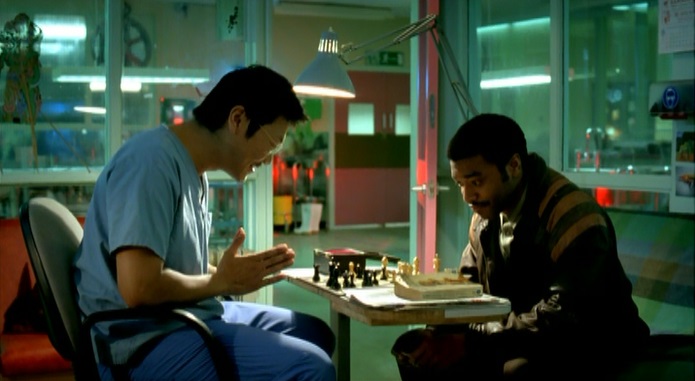
Benedict Wong and Chiwetel Ejiofor
Writer Steven Knight quickly pulls us into the shadowy world these immigrants live in. His characters are drawn in vivid detail, and while these particular people are very much a part of urban London, anyone who lives in a city will instantly recognize them. These are the folks who are just trying to make it through the day, keeping their heads down, doing everything they can to avoid trouble. There are threats on all sides, and the smallest misstep can wreck their fragile existence. Knight takes us on an intimate, uncomfortable tour of the dark side of this metropolis, showing us the London of sweat shops and sex workers, black markets and underground parking structures. The city feels like a sinister beast, feeding on the people who keep it running. Okwe has lived in London long enough to know that life is cheap. But he doesn’t realize how cheap until he enters a flooded hotel bathroom and finds that someone has tried to flush a human heart down the toilet.
The city is hungry, and needs to be fed. Okwe, a surgeon in his native Nigeria, learns that hotel rooms are being used for surgeries as part of a scheme to sell organs on the black market. The guy who’s running this ugly show is Juan, Okwe’s boss at the hotel. Juan is a happy capitalist. He sees no problem with what he’s doing, smiling as he tells Okwe that everybody benefits from the arrangement. The donors get cash they desperately need, the recipients get a new organ, and of course, he gets his cut for setting it up. And if the surgeries don’t always go smoothly, well, that’s just life. Juan finds out that Okwe is a surgeon, and immediately starts pressuring him to join the operation.
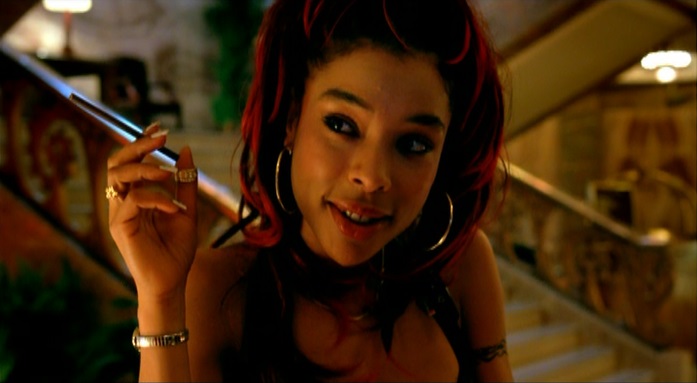
Sophie Okonedo
The cast is uniformly strong. Sergi López is maddeningly smooth and arrogant as Juan. He’s a master manipulator, sweet talking his marks at first, but always ready to put on the screws when that approach doesn’t work. Juan thrives in the city, because he sees the throngs of vulnerable immigrants simply as a business opportunity. People who live in fear are easy to exploit. Sophie Okonedo plays Juliette, a local prostitute with a breezy, pragmatic outlook on life. She’s tough enough to surive, but she has her soft side, too. Okonedo gives a lively and assured performance. As Guo Yi, Okwe’s friend who works at a hospital, Benedict Wong is both sympathetic and cynical. He brings a world-weary resignation to the role. He’s seen it all, and doesn’t have much hope of things getting better, but he still helps out when he can.
At one point Senay complains to Okwe that he never answers questions with yes or no. He’s always guarded. Chiwetel Ejiofor makes it clear that Okwe is a careful man, never revealing much of himself to anyone. He doesn’t talk about his past or his hopes for the future. He may be carrying a world of feelings inside, but he keeps those feelings to himself. Mostly. His heart aches for all the people he sees struggling to keep their heads above water. But Okwe has to keep his emotions in check. His survival depends on keeping his head down and playing along, so for the most part Ejiofor has to express his feelings in small ways, a look in his eyes, a subtle change in expression. It’s an impressive, complex performance. As Senay, Audrey Tautou also tries to keep her emotions in check, but they’re closer to the surface. Because she’s a woman, Senay is vulnerable to additional kinds of explotation, and the actress lets us see the deep anger and humiliation the character feels at being used by men. In Tautou’s performance we see a proud woman who’s determined to hold herself together, but it’s clear the sacrifices she has to make are taking a heavy toll.
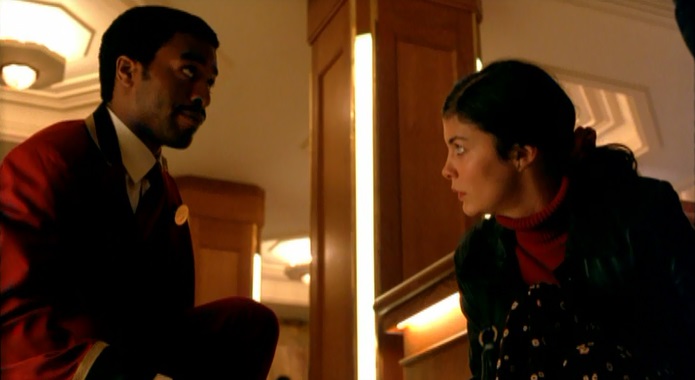
Chiwetel Ejiofor and Audrey Tautou
Working in the realm of commercial cinema, it’s not easy to make films that honestly reflect the world we live in. Amazingly, Stephen Frears has made a career out of doing just that. Combining a deft and confident craftsmanship with a passionate interest in telling human stories, this director has worked in many genres, taken on a wide variety of subjects, and somehow kept audiences engaged. His clear-eyed, unsentimental approach gives his films an immediacy that most of Hollywood’s output lacks. While his work is technically accomplished, the focus is always on the people, and the goal is always to involve us in whatever they’re feeling.
Years ago I read an interview with Frears, and one thing he said really struck me. I may not remember the quote exactly, but I can give you the gist. The director was busy working on a new film, and the reporter asked if he was trying to make a work of art. Frears seemed taken aback, and then answered, “No, a work of life.”
Dirty Pretty Things is a work of life.

Lost LA through a Camera Lens
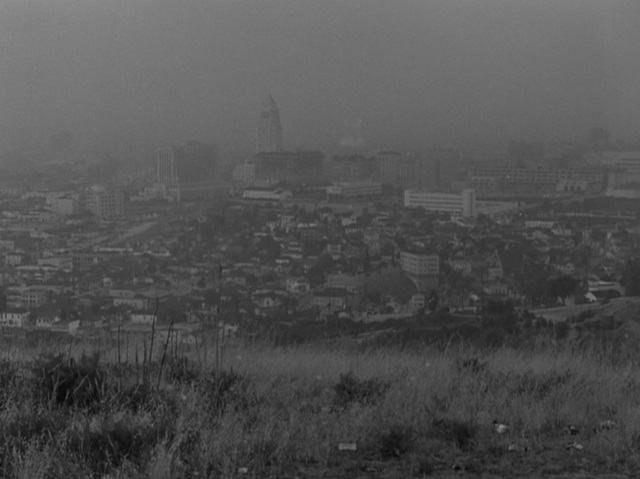
A view of Downtown Los Angeles circa 1960 from The Exiles.
I write two blogs, this one about film and another about Los Angeles. Every once in a while I do a post that brings them both together. This one deals with places and spaces from LA’s past that were captured on film. If you’re interested, follow the link below.
All That Jazz (1979)

“It’s showtime, folks!”
Looking for connections between an artist’s work and their personal life is a tricky business. No doubt, the connections are there, but generally they’re much more complicated and convoluted than we can imagine. Still, we look for clues to their motives and their manias, their politics and their passions. And at times, the work an artist does seems to reflect their life so clearly, it’s hard not to see it as autobiography.
Bob Fosse’s All That Jazz has many clear connections to the director’s life. The main character, Joe Gideon, is a former dancer who graduated to choreography and then became a director, moving between stage and film. All these things echo Fosse’s own experience. And to take it even farther, Gideon is a compulsive worker who keeps himself going with drugs and booze, chasing one woman after another, madly trying to juggle work and relationships. These things also reflect Fosse’s own life.
In an audio commentary on the DVD I watched, editor Allan Heim says that when he was working on the film with Fosse, he couldn’t help calling the main character Bob. This angered the director, who apparently didn’t want people to assume that Joe Gideon was a surrogate for himself. Heim finally managed to break the habit, but he notes the many connections to Fosse’s own life. In addition to the biographical parallels, a number of the director’s associates, including Heim, are featured in All That Jazz. And how can we ignore the fact that the numerous bottles of dexedrine featured prominently in the film show the director’s home address on the label?
So what are we supposed to make of this? It’s a mistake to assume that everything we see in All That Jazz is a realistic representation of Fosse’s own life. At the same time, it’s a mistake to pretend the connections aren’t there, especially when the tone of the film is so clearly confessional. Fosse felt a need to put his life on the screen, in large part, it seems, to acknowledge his failings. But it’s also important to remember that, like many filmmakers, the director spent a lot of time dramatizing his life. Even if the episodes we see on the screen line up with episodes from the director’s career, they’re stylized and heightened in a way that’s nothing like real life. This is especially true of the last third of the film, which spins off into expressionistic fantasy. There’s no way you can take it literally.
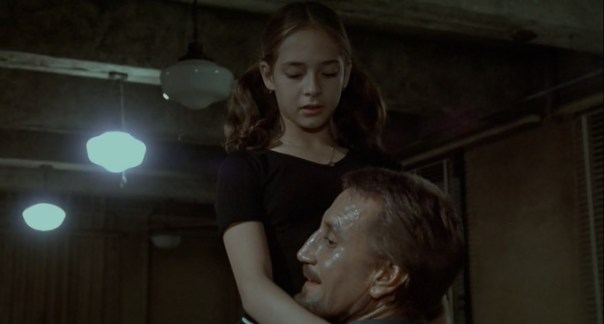
Erzsebet Foldi and Roy Scheider
Fosse loved the amped-up, overheated world of musicals. He worked as a dancer and choreographer at MGM back in the fifties, when the studio was churning out frothy, colorful, wildly energetic fantasies that audiences loved. Some of the best musicals of the studio era were made during this time, but the genre’s days were numbered. Though there were a few musicals that hit it big in the sixties, tastes were changing, and audiences were losing interest in fatuous fantasies that always had a happy ending. High profile flops like Dr. Dolittle and Paint Your Wagon almost killed the Hollywood musical.
But in the seventies, a new generation of filmmakers tried to reinvent the form.* Not buying into the easy optimism of the studio era extravaganzas, these directors approached the genre with a more cynical eye. Martin Scorsese tried to mix the glitter and glamour with a dark, disturbing romance in New York, New York. Francis Ford Coppola took a downbeat look at a doomed relationship in One from the Heart. But it was Fosse who somehow managed to reimagine the movie musical within a contemporary consciousness. He scored his first hit by adapting Cabaret, which had been a hit on Broadway. And seven years later he followed it with All That Jazz.

Leland Palmer
Fosse was never more audacious and never more assured than when he made All That Jazz. Just the idea of putting a character much like himself at the center of a big budget Hollywood musical was pretty outrageous. But pop culture was the stage Fosse chose to live his life on. Showbiz was his metaphor for the world. Of his five films, four of them are centered on entertainers. Fosse was fascinated by the relationship between performers and their audience. He understood the way a dancer or a singer or a comedian could reach out and grab a crowd, creating an electric connection that would hold them transfixed. He also knew how much performers often sacrificed to make that connection, and how damaging the lifestyle could be.
Not that Joe Gideon is a martyr to his art. It’s way more complex than that. Joe can’t stop doing what he does because he couldn’t live without the love and attention that the audience provides. He needs that fix. In spite of his apparent self-confidence, Joe is massively insecure, and constantly pushes himself to do better, because he never feels that anything he does is good enough. And while there’s no doubt he likes women, you have to wonder if he’s driven to chase them, at least in part, because he needs to bolster his fragile ego.
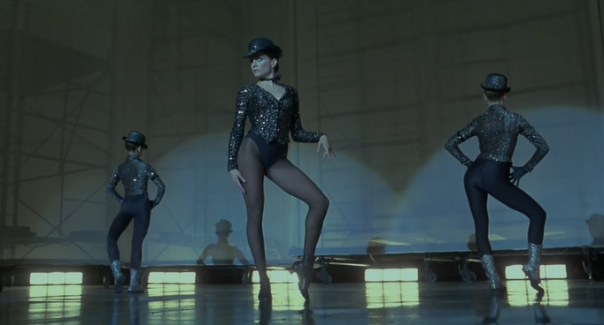
Ann Reinking, center
While Gideon has a number of women in his life, three in particular have a special hold on him. There’s his ex-wife, Audrey, who knows him better than anybody. She still loves him, and she stars in the show he’s directing, but she won’t let herself get drawn back into his web. She’s smart enough and strong enough to keep her distance. There’s Kate, his sometime girlfriend, who loves Joe desperately, and still tries to win his heart, even though she’s beginning to realize it’s impossible. And there’s Joe’s daughter, Michelle, who’s totally devoted to her father, and can’t understand why he never spends any time with her.
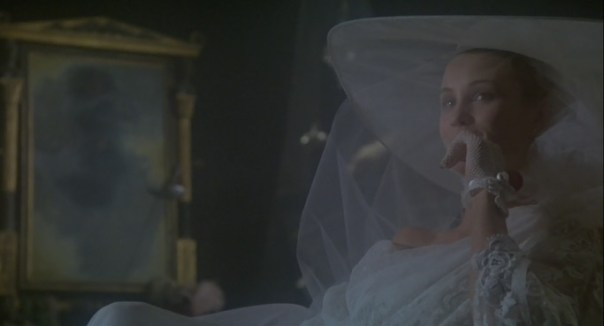
Jessica Lange
I should have said there are four women who are important to Gideon. The last is Death, who appears to the director as a female wraith draped in white. They sit together in a backstage netherworld filled with showbiz paraphernalia, Joe right at home at a dressing room table, gazing into the mirror and talking about the mistakes he’s made, the people he’s mistreated. He’s full of remorse, but he doesn’t seem to be able to change his ways. They chat, they laugh, they flirt. Joe is definitely attracted to this beautiful woman in white. For all the film’s high energy and brash theatricality, it’s actually deeply introspective. All That Jazz is a melancholy meditation on life and death.
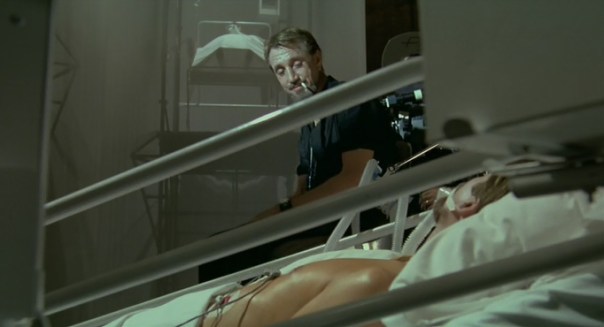
The director loses patience with his star.
But that’s not all it is. All That Jazz is also wildly entertaining, with energetic performances, breathtaking visuals, and stunning choreography. The first dance sequence, an open audition set to On Broadway, shows Gideon on stage with hundreds of performers, all trying to make an impression. It’s a virtuoso piece of filmmaking, breathtakingly shot and edited, and it pulls us right into the director’s world. Later we see Joe the choreographer take a paper thin song that he would’ve liked to cut completely and turn it into a show-stopper. The producers start sweating as they realize he’s transformed an innocuous ditty into an excuse for an erotic tour de force. Then there are the final hallucinatory dance numbers that close the film, Joe watching from his hospital bed as his wife, girlfriend and daughter perform brutally ironic riffs on Broadway shows. And extending the showbiz metaphor, as the patient lies buried under bandages and tubes, he sees that his visions are directed by himself, a cynical, detached taskmaster, descending from above on a crane to complain that his star blew the last take.
Bob Fosse died of heart failure at the age of sixty. Apparently he saw it coming. One of the most disturbing things about All That Jazz is the main character’s awareness that he’s pushing himself way too hard, and his apparent acknowledgement that he can’t live any other way. While the incidents we see on the screen may not directly align with the facts of Fosse’s life, it’s hard to avoid the conclusion that he was using the movie to talk about himself. And more than anything else, that’s what makes this film so moving. Through the movie, Bob Fosse is trying to tell us who he was. Whatever faults he may have had, in All That Jazz he was trying to come clean.
*
They weren’t the first. Jacques Demy’s Umbrellas of Cherbourg was an early attempt to rethink the film musical. And on stage, Stephen Sondheim was pushing the genre in a whole new direction.
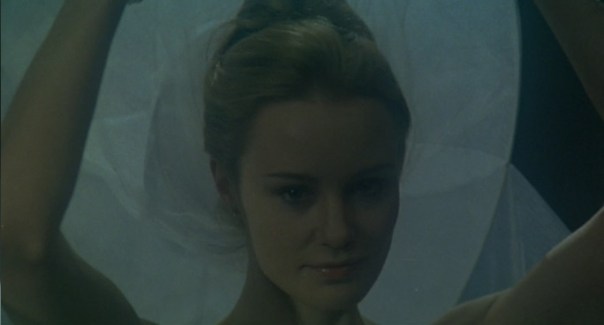
Death raises her veil.
Baby Doll (1956)

Carroll Baker and Eli Wallach
Tennessee Williams didn’t just write about sex, he celebrated it. At a time when American culture was still pretty straightlaced, he put eroticism front and center in his work. Some people thought his plays were scandalous, and actually, many of them were. Joyously scandalous. Williams had an amazing gift for combining lurid melodrama with heartbreaking poetry. His racy themes made him a target for criticism, but they also helped push him into the spotlight. The upshot was that he became one of the people who transformed American culture in the fifties.
But like so many people who lead the charge, Williams did run into a few brick walls. He was able to get away with pretty much anything when he was writing for Broadway. Not so much when his plays went to Hollywood. Even though the production code’s influence was waning, the studios still censored themselves. It must have been tough for Williams to see his work mangled. But it may have been even more painful for the writer to see the one film he wrote in complete freedom taken out of circulation and buried.
Baby Doll wasn’t an adaptation. Williams wrote it himself for the screen. It’s about a nineteen year old girl who’s married to a man twice her age. But there’s a catch. The marriage won’t be consummated until she turns twenty. Her husband Archie Lee, a lecherous Southern businessman who runs a cotton gin, can’t wait for her birthday, which is just two days away when the story begins. But Baby Doll isn’t so sure she wants to seal the deal. Archie’s business has run into trouble, and the life of luxury he promised hasn’t materialized. The mansion they live in is a decaying wreck. And to make matters worse, the furniture’s about to be repossessed. This is not the life of ease that Baby Doll expected.
There was probably no one better suited to bring Williams’ vision to the screen than Elia Kazan. He knew how to kindle the energy and intensity the playwright’s work required, and he understood William’s wicked sense of humor. Kazan’s film of A Streetcar Named Desire brought out all the play’s emotional violence against the background of a sultry, expressionist New Orleans. But Baby Doll is a comedy, and so Kazan creates a softer mood. Shot on location, the film has an easy, rambling rhythm that seems to grow naturally out of its setting in the rural South.
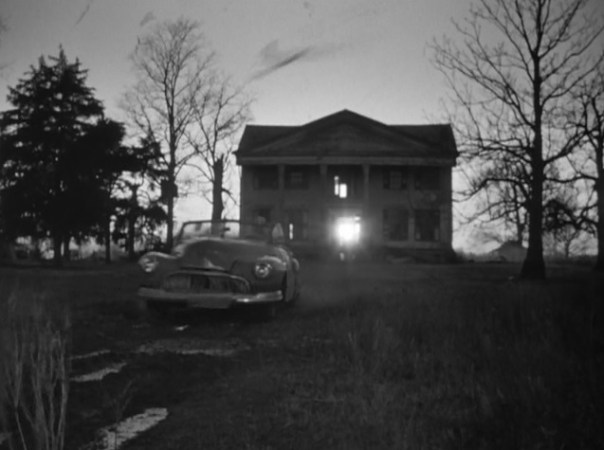
Sundown in the South.
Cinematographer Boris Kaufman seems to feel the landscape as much as he sees it. The sun’s fading rays scattered across a withered field. The flat, harsh lighting of a small town cafe. The wistful sadness of a rainy day. He seamlessly melds the weathered landscapes of the South and the crumbling grandeur of the old mansion into the same visual fabric. Kaufman had a gift for finding a film’s emotional tone. The film is a comedy, but the images also reveal the pathos in the struggles of these small town folks. Kenyon Hopkin’s sensual score also plays an important part. The strings glide along with a silky indolence, while the insinuating sax has a sensual, lazy warmth.
You can’t talk about this film without talking about the actors. Williams’ script gives them a lot to work with, and they all wring everything they can out of their parts. Karl Malden’s Archie Lee is an ignorant bully, but there are times when you can’t help feeling sorry for him. He’s so dumb he has no idea why his life is so miserable. Eli Wallach is brimming with vitality as Vacarro, the Sicilian immigrant who’s made a success of himself even though the townspeople hate him. Vacarro may be ruthless, but he’s not cruel, and Wallach let’s us see a glimmer of compassion under his hard surface. And at the center of it all is Carroll Baker’s Baby Doll, a child who doesn’t realize she’s become a woman. The actress plays the role with a bracing mix of innocence and carnality. As physical as her performance is, she also handles Williams’ dialogue beautifully. She brings a heartbreaking sweetness to the film’s melancholy final line.

Eli Wallach, Karl Malden and Carroll Baker
Baby Doll is a lively, entertaining and beautiful film. But it came out in the mid-fifties, and the world just wasn’t ready for it. The Catholic Church denounced it as pornographic. The Legion of Decency and other groups came out against it. After a brief release, Warner Bros. pulled it out of theatres. Williams was bitterly disappointed. The film had its defenders, but a few glowing reviews weren’t enough to counteract the storm of criticism. Baby Doll went back into the vaults, and sat there for decades. In spite of the amazing number of talented people who worked on this movie, it was pretty much forgotten for forty years.
Film is a funny business. There are so many artists who go to Hollywood and get completely beaten down. The movies they try to make get mangled, and sometimes even buried. But Baby Doll is back in circulation again, and it’s proof that sometimes the artists win out. Williams had a great sense of humor. I can almost hear him laughing from the grave.

Tenue de soirée [Evening Dress, aka Ménage] (1986)
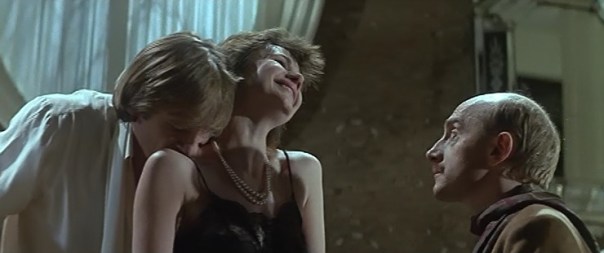
Gérard Depardieu, Miou-Miou, and Michel Blanc
Bertrand Blier loves to shock us. He knows we’ve been taught to suppress our desires, to stifle our impulses, to always play by the rules. Society tells us that theft, prostitution, incest, and murder are wrong, but for Blier they’re all just part of life. In his world there are no rules, only lines to be crossed.
Tenue de soirée is all about crossing lines. The first scene takes place in a crowded dance hall. A shabbily dressed married couple are seated at a table. The wife is complaining bitterly about their poverty. The husband meekly responds by telling her she’s beautiful and that he loves her, which only infuriates the wife further. And then a heavyset man who’s overheard the conversation walks up and slaps the wife across the face, knocking her to the floor.
The husband and wife are Antoine and Monique. The heavyset man is Bob, a thief. He invites them to join him in a life of crime. Within the movie’s first fifteen minutes Antoine and Monique have broken into two houses, stolen money and clothes, and seen their trailer home explode in flames. Now that they’ve met Bob, their lives will never be the same.
Monique falls into this new life happily, but Antoine is a bundle of nerves. Not only is he constantly afraid that their crimes will lead to jail or worse, he’s totally confused by the amount of attention he’s getting from Bob. The happy-go-lucky thief flirts with his nervous friend, but denies he’s queer. Then he flirts some more, and now he acknowledges that yeah, maybe he does like having sex with guys. Before long Bob is proclaiming that he loves Antoine passionately. Antoine is completely freaked out.
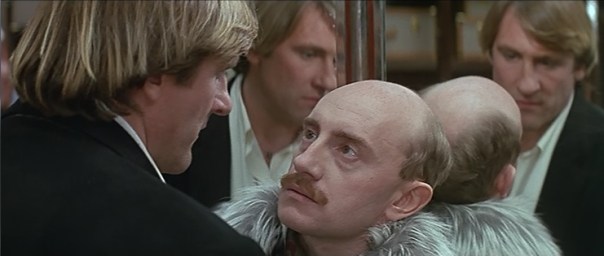
Antoine wonders if Bob isn’t a little too friendly.
You could almost say that Bob is Blier, and Antoine is standing in for us, the audience. Bob is completely unpredictable, taking every situation and turning it on its head, never allowing Antoine to get comfortable. In the same way, the writer/director keeps throwing us one curve after another, always keeping us off balance. Bob tells Antoine he loves him, and genuinely seems to mean it, but minutes later he’s selling Antoine to an old friend for a stack of crisp bank notes. Bob makes a home for Antoine and Monique, building a life of quiet domesticity, and then goes about deliberately tearing the whole thing to shreds. Each time we think something’s been resolved, there’s a new twist and the film goes off in a different direction. It may seem like chaos to us, but to Blier, it’s just life.
Blier’s stories are all about ripping up the stories we cherish most. They don’t have the structure or the symmetry that we’re comfortable with. Tenue de soirée is an especially aggressive assault on all the things that most of us hold dear. Blier doesn’t even let us settle into a comfortable rhythm. No sooner does one outrageous episode end, than he hits us with another unforeseen crisis. Is this endless parade of insane adventures believable? Of course not. Or maybe I should say, it’s not believable in the usual sense of the word. Tenue de soirée is certainly not realistic, but I don’t think Blier cares about realism.
Blier is interested in people, and the people in his movies are completely believable. They’re just as petty, foolish, greedy, and insecure as the rest of us. But Blier loves his characters, in spite of their faults, and that’s why we still care about them even when we see them at their worst. The director wants to push them to the limit to see what they’re made of. Often, they fail the test. But that doesn’t matter. Their failure just means they’re human.
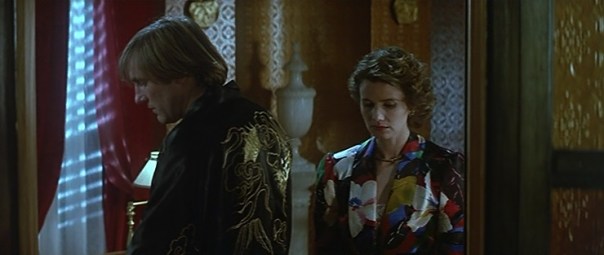
A moment of honesty.
The film is breathtakingly energetic and funny, in large part because it has an amazing trio of actors at its center. Gérard Depardieu, Michel Blanc, and Miou-Miou are all startlingly alive, and their performances are so compelling that we don’t stop to think about how improbable their adventures are. Blier has his characters run a dizzying gamut of emotions, and the actors always seem to find the right tone. They always make it ring true.
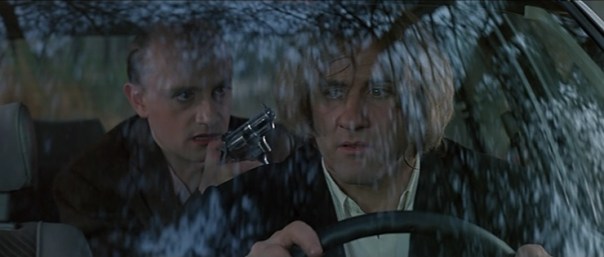
In the end Bob finally pushes everything too far, and instead of whining and moaning, Antoine picks up a gun. He’s had enough. He chases Bob into the streets and hijacks a car, forcing Bob to drive at gunpoint. Antoine has suffered too many humiliations, and it seems he’s finally reached his limit. He can’t go on with this life any longer.
But of course he does. They all do. In Bertrand Blier’s films there are no endings. Somehow life just goes on.
The Tango Lesson (1997)
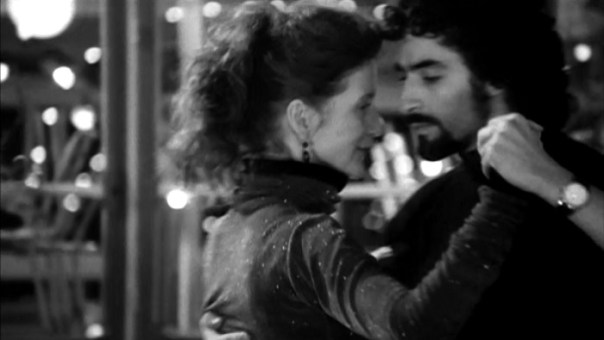
Sally Potter and Pablo Veron
Work. Love. Art. Life. All these things are intertwined, but sometimes it’s hard to keep them in balance. In fact, it’s often impossible. Sally Potter knows this, and yet she keeps trying to bring them all together. Her movies are about the constant struggle to find that balance. And in The Tango Lesson she puts that struggle at the heart of the movie.
First off, Potter plays herself, a filmmaker trying to focus on the work she needs to do in order to create her art. At the beginning of the movie we see her getting ready to work on the screenplay. First, she has to prepare the space. We see her standing in the sunlight in a sparsely furnished room, vigorously cleaning the table she’s going to write at. Next she lays a stack of paper on the table, and next to it, parallel to it, a pencil. We can tell by the careful, methodical way she approaches the task that this is someone who values order. Maybe a little too much.

Getting ready to work.
But this isn’t just a film about making a film. It’s about the creative process in general. Things don’t flow in a straight line. Disruptions are part of the process. Distractions become the focus. Potter is walking down a street one night and hears music. She follows the music into an auditorium where she sees a man and a woman dancing the tango on stage. Entranced by the performance, she lingers after the show and introduces herself to the male dancer, Pablo Veron, also playing himself.
“You use your presence on stage like an actor in a film,” she tells him, a complement only a director would offer. “Do you work in the cinema?” he asks. From the first words they speak, their relationship is defined by the work they do. Potter wonders if Veron ever gives lessons. It turns out Veron has always wanted to be in films.
This is the beginning of a complex relationship, with Potter and Veron each playing multiple roles. Teacher, student. Director, actor. Man, woman. The relationship changes according to the roles they play. Veron is completely comfortable as the performer on a stage or the teacher instructing a student. In other words, when he can be in charge. Things are different when he isn’t the one calling the shots. Potter understands that when the two of them dance the tango, the man is in charge. But Veron doesn’t understand that when the two of them make a movie, the director is in charge.
As in most relationships, these two people are at the mercy of complex and conflicting desires. An artist has to be selfish. A lover must be unselfish. Veron seems genuinely attracted to Potter, but she could also offer him the chance to be in the movies. Potter becomes fascinated by the idea of making a film about the tango, but it could also be a way to stay close to Veron. It’s not always easy to be sure of what their motivations are. They may not even be sure themselves.
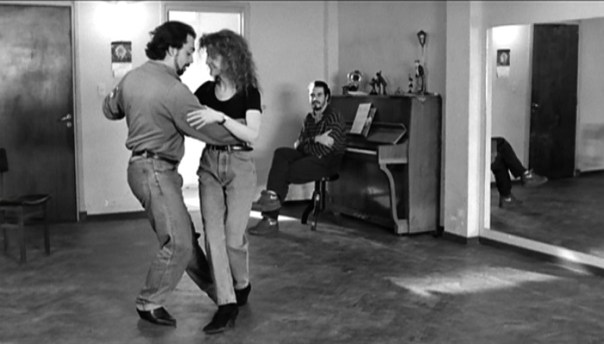
Learning the tango with two new teachers.
We watch this messy, multi-layered relationship unfold against the backdrop of the tango. In between the intimate conversations and the dramatic quarrels, Potter gives us a series of stunning dance sequences choreographed by Veron. We see the two of them performing an intense and intimate tango on an empty dance floor. There’s an ecstatic nighttime duet along the banks of a glittering river. And toward the end the two are joined by other dancers in a dramatic ensemble piece. Showing dance on the screen can be difficult. If the filmmakers aren’t sensitive to the rhythms of the performers, a beautifully choreographed sequence can be wasted. Fortunately, editor Hervé Schneid seems to have an intuitive understanding of how each scene should be shaped. His cutting is perfectly attuned to the movements of the dancers.
Cinematographer Robby Müller’s expressive black and white photography gives the movie richness and depth. He catches the moods on the actors’ faces and the way their bodies move through space. The film’s emotional landscape is also shaped by its subtle underscoring, the work of director Potter and multi-instrumentalist Fred Frith.
There’s no doubt that these two people care for each other, but they also care about their art. Passionately. The relationship may not survive, but whatever happens, Veron will go on dancing and Potter will go on making movies.
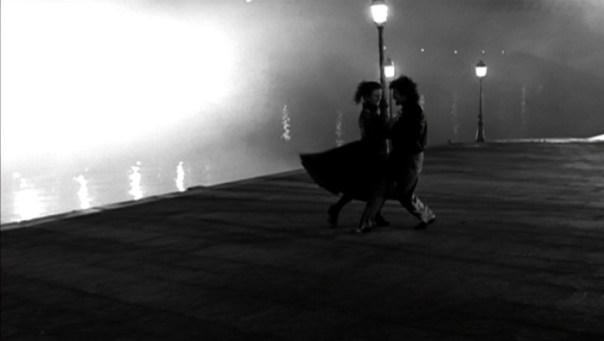
 Reality Is Scary