Blog Archives
Dog Day Afternoon (1975)

In the mid-70s, the US seemed to be lost in a chaotic haze. The optimism of the 60s had faded. Vietnam had exposed Americans to the ugliest realities of the country’s military actions. Nixon had resigned. President Ford didn’t seem to have an agenda. A recession was dragging the economy down. Unemployment was high. And the certainties that Americans had embraced in the post-WWII era had been shredded by years of cultural upheaval.
Against this backdrop, the story of two hapless guys why try to rob a bank and end up trapped inside, holding the employees hostage, seems like a reflection of the country’s state of mind. A desperate story for desperate times.
Dog Day Afternoon was inspired by an actual bank robbery, which P. F. Kluge and Thomas Moore wrote about in a Life magazine article entitled “The Boys in the Bank”. Frank Pierson’s screenplay sticks fairly close to the facts. Director Sidney Lumet felt it was important to keep the film grounded in reality, and in his book Making Movies, he gives his account of how the script evolved over time. According to Lumet, in order create the feeling of real life unfolding on the screen, he told the actors that they needed to play the parts as close to themselves as possible, even encouraging them to wear their own clothes. Taking the director’s lead, one of the actors asked if they could use their own words. Though he had never allowed improvisation before, Lumet agreed.

Still using Pierson’s screenplay as the foundation, the actors were allowed to improvise in rehearsals, and the rehearsals were recorded. Each night, the script was reworked to incorporate dialogue that the actors had come up with during the day. This is likely one of the reasons that the film has such bracing spontaneity. Rather than speaking dialogue, the characters seem to be speaking their own words. Instead of watching scenes in a drama, we get the sense that we’re witnessing events as they unfold. As the botched bank robbery turns into a hostage situation, as the NYPD tries to figure out their next move, as the crowd on the street grows larger, it’s clear that no one is in control and there’s no way to predict what will happen next.
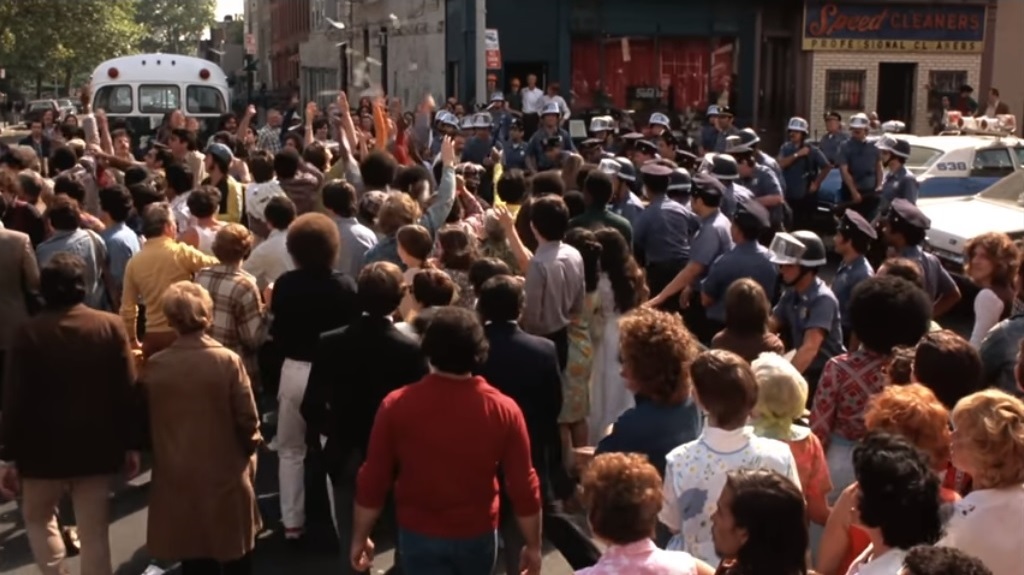
The photography reinforces the documentary feeling. Lumet and cinematographer Victor Kemper employed natural light wherever possible. The bank interiors are lit by fluorescents. For the night exteriors they relied on spotlights from emergency vehicles. And Dede Allen’s crisp, unobtrusive editing gives the film structure without making it seem forced. Dog Day Afternoon doesn’t hit the same beats as the standard Hollywood movie. It has its own subtle rhythm.
While Dog Day Afternoon was financed by a Hollywood studio, it seems very much a part of the New York school of filmmaking. In the 50s, independent filmmakers working in the city, like Morris Engel, Lionel Rogosin and John Cassavettes, tried to scrape away the gloss and glamour of commercial cinema to capture life as people really lived it. They shot on actual locations using hand-held cameras to capture the look and feel of urban life. In the late 60s and early 70s, Hollywood studios began to back projects that built on this approach, like Born to Win and Panic in Needle Park. Warner Bros. greenlighted Dog Day Afternoon at the peak of this trend. In the 70s American audiences seemed willing to explore the grittier side of urban life. But by the 80s, audiences were running back to safety, and Hollywood delivered a steady supply of comedies and action flicks.

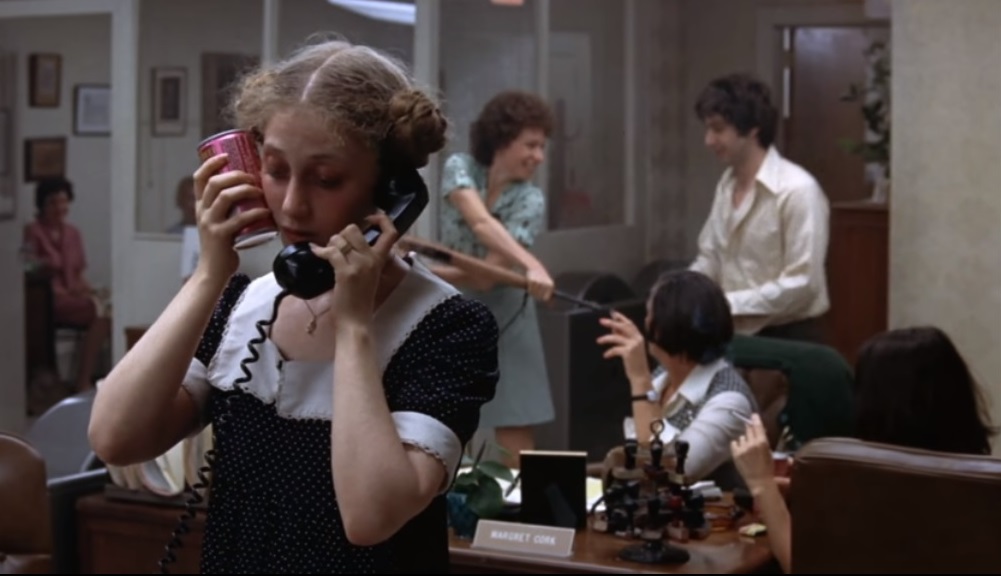
Al Pacino’s performance has been highly praised, and rightly so. There’s a naked vulnerability in his portrayal of Sonny that’s unusual in American filmmaking. But while Pacino is at the center of the story, the film is really an ensemble effort, and even the performers in the smallest roles are vivid and lively. John Cazale is eerily introverted as Sonny’s partner, Sal. Sully Boyar plays the bank manager with an air of exhausted resignation. He just wants to make it through the day alive. Penelope Allen is especially vivid as one of the tellers. She may be a hostage, but she’s not going to let these guys push her around. But to me the most impressive thing about these performers is the way they’re always in character and they’re always connected. Pacino may be in the foreground, but Lumet makes sure that the actors in the background are reacting to whatever’s going on. And as the day drags on, as the tension grinds everybody down, they all seem to be drawing closer together.
As the cop who’s pretending to be in charge of the situation, Charles Durning gives us a man who knows he’s in over his head and is hoping he can bluff his way through this mess. James Broderick is quietly creepy as the stoic, implacable FBI man. He’s just waiting for the right moment to shut these guys down. And Chris Sarandon gives a moving performance as Leon. Sonny may be at the end of his rope, but so is Leon. They may love each other, but they know it’s not going anywhere.

One of the reasons the 70s was such an amazing period in American cinema was that a film this harsh, this gritty, this different, could be a success at the box office. Apparently Dog Day Afternoon resonated with audiences. It is a tense, engrossing film that holds up well today. But I think the reason audiences responded was that Pierson, Lumet and the cast made it a compelling human story. Ultimately it’s not about bank robbers and hostages. It’s about people.

The Fugitive Kind (1960)

A drifter stands before a judge in a small courtroom in New Orleans. He tries to explain why, after being hired to entertain at a local party, he suddenly went wild and started raising hell. It seems he felt so disgusted with himself that he couldn’t keep from tearing the place up. He just couldn’t stand the life he was living any more. The judge asks the drifter what he’ll do if he goes free. The drifter says he’ll leave town and never come back again.
This is the opening scene of The Fugitive Kind, based on the play Orpheus Descending by Tennessee Williams, which debuted on Broadway in 1957. To give you an idea of how involved Williams was with the subject matter, that play had actually evolved from an earlier version called Battle of Angels, which he’d written in 1940. And the issues he deals with in The Fugitive Kind are variations on the themes he explored throughout his life. Innocence and corruption. Beauty and poetry. Desire and death.
Williams is riffing on the myth of Orpheus, which tells the story of a musician whose wife, Eurydice, dies. He’s so stricken with grief, he goes to the Underworld to find her and plays his lyre for Hades, the god of the dead. The music is so beautiful that Hades allows Eurydice to leave the Underworld, on the condition that Orpheus not look at her until they reach the world of the living. The two start on their journey, but Orpheus fails to heed Hades’ warning, turns back to look at his wife, and she’s lost to him forever.
There are actually several different versions of the myth, and Williams takes considerable license in updating it to reflect his own times and his own temperament. In The Fugitive Kind, Valentine Xavier is a drifter who wants to make a break with his past. He’s tired of his life and tired of the crowd he’s been running with. Val is a loner, an outsider. He refers to his guitar as his life’s companion. On the stormy night Val leaves New Orleans, he makes it to a small Southern town where his car breaks down. Trying to escape the pouring rain, Val seeks refuge at the local jail, where the sheriff’s wife lets him inside. The sheriff is out chasing a prisoner who has just escaped. As the two of them talk, the clamor of barking dogs is heard close by. Then gunshots ring out. Val knows the manhunt is over. While this town may be new to him, he knows these places well. Small Southern hamlets where intolerance and violence are the rule.
But Val is stranded. He needs a job. He ends up finding work at the local general store, run by Lady Torrance. Her husband, Jabe, is the owner, but he’s so ill he can barely get out of bed. In spite of his weakened state, he uses what energy he has to dominate and humiliate his wife. He’s a bitter, angry man, and he’s certain that his wife is interested in the good-looking young drifter she’s hired to work at the store.

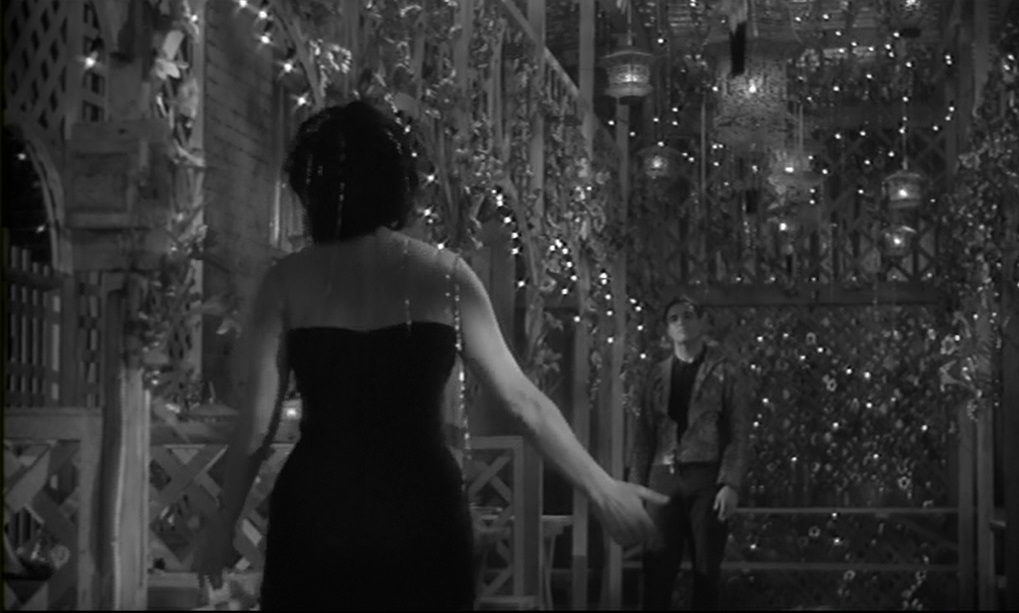
Which, of course, is true. It’s not long before Val and Lady find they’re drawn to each other. These are two lonely people, holding a lot of pain inside. In one scene Lady remembers the days when she was young and her family had parties in the wine garden built by her father. Those days came to an end when an angry mob burned it to the ground. The reason? Her father sold some alcohol to black men. The pain she feels from that loss is still very much with her, compounded by the pain of her loveless marriage to Jabe.
And Lady isn’t the only one interested in the newcomer. Carol Cutrere comes from a prominent local family. She used to be a starry-eyed idealist, but now she’s a rowdy drunk, driving around in her beat up car and raising hell. She’s suffering, too, but she doesn’t try to hide it. In fact, she does everything she can to rub her anger in the faces of the straightlaced locals.
Williams may have fared better than many writers when it came to film adaptations of his work. While it has its flaws, over all The Fugitive Kind is a beautiful and heart-rending film. The director, Sidney Lumet, was wildly erratic as a filmmaker. A fast worker, in the course of his career he made almost 40 features, and his filmography lists dozens of TV credits. Some of his work is so thin and forgettable you get the feeling he was just looking for a paycheck. But when he found a script he could really commit to (like Dog Day Afternoon or Before the Devil Knows You’re Dead) his work has a compelling immediacy and intensity. Lumet could be heavy-handed, and there are times when that tendency shows itself here, especially in the portrayal of Jabe. But he also seems to have had a special feeling for the broken, lonely people who can’t find their place in the world, which is what this film is about.
Lumet seems to have had a close relationship with cinematographer Boris Kaufman. They worked together on seven films. This was their third collaboration. Honestly, I can’t think of anyone better suited to this project than Kaufman. In addition to his enormous technical skill, he’s also a poet, and he gives us a number of images that echo the poetry in Williams’ lines. With carefully layered lighting he creates a sense of space in every scene. The jail, the store, the roadhouse, all feel real, but over all the film has an ethereal, ghostly quality. This is especially true of the scene where Carol drives Val out to the cemetery at night. As they talk their voices seem to fall into a vast silence. Carol tells Val that she can hear the dead, that they’re talking all the time, but they can only say one word. “Live.”

This is a quiet, melancholy film, and Lumet uses music sparingly. The understated score by Kenyon Hopkins is one of the composer’s best. As the opening credits are shown, Hopkins starts off with nothing more than a flute playing a simple motif, joined by broken chords on a guitar, as we gaze down a lonely road. While there are times where the composer brings in a larger orchestra, for the most part he keeps things low-key. The music reflects the deep sadness that haunts these people, but it also echoes their hopes.
To say that Anne Magnani is a powerful presence isn’t saying nearly enough. At times the emotions she’s expressing are so intense that it can difficult to watch her. She makes you feel Lady’s pain. This is a woman who is bitterly disappointed in the life she’s been handed, but she still holds on to a spark of hope that love could change her world. Though she’s worked hard to bury her emotions, you get the feeling that they’re always just beneath the surface, ready to erupt. When she does let go, the anger and pain is scorching. In a different way, Marlon Brando is just as powerful. Like Lady, Val is lonely. In spite of his surface cool, he really wants to connect with someone. He doesn’t really know where he’s going or what he’s doing, but he’s trying to build some kind of a life. Brando’s approach is understated, but he lets us see Val’s confusion, his loneliness, his longing.
While the tone of the film is mostly subdued, there’s a powerful undercurrent of violence running through it. This small town holds a lot of hate. Outsiders and outcasts are not welcome. If they fail to understand how unwelcome they are, there are frequent reminders laced with bloody threats. It’s no surprise that the film’s violent climax ends in death. But since this is Tennessee Williams, it’s also no surprise that beauty survives. As Carol muses at the end of the film, those outsiders leave tokens behind them, “…so that the fugitive kind can follow their kind.” We all die. Poetry lives on.
 Reality Is Scary