Moby Dick (1956)
You really can’t put a book like Moby Dick on the screen. There’s no way to duplicate the experience of reading Melville’s words and being drawn into the ecstatic chaos and the terrifying poetry of his world. But John Huston was never one to shy away from a challenge, and in fact, he seems to have enjoyed taking on projects that tested him. If his version of Moby Dick isn’t completely successful, it’s still a beautiful and powerful adaptation that preserves much of what was most important in the book.
One of the problems in making a commercial film from Moby Dick is that it’s less a novel than a cosmic meditation on God, man and nature. There’s very little plot. At the beginning an innocent young man gets on a boat with a crazed captain in search of a white whale. At the end they find the whale, the boat is destroyed, and the young man is left floating in the middle of the ocean. In between, Melville’s narrator, Ishmael, offers his musings on life, death, the ship, the sea, and endless ruminations on whales.
Huston hired Ray Bradbury, who at that point had never written a screenplay, to fashion a script from the book. While the two men had great admiration for the other’s talent, apparently they didn’t get along at all. The experience was a traumatic one for Bradbury, but for the most part Huston was very pleased with his work, and the finished product gave the director an admirable adaptation to start with.*
There are moments in the film that capture Melville beautifully, and one of them is the opening sequence where we see Richard Basehart as Ishmael, strolling through the countryside, following the course of the water as he makes his way to the shore. Basehart was the perfect choice for the central character. He keeps us with him all the way, Ishmael playing the fascinated witness to Ahab’s monstrous madness. Basehart is surrounded by a marvelous supporting cast. On his arrival in New Bedford, the young sailor is greeted by Stubb, and Harry Andrews plays the veteran seaman with a vigor that is both intimidating and ingratiating. Orson Welles delivers Father Mapple’s sermon about Jonah with a sober gravity and a heartfelt humility that serves as the perfect prologue to this story of a man who dares to defy God.
Many people have criticized Gregory Pack’s performance as Ahab. Huston defended Peck, and I have to say I side with the director, though with some reservations. I think Peck has all the steely resolve that Ahab should have, and he is convincingly commanding as the captain who seduces his crew into following him to the gates of hell. On the other hand, I feel that there’s a certain weight or depth that’s missing. I don’t know if I would say that Peck is miscast. The role must be incredibly difficult to play, and there are probably few actors who could really take it all the way.

Leo Genn and Gregory Peck
Opposing Ahab is Starbuck, and Leo Genn plays the part with impressive conviction. Starbuck is the voice of morality, a humble man who believes that in doing their work the whalers are serving humanity and serving God. Genn does a fine job of portraying the chief mate’s conflicted feelings as he slowly realizes that the captain has no interest in anything except pursuing the white whale. Starbuck is a Quaker, but he is so deeply disturbed by his captain’s conduct that he finds himself contemplating mutiny, and eventually murder. It’s a striking performance that’s easy to overlook, because the actor is so completely immersed in the role.
Oswald Morris, the tremendously gifted cinematographer who shot the movie, says that Huston wanted to recreate the look of nineteenth century steel engravings. After extensive tests, Morris hit on the idea of desaturating the color image and adding a grey image over it. This approach imbues the film with a dark beauty, giving the sailors’ faces, the weathered boat, and the glowering sea a grim, storybook look. The score by Philip Sainton is good and supports the drama well, but it is the source music, the various songs sung by the crew and the townspeople, that bring us into this peculiar world of whaling towns, whaling boats and whaling men. There is the wild dance at the New Bedford inn, accompanied by a boisterous accordion. There is the solemn hymn sung by the church’s congregation as the prelude to Father Mapple’s sermon. And there is the ringing chant that the whalers shout out as they row steadily towards murder or death. This is the music that these people sing in celebration and in sorrow, the music that is woven into the fabric of their lives.
Huston does a magnificent job of portraying both the wonder and the terror that must have been inextricably intertwined on a nineteenth century whaling ship. The director was an adventurer himself, and was constantly searching for projects that would challenge him and challenge his audience. This didn’t always work out. It’s not easy to combine action with introspection, especially when you’re shooting on the ocean in bad weather and the budget is spiraling out of control. I feel like the final sequence, the whalers’ attack on Moby Dick and the murderous revenge he takes on them, goes by too quickly. Huston has written about the extreme difficulties that his crew had filming at sea, and it’s possible they couldn’t get all the footage they needed.
In the end it doesn’t matter whether Huston pulled it off completely. At its best the film is so rich and so powerful, so subtle and so complex, that it seems foolish to complain of its faults. Most commercial filmmaking is based on familiar formulas because it’s easier to turn a profit when you play it safe. Huston didn’t play it safe. He was always ready to take a chance, and often found himself out on a ledge, dancing on the brink. For an artist, that’s not a bad place to be.
————————————————————————————-
*
Years later Bradbury wrote a short teleplay titled The Banshee, which is based on his stormy relationship with Huston. It’s both creepy and funny, and Peter O’Toole is devilishly perfect as the autocratic director, whose name happens to be John.
Support the Independents
On Saturday night I went out to the Nuart to see John Sayles’ new movie, Go for Sisters. It’s a moving story about a mother who goes to Mexico looking for her kidnapped son. She’s accompanied by a friend, a former addict who’s trying to get back on track, and the two of them join up with a former cop who helps them navigate the streets of Tijuana. As you would expect with Sayles, the screenplay is excellent, and the performances by LisaGay Hamilton, Yolonda Ross and Edward James Olmos are first rate. It’s a tough, tense little movie that really digs into the characters.
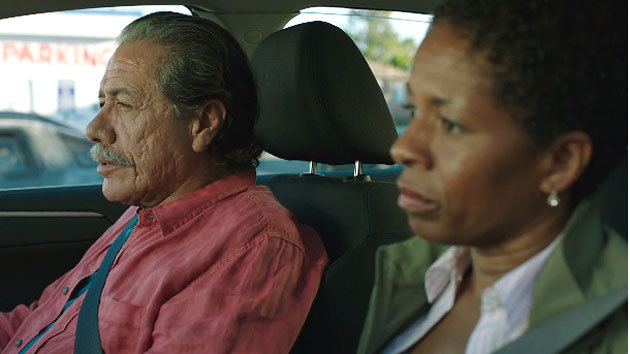
Edward James Olmos and LisaGay Hamilton
Sayles has been around since the seventies, shunning the bright lights and big bucks of Hollywood in order to do things his own way. He has doggedly pursued his goal of making honest movies, and as most independent filmmakers will tell you, this is always an uphill battle. After the movie was over, Sayles was joined by Hamilton and Olmos to take questions from the audience. During the session, Hamilton asked the audience to help get the word out, and that’s the reason for this post.
Go for Sisters is getting very limited distribution, and the filmmakers have very little money to promote their work. They need our support. They deserve our support. The link below will take you to the web site, where you can view a list of dates and locations. If you want to see a real movie about real people, check it out.
At Land (1944)
 We see the ocean. Waves cresting and breaking. The tide rolling across the shore. And then a woman lying on the sand. At first she seems to be unconscious. But her eyes open. She gazes at gulls flying overhead. A large, twisted chunk of driftwood lies nearby. She reaches for it, wraps her fingers around a broken branch, and starts to pull her body up….
This is the way Maya Deren’s At Land begins. A woman, played by the filmmaker, is left on the shore by the tide. The film follows her as she explores a world that is constantly shifting, constantly changing, where different realities seem to exist on intersecting planes. Climbing up the jagged driftwood, she suddenly finds herself peering down a long table in a huge dining room. The woman pulls herself onto the table and crawls slowly down it, while men and woman on either side talk and laugh, drink and smoke. They all seem completely unaware of her presence.
At the end of the table she discovers a chess board, and she is transfixed by the pieces as they move about. A pawn is taken, and rolls off the board. In the next shot we see the pawn floating in water that soon carries it tumbling over jutting stones. The woman follows, stepping seamlessly from the dinner party to a river in the wilderness. This might seem like a jarring leap, an absurd juxtaposition, if we were to view it from the same narrow window that we usually watch the world from. But Deren offers us a new window. The film flows naturally from one scene to the next because she’s following an inner logic. She creates her own reality, and invites us to experience it with her.
The woman keeps moving forward as the landscape continues to shift around her. As we follow her from the beach, to a dinner party, to a river, to a lonely road, we experience what she does. We see it all through her eyes. There is a story here, but not the kind we’re used to. We’ve been brought up with stories told in familiar terms, we’ve come to expect that stories will describe the world in a way that we can readily understand. But Deren discards all that, speaking to us with images instead of words. She leaves the world of rational explanation behind, instead relying on her intuition and asking us to do the same.
In some ways Deren’s movies are direct descendants of the avant-garde cinema of the twenties and thirties. Rich in symbolic references, charged with sexual tension, her work seems to be exploring the unconscious in the tradition of Germaine Dulac, Jean Cocteau and Luis Bunuel. But though Deren may have learned from these and others, her films are very much her own. In fact they’re some of the most intensely personal films I’ve ever seen. Her strange and startling images offer a vision of the world that is unique. In the history of cinema, there is no one else like her.
Deren’s fascination with dance is evident in At Land. This is a ballet and she is the central character. Whether she is walking or running, crawling or climbing, her body expresses what she’s feeling. Often she seems to be fearful, anxious, ill at ease. The woman’s journey brings her in contact with a number of different people, but she doesn’t connect with any of them. Walking along a path, she chats with a man, who is suddenly a different man, and then another different man. This last man walks ahead of her and disappears into a house, closing the door behind him. When she follows him she finds herself in a room with yet another man, lying in bed, covered with a sheet, staring at her. The woman stares back, watching him intently. The tension between the two of them is palpable. Later she returns to the beach, where she finds two women, a blonde and a brunette, playing a game of chess. She stands behind them, stroking the brunette’s hair. The three laugh, and for a moment it seems as though she’s at ease, enjoying their company. But it’s a ruse. As the chess players go on laughing, the woman reaches down and grabs a pawn, then runs off with her prize.
And as she runs off, we see that she is also standing with the chess players, the three of them regarding the figure running along the beach with curiosity. She is also watching herself from the edge of a cliff. She is also watching herself as she peers over the table. And she is also watching herself as she clings to the driftwood. These are the film’s final images. The woman regarding herself from multiple perspectives, looking on as she herself runs down the beach, leaving a trail of footprints in the sand, until she finally disappears into the distance.
To watch At Land now, click here.
My Own Private Idaho (1991)
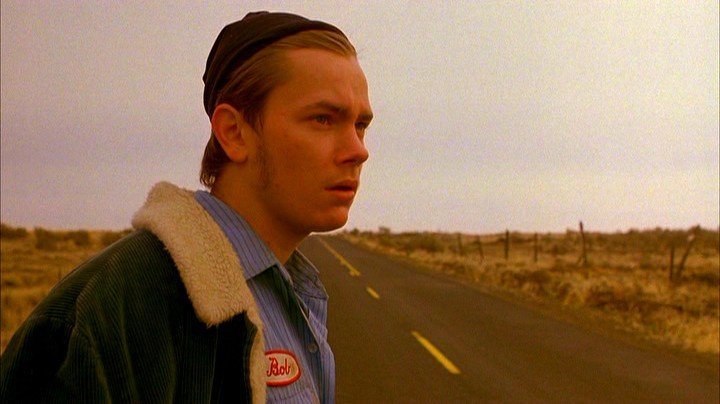
River Phoenix, waiting for a ride.
The first image we see in My Own Private Idaho is a young guy standing by a lonely road waiting for a ride. We hear crickets chirping. Birds chattering. The landscape is huge and beautiful and rolls all the way back to the horizon where it meets the sky. The guy, Mike, starts speaking to no one in particular. He talks about how he recognizes this road. He’s been on it before. He says it looks like a fucked-up face. Then he starts to tremble, and within seconds he has fallen down in the middle of the road, fast asleep.
Mike is a narcoleptic, which means he can fall asleep at any time with little warning. He’s also a hustler. He wanders around the northwest, hitting the cities, turning tricks at night and hanging out with friends during the day. Obviously, it could cause problems for a hustler if he’s prone to passing out when he’s with a client. At one point he has a seizure when he’s with an older woman. It seems she reminds him of his mother….
This rootless wanderer, a hustler in search of a home, is at the center of My Own Private Idaho. Mike is the classic Van Sant character. He wants to connect with the people around him, but he’s too innocent and too fragile to play their games. He sells his body for money, but he doesn’t know the facts of life. Van Sant builds this complex, rambling film around a young man who’s searching for some kind of perfect love. Mike hangs out with the hustlers in Portland, rides a motorcycle to see his brother in Idaho, and even takes a plane to Italy looking for that warm, nurturing embrace. But he’s looking for love in all the wrong places. He’s chasing a fantasy that only exists in his mind.
Mike thinks about his mom a lot. He has visions of her holding him, speaking to him softly, reassuring him. In his memory she’s an idealized figure, gentle, sweet, loving. From what we learn about Mike’s childhood, though, it was anything but ideal. Apparently his mother spent some time in an institution. He hasn’t seen her for years. Throughout the film Mike talks about wanting a home, a family. He feels lonely and lost. Really he just wants to be loved. Unfortunately, he ends up falling in love with Scott.
Scott is also a hustler, but not because he needs the money. His dad is a bigshot in Portland. The family is loaded. Scott could be living in the lap of luxury, but he likes living on the street, drifting around, doing drugs and pulling petty scams. He also likes the fact that his lifestyle is a slap in the face to his father’s straight world. When a city official shows up with a legion of cops to fetch the wayward youth home, Scott pretends to be having sex with Mike. He just wants to see the embarrassed looks on the squares’ faces. Scott revels in the crazy, messy world of the misfits who scrape to get by on the streets of Portland. He especially enjoys the company of an aging vagabond named Bob Pigeon, who he calls his true father. But this lowlife prince knows he’s slumming. He knows that in the end he’ll cut Bob loose, along with all his other hustler friends.
If this sounds familiar, it’s because Van Sant has lifted this part of the story from Shakespeare’s Henry IV. But there’s another layer here, because the relationship between Scott and Bob is actually based on Orson Welles’ adaptation of the play, Chimes at Midnight. Welles’ film essentially follows the structure of Henry IV, but there is a major change in emphasis. Where Shakespeare focussed on the prince’s transformation from roustabout to ruler, Welles’ drama is about the prince’s betrayal of his best friend, his “true father”, Falstaff. And this is the heart of Van Sant’s film, too. Mike and Bob both love Scott. They’re innocent enough to believe that he loves them, too. And he does, but only up to a point. When the time comes for him to take over his father’s role, he does it without hesitating. And there’s no place for his old friends in his new world.
There’s another thread running through the film, so subtle that it’s almost subliminal until the very end. A few of the characters, including Mike’s mother and brother, are seen wearing crosses. At first I wondered what this was about, because I couldn’t see anything explicitly Christian about the movie. But it all becomes clear at the funeral for Scott’s father. We see a group of people gathered in a cemetery, everyone dressed in their Sunday best, and the minister reading from the Gospel. “Do not lay up for yourselves treasures on earth, where moth and rust destroy and where thieves break in and steal, but lay up for yourselves treasures in heaven, where neither moth nor rust destroys and where thieves do not break in and steal.” There’s an accordion playing softly in the background, but it’s not part of the service for Scott’s father. We see that another funeral is taking place just a few hundred feet away, or maybe not so much a funeral as a wake. A group of Scott’s former friends are gathered around Bob’s casket, getting ready to lay him to rest. Their gathering starts out quietly, but soon becomes loud and raucous, with everybody screaming Bob’s name. The formal service for Scott’s rich father, one of those who laid up his treasures on earth, is dull, dreary, dead. The mad gathering to mourn Bob is made up of misfits and outcasts, loners and losers. The people Christ spoke for.
Van Sant knew exactly what he was doing when he cast River Phoenix as Mike, the young, clueless, drifter hustler. He seems to just be living in the moment, a pretty boy with innocent eyes, hanging on a street corner, waiting for a trick or a friend to come along. Keanu Reeves is excellent as Scott, a suave, smug rich kid who knows from the start that he’ll eventually cut all these people loose. And then there’s the great Udo Kier. As Hans he has an awkward charm, a winsome vulnerability, and he provides some of the film’s best comic moments. Kier is in a category all by himself. There’s no one else like him.
My Own Private Idaho has so many different layers that it’s hard to grasp them all. I get the sense that this was a very personal project for Van Sant, and that he poured everything he was thinking and feeling into it. It’s not a neat, tidy, linear film. It’s a sprawling, rambling epic. A poem in sounds and images. Van Sant shows us hustlers hanging in coffee shops, houses falling out of the sky, and the vast grandeur of the American northwest. The soundtrack is a lovely patchwork that weaves together America, the Beautiful, music from the Renaissance, and the Pogues. It also includes original material by Bill Stafford that echoes the melancholy beauty of decaying hotels and lonely roads. Van Sant is trying to say a lot in this film, and I really don’t care if it all fits together. This isn’t a movie you understand with your head. It’s a movie you feel in your heart.
Cops (1922)
 The great screen comedians need to create a world of their own. In their best films, Buster Keaton, Charlie Chaplin, W. C. Fields and others inhabited a universe that was governed by their own set of rules. I think this is one of the reasons comedians have such a hard time sustaining their careers. They tend to choose projects where they get to do funny things, instead of choosing projects that will allow them to be themselves. Woody Allen has been more successful than many, I think in large part because he writes and directs his own movies. Steve Martin can be brilliant, but his films are often crippled by directors who seem more focussed on framing the action than creating a world where the star can be his eccentric, outrageous self. Richard Pryor is one of the greatest comics this country has ever seen, but aside from his concert documentaries, he generally ended up in movies where the makers seemed to have no idea what to do with him.
For a time, Buster Keaton managed to create a world on film that was his alone. While his movies usually have a love interest, and there’s always an assortment of supporting characters, Keaton is the only one who truly has a presence. The rest are two-dimensional figures drawn with a few bold strokes, staying on screen just long enough to fulfill their purpose. In a Chaplin film the supporting players often have a life of their own. We might recognize them as people we’d meet on the street, and sometimes they have surprising emotional depth. The laughs in Laurel and Hardy’s silent films come out of their absolute inability to cope with everyday situations. They just aren’t equipped to deal with the real world. But Keaton’s films have little to do with the real world. They take place entirely in his imagination.
Cops starts off with Keaton’s girlfriend telling him to get lost. He’s not successful enough, and she doesn’t want to marry a loser. In the very next scene, Keaton finds a wallet full of money. It’s actually not quite that simple, but it would be impossible to describe the high-speed, knockabout ballet that ends with our hero making his getaway with a wad of cash. Now having the necessary capital to invest, our hero runs across a man sitting on the curb next to a mountain of furniture. The man says he’s just been evicted, and has to sell his belongings. Keaton, trying to act like a real businessman, makes the purchase, thinking he can sell everything for a tidy profit. Naturally this would impress his girlfriend. Unfortunately, the man on the curb doesn’t tell him that the furniture is not his. It actually belongs to a family that’s getting ready to move. They’ve put everything they own out on the sidewalk to have it ready for the expressman.
Soon Keaton is driving a horse-drawn wagon, the back piled high with furniture. The magical series of misunderstandings leading up to this is completely absurd, but in the context of the movie it all seems to make perfect sense. After a fairly prosaic beginning, this tight little two-reel film is rapidly moving into the realm of surrealism. A boxing glove is transformed into a turn indicator, which works well until a policeman is decked. Keaton decides it’s easier to communicate with his horse by calling him on the phone. One minutes he’s driving down an empty street, the next minute he’s in the middle of a parade, doffing his hat to the cheering crowd. As if all this weren’t enough, out of nowhere an anarchist tosses a bomb, and all hell breaks loose.
Of course, Keaton gets the blame for it all. He has gone from being a rising entrepreneur, calmly driving his cart down the road, to being public enemy number one, now fleeing from an army of cops. And it gets worse. Completely in keeping with the film’s absurd logic, it turns out that the head of the household that lost all its furniture is a policeman. And to take it even further, the father of the girl he’s trying to impress is the chief of police. Soon Keaton is dashing madly down the city’s streets, pursued by a horde of cops that seems to keep growing larger and larger. In the hands of a less talented man, this might seem like overkill. In the world that Keaton has created, it seems like the only possible outcome. Years later, Edgar Ulmer directed Detour, a noir classic which tells us in the starkest terms imaginable that there’s no point in running. We can’t escape our fate. Cops basically has the same premise, but in this case it’s played for laughs. It’s not surprising Samuel Beckett was such a big fan of Keaton’s work.
If you’d like to take a look at Cops, here are a couple of links you can follow….
The reason I’m giving two links is not because the prints offer different versions of Cops. It’s the music. The first one was scored with a small chamber ensemble for a contemporary release of the film. The second one is scored with a large pipe organ, which is much more in keeping with what you would’ve heard in a theatre back in the twenties.
I have to say I’m not totally happy with either version. While the chamber score is certainly a nice piece of music, it doesn’t capture the spirit of Keaton’s world. The music is too genteel for this rough and tumble comedy. The organ soundtrack, while probably close to the accompaniment Cops would have had in the silent days, is too big and too busy for my taste. It doesn’t give the film room to breathe, and doesn’t capture the subtlety that was so much a part of Keaton’s genius.
I’d prefer something in between the two. Actually, I remember a night years ago when the Silent Movie Theatre was still actually showing silent movies. They had a Keaton night, and I’m pretty sure Cops was on the bill. At any rate, to accompany the films they had a guy on piano, and I thought he really nailed it. He knew how to complement the action on the screen without competing with it, and he had a light touch where it was needed. I was so impressed with his playing, I went up to him during intermission and asked him his name. Of course, that was years ago, and now I’ve totally forgotten it.
Rojo amanecer [Red Dawn] (1990)
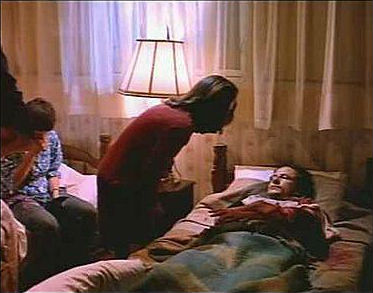 An older man wakes up, gets out of bed and makes his way to the kitchen. He tears a page off the calendar, revealing the date October second. This date probably has no meaning for most people, but for Mexicans who were alive in nineteen sixty eight, it means a great deal.
In nineteen sixty eight, the Olympics were held in Mexico City. The government had a huge investment in the event, and so did many powerful business interests. But like several other countries back in the sixties, Mexico had a growing protest movement. Students and others had been holding marches and rallies for months, speaking out against police violence and asking that political prisoners be freed. Tens of thousands of people had shown up for some of the gatherings. Finally, as the opening of the games drew near, the government decided to shut the movement down once and for all. On October second, a protest was held in Tlatelolco, a neighborhood in Mexico City. As speakers addressed the crowd, police and soldiers surrounded the square. Just as the meeting was ending, government forces opened fire on the protesters. It’s estimated that between three hundred and five hundred people died that day, though no one will ever know for sure. Hundreds more were taken to prison and tortured.
Governments don’t usually acknowledge acts like this, and often the media doesn’t either. It was left to artists to address one of the more horrific events in Mexican history. Rojo amanecer is a fictionalized drama based on massacre of October second, nineteen sixty eight.
The movie tells the story of a middle-class Mexican family living in an apartment block in Tlatelolco. The family is made up of three generations, the grandfather, the mother and father, and four children. Through this one family, screenwriters Xavier Robles and Guadalupe Ortega Vargas give us a broad overview of Mexican society at end of the sixties. The grandfather is a veteran of the revolution, an arch-conservative who respects the military and thinks the protesters need to be taught a lesson. The father and mother just want a quiet, middle-class life for themselves and their children. The two older sons are part of the protest movement, determined to change the system, convinced that victory is inevitable. The younger boy and girl are enjoying a happy, carefree childhood and have no idea what’s going on around them.
Director Jorge Fons immerses us smoothly and swiftly into the life of the family. The screenwriters waste no time in setting the scene and laying out the divide between the generations. As the grandfather tries to pour his morning coffee he complains that his grandsons are useless. The TV carries news of the Russian invasion of Czechoslovakia. A Beatles song on the radio sparks a debate about long hair. The chatter around the breakfast table is initially pretty innocuous, but quickly gets heated. The two older sons are full of talk about the injustices committed by the government, and are convinced that the protesters will win in the end. But the father, who works for the city, becomes angry and tells them they’re playing with fire. He has heard rumors around the office of a coming crackdown. The mother is upset by all the arguing and worried about her sons. She just wants her family to get along.
The film is remarkably compact both in terms of space and time. Everything unfolds in the family’s apartment and the corridors just outside. The action takes place in a twenty four hour period. We are constantly reminded of the time. Fons frequently cuts to clocks, and we even hear the ticking of a clock under the opening credits. Fons’ approach is admirably straightforward. He doesn’t try to dramatize the events. For the most part he simply focusses on the actors, first as they go about their business, unaware of what’s coming, and later as they’re desperately trying to cope with the horrifying reality of their situation. The film is given resonance and texture by the characters’ surroundings. Production designers José Luis Garduño and Helmut Greisser, along with set decorator Mario Sánchez, deserve a good deal of credit for creating the family’s home. Not only does the apartment feel lived-in, the pictures, posters, knick-knacks and bric-a-brac that fill it up tell us a lot about these people. The older boys have a Beatles poster on their door, and a picture of Che Guevara on the wall. The living room is filled with family photos, including a black and white picture of the grandfather at the time that he fought in the Mexican Revolution. Early on in the film we see a picture of Christ on the wall. After the shooting has started, we see it again, now pierced with a bullet hole.
One of the reasons the film is so compelling is that the actors inhabit their roles completely. Watching Hector Bonilla as the father, it’s easy to see that his anger with his idealistic sons comes out of a very real fear that something will happen to them. María Rojo starts off as a housewife complacently doing her chores, is reduced to abject panic when the shooting starts, and then forces herself to deal with the situation as best she can. One of the most interesting performances is given by Jorge Fegán as the reactionary grandfather. He is disgusted by his older grandsons, but has a special bond with the youngest, and takes care to protect him when violence threatens the family. Bruno and Demian Bichir play the college students, brimming with fiery passion and frightening naivete.
Really, everyone involved in this making this film deserves respect, not just for the skill with which it was made, but for keeping the events of October second in the public consciousness. The Mexican government lied about the incident when it first occurred, and then spent years trying to bury the facts. Decades later, President Vicente Fox launched an investigation, but the results were severely compromised. Fox promised that those responsible would be brought to justice. Somehow that still hasn’t happened.
Rojo amanecer is hard to watch. It would be difficult even if the film were pure fiction, but because we know it was inspired by actual events, that people actually died, it is deeply disturbing. If you’re like me, you’d probably prefer to watch something entertaining, some escapist fantasy that pushes the real world into the background for a while. The news is filled with atrocities, so much so that it’s easy to be overwhelmed by the horror. If we spent all our time dwelling on the violence, we’d go crazy. But it’s just as dangerous to tune the world out and live in blissful ignorance. So how do we strike a balance? How do we acknowledge the bloodshed that’s occurred and still go on with our lives? Believe me, I know it’s tempting to forget….
But we can’t forget. We have to remember.
Released on DVD by Quality Films. In Spanish. NO ENGLISH SUBTITLES.
The Trip (1967)

Bruce Dern and Peter Fonda
The Trip is one of his smartest, sharpest films. Though he wasn’t into drugs himself, Corman understood that drug experiences were central to the counterculture movement. In a way it seems he may have even anticipated the drug culture with features like The Masque of the Red Death and X: The Man with X-Ray Eyes, which included delirious, hallucinogenic imagery. Corman understood that a shift in consciousness had taken place. As a commercial filmmaker, he was interested in exploiting current trends, but as an artist, he was also interested in exploring the changes that were happening in the world around him.
The first draft of the script was by Charles Griffith, who had already written numerous Corman films, including Not of this Earth, Little Shop of Horrors and The Wild Angels. But apparently the director wasn’t satisfied with Griffith’s screenplay and handed the job to Jack Nicholson, who received sole credit. The script is pretty unconventional. There’s no plot, at least not in the usual sense. Corman avoids the melodramatic structures that had served him so well for years. He doesn’t need them because he’s not trying to deliver a message about drugs. He just wants to immerse the audience in an experience. From the beginning of the film to the end, we simply stay with the main character while he’s tripping on acid.
Corman starts off with a shot that sets the tone for the movie. We see a beautiful young couple embracing against a blue sky. Then the woman speaks, and we realize that she’s reciting an ad slogan. The camera pulls back to reveal that the couple is standing in the middle of the ocean. We then see two men perched on some rocks by a camera. The director yells cut. We’re at the beach, watching a commercial being filmed. The director, Paul, is satisfied with the shot and tells his crew to bring the couple back to the shore. Opening the film with a surreal image of an idealized couple is not accidental. Paul is shortly confronted by his wife, who is angry that he missed an appointment to sign divorce papers. It’s clear that Paul isn’t happy about splitting up with his wife, but it’s also clear that he’s interested in getting together with other women.
This sets up the dynamic for the film, the conflict that will shape Paul’s hallucinations once he drops acid. His friend John is going to act as his guide while he’s tripping, staying with him to make sure that everything goes well. They go to John’s home in the Hollywood Hills, a large, comfortable house decorated with an array of psychedelic colors and op-art patterns. When the acid first starts coming on, Paul is childlike, enchanted by everything he sees. Simple objects suddenly seem incredibly beautiful. We see Paul roaming through the house, enthusing about the living energy he sees around him, and these scenes are intercut with subjective images of Paul’s visions.
In this imaginary landscape Paul encounters all sorts of strange things. His wife appears, but there are other women, too, and it seems that the conflict between love and desire is very much on his mind. We see two riders on horseback, completely covered by black cloaks with hoods. At first they seem to be figures in a landscape, but suddenly they’re pursuing our hero and he runs into a cave filled with mist. As the film goes on, Paul’s hallucinations become darker and more complex. He starts getting very paranoid, and when John leaves the room for a moment, Paul bolts from the house, running down the side of the hill to the Sunset Strip. Somehow Paul manages to negotiate the colorful chaos of the Strip at night, though he does have a couple close calls. Finally he meets a woman in a club and goes back to her home to spend the night. When he wakes up the next morning, the LSD has worn off, leaving him wondering what has happened. He dropped acid to gain insight, but he’s unsure if he’s learned anything at all.
Corman gives us a striking snapshot of LA in the late sixties. From the illusionistic opening at the beach, to John’s colorful hillside home, to the happy frenzy of the Sunset Strip at night. The Trip doesn’t just document the locations, it also captures the state of mind of the hipster crowd in LA at that time. Everything’s cool, everything’s mellow, everything’s groovy. Until the cops show up, and then you just run like hell. By this point in his career Corman had become an extremely capable filmmaker, able to produce interesting, intense movies on very tight budgets. He was always concerned about holding the audiences’ attention, so there’s usually a fair amount of action and a certain amount of sex. But his best films were also visually expressive, and he knew how to create potent, compelling images. I wish that he’d invested a little more time and money in The Trip, because some of Paul’s visions seem to have a cut-rate quality, and some scenes could have benefitted from a little rewriting and a few more takes. To their credit, Nicholson and Corman are tackling some serious themes. I feel like they could have dug a little deeper, taken it a little farther. Still, Corman was not out to deliver a message, and the movie is honest in that Paul doesn’t claim to have any more answers after taking acid than before. It is maddening, though, that AIP changed the ending, superimposing something like shattered glass over Paul’s face in the final shot to imply that he’d been damaged by the experience. It’s a nasty scar on a film that is otherwise an imaginative and engaging look at a moment in American culture. It’s a rare example of a commercial film that’s willing to engage the counterculture on its own terms.
——————————————————————-
* The Intruder, a sharp, tough little movie about racial prejudice.
Oz in 3D?
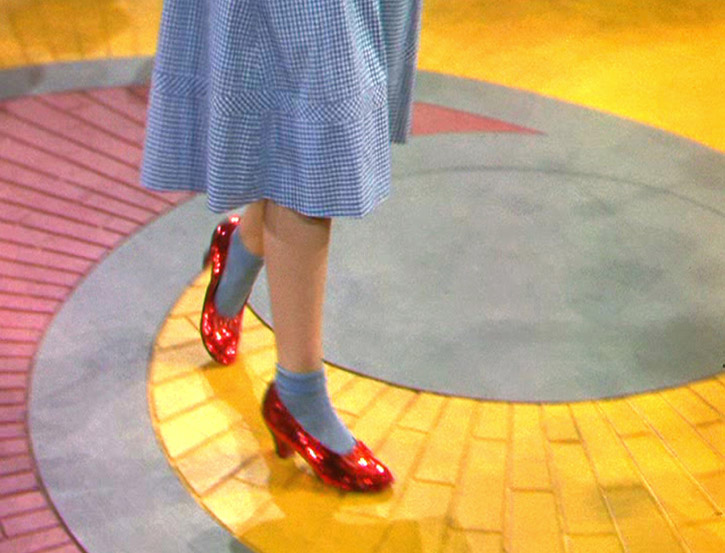 I was standing on Hollywood Boulevard the other day, and I noticed that the Chinese Theatre was advertising a new version of The Wizard of Oz in 3D. I’ve gotta say, this really bugs me.
I have no problem with recent 2D films being converted to 3D, as long as the director approves. If James Cameron wants to re-release Titanic in 3D, that’s his business. But Victor Fleming and his numerous collaborators have been dead for many years, so there’s really no way of knowing whether or not the original creators would approve of this update.
It’s not just The Wizard of Oz I’m worried about. The thing that really concerns me is the precedent this sets. If the 3D Oz is a success, does this mean studios will start a stampede to do the same thing with other classics? I’m thinking back to the eighties, when companies were colorizing movies for release on video. Isn’t this the same thing?
If the theatrical re-release of Wizard of Oz in 3D makes a lot of money, what’s next? Lawrence of Arabia? 2001? Psycho? And now that technology has advanced to the point where 3D is available on home video, does this mean we’ll see “enhanced” versions of The Maltese Falcon? The Searchers? Rebel without a Cause?
Does anyone else see this as a problem? And if so, should we be doing something about it? I wonder if the DGA has this on their radar….
Ha! Ha! Ha! (1934)

Betty Boop
In the twenties, the Fleischer brothers created Ko Ko, the Clown, who appeared in their popular Out of the Inkwell series. Later on they produced successful series of cartoons featuring Popeye and Superman. But the character probably most closely associated with the Fleischers was Betty Boop. Though Betty didn’t appear until the thirties, she seemed to be channeling the spirit of the twenties with her short dresses and bobbed hair. At times the cartoons she appeared in featured music performed by Cab Calloway and Louis Armstrong.
Ha! Ha! Ha! begins, as many Fleischer cartoons do, with one of the Fleischer brothers at the drawing board. Max has just finished drawing Betty when quitting time arrives. Shortly after Max leaves for the day, Ko Ko pops out of the inkwell and starts wandering around on the desktop. Fleischer characters often interact with live action settings, and Ko Ko starts munching on a candy bar that Max has left behind. Almost immediately, he’s struck with a painful toothache, and Betty comes to his rescue. Jumping down off the drawing board, she picks up a pen and draws a dentist’s office, giving her all the tools she needs to pull Koko’s tooth, she thinks. After a brief, painful struggle, where pulling the tooth somehow looks more like dancing the tango, Ko Ko is still suffering terribly. Betty decides to give him some laughing gas, but unfortunately she’s a little careless. Soon the room is filled with a dense cloud of nitrous oxide.
This is where things really get interesting. One of the coolest things about the Fleischers’ world is that anything can, and does, happen. In this case, the clock on the wall suddenly has a face, and it begins to laugh. Then the same thing happens with a typewriter. But the effects of the drug aren’t just confined to the Fleischer studio. The gas spills out the window and into the streets below. Soon crowds of people are laughing hysterically, and even more inanimate objects come to startling life. A mailbox, a bridge, and a car are overcome with mirth, but it goes even farther. As the film nears its end we see an entire cemetery filled with tombstones, all of them bellowing with uncontrollable laughter.
Most animation studios produce cartoons with familiar stories based on familiar formulas, because they know their audience is looking for a safe high. The Fleischers didn’t play it safe. They really took advantage of the possibilities in animation by creating a universe where anything could happen, and the laws of nature didn’t apply. Their cartoons may take you into other dimensions, other realities. They may take you places you don’t even want to go. Much of their work has a wild, surreal quality, and some of it is truly creepy.
Unfortunately, they had to clean up their act in the mid-thirties when the Production Code took hold. The Fleischers continued to do excellent work, but without reaching the same crazy heights and scary depths. The character who suffered most was Betty Boop. In a way she seemed like the last hold-out from the jazz age, a cute, sexy girl looking to have fun. The Production Code put an end to all that. Forced to change her ways, Betty became a much less interesting character. She made her last cartoon in nineteen thirty nine.
You can watch Betty in Ha! Ha! Ha! by clicking on the link below.
If you’re interesting in seeing one of the most startling and strange cartoons the Fleischers produced, take a look at…
As for their later work, one of their most visually striking efforts is…
Bande à part [Band of Outsiders] (1964)
Not too long ago I saw Bande à part at the Arclight, Hollywood. I’d already seen the film a couple of times and liked it, but this time I connected with it in a way I hadn’t before. The best word to describe what I felt is euphoria. I was swept up in the whirl of images and sounds, I was completely involved in the performances, I was overwhelmed by the audacity of it all. The movie was totally intoxicating.
I think Godard is one of the most gifted filmmakers ever, but I’ve often had trouble relating to his work. I know I’m not alone. Many critics have written about Godard with a mix of admiration and frustration. Audiences have never flocked to his films, though he does have a small, passionate following. His movies are amazingly inventive and imaginative. But they can also be difficult, didactic, and even dull. I think in part this is because Godard has a complicated relationship with the medium. He’s spent a good part of his career trying to figure out what role film should play, and what role he should play as a filmmaker. While he grew up watching American films, and has spoken of his respect for some Hollywood filmmakers, he’s definitely conflicted about the impact commercial cinema has had on the world. Like many of us, as a young man he fell under the spell of Hollywood’s magic, but as an adult he finds himself horrified by Hollywood’s madness.

Anna Karina, Claude Brasseur and Sami Frey
Many of Godard’s early films were based on Hollywood genre formulas, and movies about criminals seem to have had a special hold on him. Bande à part falls into that category, but rather than just make a crime film, the director ended up making, as he often did, an essay on crime films. He doesn’t want us to just sit back and enjoy the ride, letting ourselves get pulled along by the narrative. As much as he loves Hollywood movies, he also knows you can’t trust Hollywood movies, and that makes him want to question the form, to twist it, to turn it inside-out. Anything to keep himself and us from sliding into complacency.
It’s Godard’s irreverent, anarchic approach to the material that makes the film such a thrilling, dizzying experience. As soon as the credits begin we’re assaulted by raucous music as close-ups of the three leads flash before us. Bande à part is full of abrupt transitions and sudden changes in tone. The restless energy of the three would-be thieves drives the film. The visual style is amazingly alive and vibrant. And the sound is just as important as the images, catching both the din of the city and the intimacy of quiet conversations. Rather than trying to clean up the audio, bringing down the ambient noise, looping the dialogue, Godard lets us hear the world as it is. We hear feet scuffling along the street, music bouncing off the walls, traffic droning in the background. And when we get to the house where Odile lives we’re suddenly surrounded by an unsettling calm. The silence somehow feels strangely sinister.
The film is based on the novel Fools’ Gold by Dolores Hitchens, though apparently Godard took a lot of liberties in adapting it. The story follows Odile, Franz and Arthur, three young people in Paris who are planning to steal some money. Though the trio wants to pull a heist, they seem to have no idea how to proceed, and when it comes to committing the crime they’re hopelessly inept. Arthur takes charge, giving orders and acting tough to impress Odile, but he’s really just as clueless as his friends. Franz goes along, seemingly because he doesn’t have the nerve to challenge Arthur. And Odile is a naïve young girl who just wants to get away from her home and have fun.
One of the main differences between Bande à part and the crime films of the studio era is the way the main characters are portrayed. If we were watching a movie with Humphrey Bogart or James Cagney (later on maybe John Garfield or Robert Ryan), for the most part the star would be tough, confident, assured. As the tension built, as the pressure mounted, we’d get to a point where that confident surface would start to crack, revealing the tough guy’s vulnerable side. Often the heart of the film would lie in the moments where we saw how frail the hero was beneath his hard exterior. That conflict between the tough and the tender was one of the linchpins of Hollywood melodrama. But Godard takes a totally different approach. In Bande à part, it’s obvious from the beginning how vulnerable these three are. It’s clear that Arthur and Franz are doing their best to mask their insecurity by acting cool, and Odile is trying as hard as she can not to let them see how scared she is. These three are not crooks. They’re playing at being crooks. At times we see Arthur and Franz literally acting out scenes from movies.
Bande à part has an ending, but it doesn’t have a resolution. It couldn’t, because Godard doesn’t believe in tying things up neatly. Rather than trying to find order in chaos, Godard lets us experience the world as it is. My sense is that he’s a romantic who feels he should be a realist. His work is formed by the tension between these two perspectives. In his films he seems to be offering us an invitation to explore with him the massive contradictions that make up our lives, the sorrow and the violence, but also the joy and the beauty
How can you turn down an invitation like that?
 Reality Is Scary