F for Fake (1973)
In France in the fifties, Orson Welles was a hero. Citizen Kane was a key film for the young French critics of that era, the generation that formulated the auteur theory. When the auteur theory made its way over to the US it mutated into something different, and became the basis for a cult that worshipped the director as a god. Welles became an icon, a genius who was banished from Hollywood after bringing fire to the mortals.
Welles seems to have been uncomfortable with the attention he was getting from his acolytes. Beginning in the sixties, the man who used to represent the director as hero began minimizing the role of the director. In interviews with Peter Bogdanovich and others, Welles repeatedly maintained that critics overstated the role he and his colleagues played behind the camera. The brash young egotist who at twenty needed to be the center of attention now seemed frustrated by the extravagant amount of attention focussed on directors.
F for Fake seems to be his argument against worshipping the author. Though the film begins as a story about forgers, it is really about something very different. The tone is mostly lighthearted, but Welles is actually asking some fundamental questions about the nature of art. What is it? What makes it valuable? And what the hell do critics know, anyway?
Welles begins with art forger Elmyr de Hory, who for years produced magnificent fakes that were sold as Modiglianis, Matisses and Derains. We are also introduced to author Clifford Irving who wrote a book chronicling de Hory’s career. Unfortunately, Irving later found himself in jail for faking a relationship with Howard Hughes in order to land a book deal. The adventures of these two swindlers make a great story, and Welles has a great time telling it. But as he relates the details of the scandal, he begins to weave in other threads. One thread has to do with “the experts”, and the control they exercise over the art market. Another thread has to do with fakery, which could also be construed as creating an illusion. Welles reminds us of his own efforts as an illusionist, not only as a director, but as an actor and magician.
Welles’ role as the “author” of F for Fake raises some interesting questions. The footage of Elmyr de Hory was largely shot by Francois Reichenbach for an altogether different film. The director also incorporates a good deal of archival footage. And even some of the material shot by Welles himself was intended for other projects. So the bulk of Welles’ work was done in the editing room, appropriating existing footage and shaping it to suit his own ends. Certainly this does not fit the standard definition of what a director does, but there is no question that the finished product expresses Welles’ point of view.
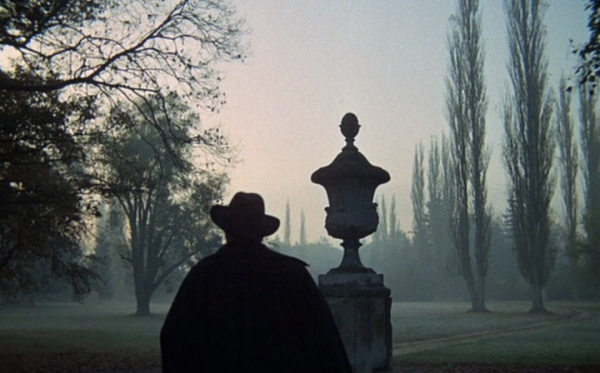
What is art? And what does art have to do with its author? Welles seems to be telling us to shift our attention away from the man behind the camera. After sweeping us along in a frenetic quest that has taken us to Ibiza and London, Vegas and Hollywood, we suddenly find ourselves in front of the cathedral at Chartres. The pace slows and we enjoy a moment of meditative calm. Welles stands in front of the cathedral, calling it possibly the greatest achievement in Western culture, and reminds us that we do not know who built it. We do not know the names of the people responsible for the towering spires or the radiant stained glass. Its authors are anonymous, yet centuries later we are still moved by its beauty. Nearing the end of his career, Welles seems to be arguing that we should be less interested in who’s speaking than in what’s being said.
Northwest Hounded Police (1946)
 Animation means total freedom. You can create fantasy landscapes and flying saucers, crazy cats and gentle giants. Anything you can imagine is possible. There are no limits.
But in spite of the possibilities, there are very few people who have taken advantage of animation’s full potential. One of those people is Tex Avery. Having arrived in Hollywood in the early 30s, by the middle of the decade he had his own unit at Warner Bros. where he helped to create and refine characters such as Bugs Bunny, Daffy Duck and Porky Pig. By 1942 he was working at MGM, which is where he made the cartoons most closely associated with him.
By the early forties Avery had refined his approach to the point where his best films had a distinct style. Most of his cartoons revolve around a conflict between two characters, and the surreal mayhem that ensues. The artists and animators at MGM were skillful enough to deliver pretty much anything he wanted, making the action flow swiftly and smoothly no matter how bizarre the situations.
I used the word “characters” in the last paragraph. Actually, Avery wasn’t really interested in characters. The dogs, cats, canaries and wolves that populate his cartoons are strictly two-dimensional. Northwest Hounded Police features a stoic little dog and a wolf on the run from the law. That’s all he needs to set up the ridiculously simple premise. Everywhere the wolf runs, the dog is there waiting.
It’s a one gag movie, and the gag was actually used by Avery in more than one cartoon. How does he get laughs when he’s repeating the same joke over and over? Part of the answer is that this basic joke becomes progressively more absurd. Another thing that makes it work is the tension between the little dog’s deadpan face and the wolf’s increasingly outrageous reactions.
But for me the most important factor is the sadistic glee that Avery shows in tormenting the desperate wolf. This is a dynamic that runs through a lot of the director’s work. Often one character tortures another for the full length of the cartoon. Sometimes the victim is finally caught, as in Northwest Hounded Police. Sometimes he loses his mind (Slap Happy Lion). And in one case he’s so maddened by the relentless trauma he just explodes (SH-H-H-H-H). People who knew Avery described him as a smart, funny, talented guy, but they also agree that he had his demons. There’s something insane about these frenzied exercises in non-stop mayhem, and that insanity is ultimately the reason I love these cartoons.
The movie begins with the wolf’s escape from prison. We watch him careening around a map of North America, swimming across the Great Lakes, and finally ending up in Canada. When the wolf first realizes that the dog is on his trail, he takes off at top speed. We get a series of lightning fast shots where he moves from extreme foreground to extreme background in the blink of an eye. With the help of the artists at MGM, Avery imagines an amazingly flexible landscape that expands and contracts as we follow the manic chase. We fall from the top of a mountain to the bottom of a lake, parachute from a plane’s cockpit, swim across the Atlantic. At one point the wolf is moving at such terrific speed that he ends up skidding off the film frame, past the sprockets and into an empty white space.
And this is another of the director’s favorite devices. Reminding you that you’re watching a movie. Avery lets his characters tell you what’s going to happen next. Sometimes they even tell you the end of the story. They suddenly run out of Technicolor and the landscape turns black and white. There are cartoons within cartoons. Avery didn’t just work in the medium. He played with it, commented on it, twisted it this way and that to suit his own needs.
His limitless imagination finally did hit some hard boundaries. By 1953 he was exhausted and left MGM for the Walter Lantz studio. He only did four cartoons for Lantz, and when he quit in 1955, that was the end of his career in theatrical animation. While Avery continued to work in the field, the market had changed. He never again had access to the same resources or the same kind of outlet for his unbridled creativity.
But you can still watch Northwest Hounded Police. Just click here.
¡Que Viva México!
When I started this blog back in two thousand ten, I was just discovering Mexican film, and I thought it would be a good idea to do a short survey of the country’s cinema. At the time I envisioned spending a few months on the project. And here I am actually wrapping it up almost two years later. During that time, I learned a few things….
First, I learned that blogging can be hard work. I initially thought I’d try to post every two weeks. On average I’ve actually been posting about every two months. One reason for this is that I write slowly. Not sure if I can change that. But another reason is that almost all of the films I’ve written about were new to me. I had to watch many of them two or three times just to figure out what I wanted to say. In the future I’d like to spend more time on movies I’m familiar with. Hopefully that will translate into more frequent posts.
Second, I’ve learned a lot about Mexican cinema. When I started writing on the subject I’d only seen a handful of films. My knowledge is still pretty limited, but I’ve come to realize how rich Mexican cinema is. It’s been like opening a door on a whole new world. Mexico has produced some amazing talent, both behind the camera and in front of it. I know there are a lot of wonderful films I have yet to see.
And finally, I’ve learned a lot about Mexico. I’ve looked at books on the country’s history. I’ve spent some time following current events on the net. So I feel like I have a vague grasp of where Mexico is and how it got there. But you can only learn so much from reading history, and the media never gives more than part of the story. Art in general, and cinema in particular, can bring us right into a nation’s soul. As I said in writing about Pueblerina, the film does not show the reality of Mexico, but it brings us to the heart of the country’s mythology. Movies like Lo que importa es vivir and El jardín del Edén reveal subtle, complex truths that can’t be stated in words. An image of a man walking down a dusty street. The sound of musicians playing in a camp by the border. Language can be used to communicate, but it can also create barriers. Images and sounds can speak to you no matter what your native language is.
Mexico has just elected a new president. It’s hard to say exactly what that means. Given the massive problems facing the country, it’s unrealistic to hope that a different chief executive will bring about some kind of magic transformation. But one thing that Peña Nieto could do is stop the government’s insane war on drugs. Even if this policy has weakened the cartels, it hasn’t weakened the basic dynamic that drives the drug trade. And it has caused incredible violence, killing tens of thousands of citizens.
The violence needs to stop. ¡Viva México!

No Mas Sangre/No More Blood
Miss Bala (2011)
A word about the title of this film for those who don’t speak Spanish. The main character wants to enter the Miss Baja California beauty contest, but is instead drawn into Mexico’s drug war, dodging bullets to stay alive. The word “bala” means “bullet”, so the title is a play on words, contrasting her goal with her reality.

Stephanie Sigman
How do you survive if you live in a war zone? You keep your head down and hope nobody blows it off. Parts of modern day Mexico are war zones. Since the Calderon government sent in the army to combat drug traffickers, over forty seven thousand people have died in the ensuing violence.
The film’s first shot tells us a lot about the central character. We are in a young woman’s bedroom, and her mirror is plastered with photos of models and celebrities. Laura Guerrero (Stephanie Sigman) is a young woman living in Tijuana with her father and brother. The family pays the bills by selling clothes, but Laura has dreams of a different life. Moments after her father drives away to sell his wares, Laura runs off to enter the Miss Baja beauty contest. This is her chance to make it big.
Everything goes horribly wrong. Laura goes looking for a friend in a dance hall and ends up in the middle of a bloody gun fight. In trying to find her friend she’s captured by drug dealers. From that point on her only goal is survival. She swings back and forth between desperate panic and catatonic numbness.
Looking at all this through Laura’s eyes, the director captures the state of mind of contemporary Mexico. The script, by Naranjo and Mauricio Katz, takes us on a dizzying tour of the drug war that’s consuming the country, putting us in the middle of chaotic shootouts and confusing subterfuges. All the men carry guns, and it’s often hard to tell if they’re drug dealers or government agents. Though really, does it matter who they’re working for?
Naranjo and cinematographer Mátyás Erdély shoot scenes in long, fluid takes with a minimum of cutting. We stay with Laura throughout, following her from one chaotic situation to another, experiencing it all with her. The film has a dizzying, kinetic energy, pulling us from busy streets to underground garages, from noisy auditoriums to deserted beaches. But Miss Bala is not an action film. The director does not play it for suspense. There is no traditional story, no structure we can hang on to for reassurance. We share Laura’s fear because, like her, we never know what’s around the next corner.
Laura does win the beauty contest. Her wish does come true. But as she stands on the stage wearing her tiara, music blaring, confetti swirling around her, Laura feels only fear and confusion. And hours later she’s again the center of attention, this time having been arrested in the course of a massive police action. She is dragged in front of cameras as part of a press conference staged by government officials to boast of their anti-drug efforts. In both cases she is nothing more than a prop used by the media to tell lies. The story of the ordinary girl turned beauty queen and the story of the beauty queen turned drug dealer are both equally dishonest, both equally meaningless.
Don’t Forget Mexico
I’ll be honest. When I said I wanted to participate in a blogathon to support film preservation, I envisioned writing a thoroughly impassioned and well-documented account of the challenges faced by those who were trying to preserve Mexican cinema. I’ve been writing about Mexican films for over a year now, and during that time I’ve reached two conclusions:
1.
Mexico has produced a lot of great movies.
2.
A lot of them are really hard to see.
Up until a few years ago, I was pretty much completely ignorant about Mexican film. I’m still pretty ignorant, but I realize now what an amazing cinematic tradition the country has. I get the sense that most Americans are in the same place I was a few years ago. People talk about films from France, Denmark, Iran, Azerbaijan and Croatia, but I never hear anybody talk about films from Mexico. Sure, you can point to the buzz about del Toro, Iñárritu and Cuarón, but the fact is that none of them are making films in Mexico any more.
So when I was offered the opportunity to participate in a blogathon devoted to film preservation, I decided this was my chance to let everybody know how rich Mexican cinema is, and how important it is to preserve that heritage. Unfortunately, after a week of scouring the net for information, I haven’t come up with a lot of hard data.
The good news is that Mexico seems to have the largest film archive in Latin America, and also seems to be a leader in the preservation of Spanish language films. The Filmoteca at UNAM (National Autonomous University of Mexico) and the Cineteca Nacional have thousands of films in their archives, and have a fair amount of funding to pursue their work. Within Mexico, there is widespread recognition of the importance of conserving the country’s cinematic tradition.
The bad news is that, just like in every other country, there are a lot of films that are neglected, forgotten, or just plain gone. Here’s my imperfect, inadequate, but still impassioned account of some of the challenges that face those who are working to preserve Mexico’s film history.
It won’t surprise anybody that many of the films made during the silent era in Mexico are gone. But in reading about some of the lost films from that period, I came across the name Elena Sánchez Valenzuela, who starred in La luz, tríptico de la vida moderna (1917). Not only was Sanchez Valenzuela one of the first stars of the Mexican film industry, she was also one of the first people to understand the importance of preserving cinematic history. In the 20s she wrote about film for for a daily newspaper, and later Sánchez Valenzuela helped lay the groundwork for the Cineteca Nacional, which today plays a leading role in film conservation. Back when most people saw movies as cheap entertainment, Sánchez Valenzuela understood their importance in the larger culture.
If I tell you that El anónimo (1932), directed by Fernando de Fuentes is considered lost, you may not get too worked up about it. But imagine that Howard Hawks’ first feature was gone forever, and maybe you can understand how sad this really is. If you haven’t seen Vamonos con Pancho Villa or El Compadre Mendoza, you have no idea how important Fuentes was to the history of Mexican film. I wouldn’t want to push the Fuentes/Hawks comparison too far, but this director had a clear-eyed, unsentimental view of the Mexican Revolution, and did not shy away from the scarier aspects of the country’s culture of machismo.
Some of you may be familiar with Maria Candelaria (1944), one of the more famous films directed by Emilio Fernandez. However you may not be familiar with the ongoing struggle to return the film to its original form. When MGM bought the rights to distribute Maria Candelaria in the US, for some reason the original negative was shipped to Hollywood. There it was cut by more than 20 minutes and the film was dubbed into English. While the Filmoteca/UNAM was able to reclaim the negative, the soundtrack has not survived. So at this point, there is no way to restore Maria Candelaria to its original form.
It’s difficult to find information on more recent movies, but I can tell you I’ve had a hell of time tracking down many titles. I should emphasize that I’ve had to watch all of this stuff on DVD. Nobody in the LA area is showing Mexican films on the big screen, and as far as I can tell that applies to the rest of the US. It’s disturbing enough that many of the films I’ve purchased are cut rate releases that use degraded prints. It’s even more disturbing that a number of works by established directors aren’t even available on DVD.
I wish I had more information to pass on. But I’ll close by saying that if you haven’t seen anything by Fernando de Fuentes, Emilio Fernández, Arturo Ripstein or María Novaro, you’re missing some of the most beautiful and interesting films ever made.
And if reading this makes you want to throw a few bucks at film preservation, follow this link….

https://npo1.networkforgood.org/Donate/Donate.aspx?npoSubscriptionId=1001883&code=Blogathon+2012
El jardín del Edén [The Garden of Eden] (1994)
 You could take El jardín del Edén as a meditation on borders. Not just the boundaries that separate nations, but also the lines we draw between ourselves and even the barriers we create inside ourselves. Most of the film is set near the border between Mexico and the US, in and around Tijuana. This is a place where different cultures come together, sometimes merging in a happy chaos, other times grinding against each other and shooting off sparks. Labels like “Mexican”, “American”, “Indigenous” start to lose their meaning. It all depends on your perspective.
The film centers on three women who have come to Tijuana, each for different reasons. Liz is a Mexican-American woman working on an exhibition about cultural identity. Her friend Jane is Anglo and speaks almost no Spanish, which doesn’t stop her from trying to be friends with everyone she meets. Serena is a single mom who is struggling to make a living and trying to deal with her teenage son. The script, by director María Novaro with Beatriz Novaro, doesn’t try to fit these women into a standard dramatic framework. The film isn’t about drama. It’s about people trying to find a way to live their lives.
Novaro seems to be as interested in the place as the people. She takes the time to dwell on details that give us a feel for the city. The cinematography captures the tacky beauty of the border, the dusty landscapes and cheap hotels. English and Spanish collide and mutate in garish neon and hand-painted signs. While the movie doesn’t have a traditional score, we hear music all over the place, in dance halls, border camps, and on the street.
References to Eden and paradise come up throughout the film. Is paradise across the border? Is it right here inTijuana? Or does it exist on some other plane? Novaro doesn’t answer these questions. Instead she follows these people who want to find that perfect place, but don’t know how to get there.
Lo que importa es vivir [Living Is What Matters] (1987)
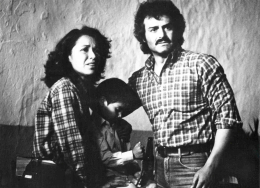
Maria Rojo and Gonzalo Vega
I don’t think I really understand this movie, and that’s one of the reasons I like it so much. At the start I thought I was watching a romantic melodrama. Then I thought the film was pushing a political message. By the end I wasn’t sure how to react. But I can say this movie is beautiful, disturbing and moving.
Gonzalo Vega plays Candelario, a wanderer. At the beginning of the film he walks into a sleepy little town in the middle of nowhere. He asks for shelter at a ranch, intending to stay for one night, and he ends up staying for years. The premise is familiar, but the story takes unpredictable turns. The screenplay is by director Luis Alcoriza and his wife Janet. While they deal with themes that are familiar from other Mexican films, the characters don’t always act the way we’d expect, and the screenwriters avoid delivering any comfortable resolutions. Initially many of the town’s residents react to Candelario with suspicion and fear. Over time some of them come to regard him as a man to love and respect. But he never seems quite sure how to take it all. Should he accept his new life and take the good with the bad, or just walk away from it all?
This ambiguity is at the heart of the movie. Like Renoir, Alcoriza seems to be interested in the way people interact, and doesn’t feel the need to judge his characters. He takes his time in telling the story, and the film has a easygoing, unforced rhythm. Miguel Garzon’s cinematography captures the muted colors of rural Mexico, and Pedro Plascencia’s sparse music has an air of gentle melancholy. I don’t feel like I need to understand this movie completely, because the director isn’t asking for that. He seems to content to let us watch these characters as their stories unfold, and life takes its course.
Released by Desert Mountain Media (Latin Cinema Collection). In Spanish with English subtitles.
El lugar sin limites [Place without Limits] (1978)
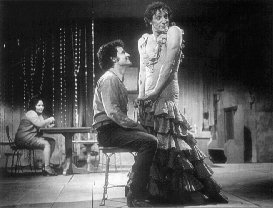
Gonzalo Vega and Roberto Cobo
Let’s start by talking about the title of this film. It’s taken from Marlowe’s Dr. Faustus. Faustus asks Mephistopheles where hell is located. Mephistohpeles replies….
Within the bowels of these elements,
Where we are tortur’d and remain for ever;
Hell hath no limits, nor is circumscrib’d
In one self place; for where we are is hell….
The movie is set in “the place without limits (el lugar sin limites)”. In this case hell is a small, impoverished Mexican town. The story centers on Manuela, an openly gay man living in a brothel with his daughter and a handful of other women. In the first scene we see Manuela waking up in fear. She hears a truck outside, and knows that a bully named Pancho is back in town. This sets the tone for the whole film. An air of desperation hangs over everything. The inhabitants of the town are all mired in unhappiness of one kind or another, even the wealthy “patron” who owns almost everything and everybody. What do they do about it? They lie to each other, manipulate each other, and try to drown their sorrows in booze.
This film is as cynical as anything Luis Bunuel ever made, but director Arturo Ripstein imbues it all with a painful melancholy, a heartbreaking sadness that you won’t find in Bunuel. I make the comparison because Ripstein worked on some of Bunuel’s Mexican films as a young man, and the two men were close for many years. But while Bunuel maintains a savage detachment, Ripstein seems to be very much involved with his characters. In spite of their flaws, he’s still moved by their struggles. The film is based on a novel by Jose Donoso. Ripstein shoots it in a straightforward manner, keeping the cutting simple and allowing the actors to pull you in. There is no underscoring, and the silence increases the air of desperation.
The cast is strong in general, but Roberto Cobo especially stands out. He does something very difficult for an actor. He makes himself truly vulnerable. Manuela has no defenses. She lives her life by clinging to fantasies, naively hoping that others will treat her kindly. In many ways the film reminds me of Tennessee Williams, and Manuela could almost be an updated Blanche DuBois. Manuela suffers the same fate as many of Williams’ characters. She’s destroyed by the cruelty of the world she lives in, the place without limits.
Released by Strand Home Video, in Spanish with English subtitles.
The Invisible 60s
I’ve been trying to go through Mexican cinema more or less chronologically, so for this post I wanted to write about a film from the 60s. Tough luck. It seems that Mexican films from that decade are almost impossible to see. There are probably a few reasons for this….
First, the Mexican film industry was more or less falling apart. The movies produced throughout the 50s had become increasingly tired and routine. By the end of the decade three of the major studios had closed. Unions made it difficult for new filmmakers to enter the industry, so there was little innovation or experimentation. And of course, television was becoming more popular, which led to lower receipts at the box office. So while filmmakers in France, Italy, Japan and the US were breaking boundaries and trying new approaches, Mexican filmmakers were dealing with tremendous challenges.
This doesn’t mean nobody was doing good work. But it does mean that Mexican movies made during this period were mostly low budget affairs that got little or no distribution outside the country. While Godard, Oshima and Antonioni are known to almost anybody with a background in film, even film scholars are mostly unaware of directors like Alberto Isaac or Carlos Enrique Taboada.
As a result, these days Mexican films from the 60s seem to be pretty much invisible. No doubt you could dig up a number of cheap comedies and masked wrestler flicks. But if you look for movies made by people who actually cared about what they were doing, they’re impossible to find. My search for DVD releases of films that Isaac and Taboada made in the 60s turned up absolutely nothing. I did find people writing about their work, some of them enthusiastic about what they’d seen. But the movies are not available. I was dying to see a title called En el balcon vacio, directed by Jomi Garcia Ascot in 1961. The comments I read about the movie really intrigued me. But forget it. It ain’t out there.
The thing that scares me most is the possibility that prints of these films are either in really bad shape or don’t even exist. In spite of the fact that film preservation has a fairly high profile in the US and Europe, there are numerous titles that are lost forever. Because Mexican cinema doesn’t attract as much interest as other countries, I’m afraid that most of these films aren’t even on anybody’s radar.
[Update: I was able to find a few titles by Carlos Enrique Taboada on eBay. I purchased Hasta el viento tiene miedo, and enjoyed watching it. I hesitate to even call it a horror film, because it’s pretty tame by current standards for the genre. But it’s an interesting movie, focussing on a group of young woman at a school where the headmistress is very stern….]
Victimas del pecado [Victims of Sin] (1951)
In 1949 Emilio Fernandez made Pueblerina, painting a poetic mural as a tribute to Mexican rural culture. Two years later he made Victimas del pecado, which plunges us into the dark side of life in urban Mexico. Where the earlier film is is gentle and leisurely, Victimas is brutal and frenetic. Where the earlier film is illuminated by love and tenderness, Victimas is brimming with disgust and fear.
Aside from Touch of Evil, it’s the only film I’ve seen from the fifties that creates such a vivid, tactile picture of life at it’s harshest. And apparently censorship in Mexico back then was not as strict as it was in the US, because Vicitmas is racier and raunchier than any American movie I know of from that era.
The story starts of in a nightclub where Violeta dances. She finds out that one of the other dancers has dumped her newborn baby in a trash can at the insistence of her gangster boyfriend. Violeta rescues the baby, but ends up getting fired from the club. The roller coaster plot gets more and more complicated as we follow our dancer heroine through a series of harrowing reversals. The script could’ve used some trimming, but you won’t be bored. Fernandez’ script, based on a story by himself and Mauricio Magdaleno, keeps the over the top melodrama coming, and the images are framed and shot to create a feverish intensity. The film’s keyed up visuals are handled by Gabriel Figueroa, who brings richness and texture to the gritty images.
One aspect of the film that startled me was the interaction of blacks and whites in the clubs. American movies from the period generally keep black performers strictly segregated. Here not only are the bands integrated, but we see blacks and white dancing together. At one point Violeta brings a black musician onto the floor and they engage in one of the most overtly sexual dances I’ve ever seen on the screen. This is a film made in a Catholic country, where the church’s attitudes were extremely conservative. I’m amazed that Fernandez was able to get away with this stuff.
There’s an odd paradox in Victimas. Somehow it manages to be moralistic without being judgemental. Fernandez seems to believe that we’re all “victimas del pecado”, or victims of sin. The film seems to be saying that it’s not a crime to drink or take drugs or steal, but it is a crime not to have compassion for other people.
If Victimas is any indication, it appears that Fernandez was horrified by modern urban life. The serene, stately rhythms and expansive compositions of his earlier work give was to a rough and tumble approach that highlights the chaos and confusion of life in the city. Here he focusses on sprawling industrial zones, streets lined with prostitutes and crowded nightclubs. One of the nightclubs in named La Maquina Loca, or The Crazy Machine, and my feeling is that this is the director’s comment on modern cities. This feverish film portrays the city as a machine out of control, a monster that feeds on peoples’ worst impulses and grinds its victims down to dust, without even being aware of it.
 Reality Is Scary