Two-Lane Blacktop (1971)
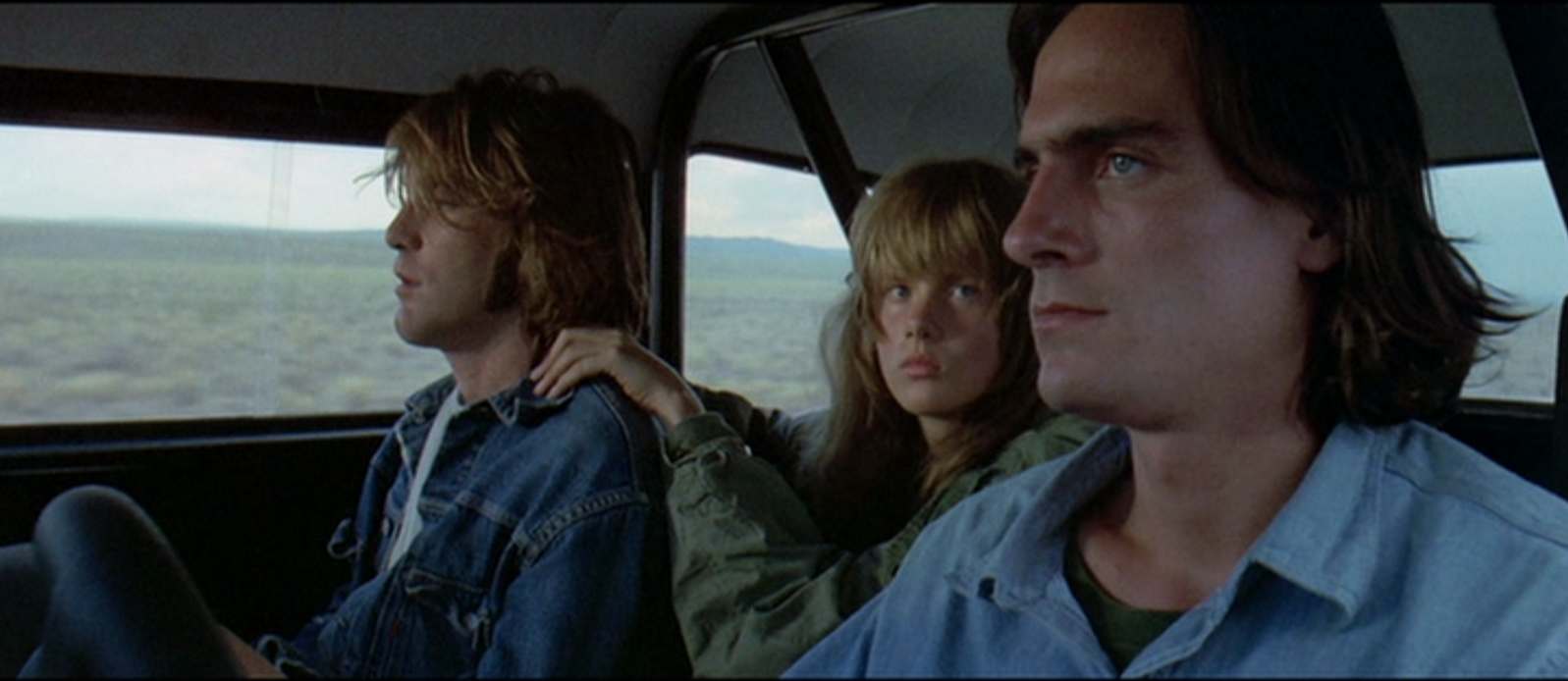
Dennis Wilson, Laurie Bird and James Taylor
This is a movie made by guys about guys. James Taylor and Dennis Wilson play two gearheads whose lives revolve around their car. We never get to know their names, and the credits just list them as The Driver and The Mechanic. Warren Oates is an amiable eccentric who picks up hitchhikers in his yellow GTO. The three meet on the road and bet their pink slips on a cross-country race. For the rest of the film we follow them as they travel down country highways, stopping at diners or garages, racing to make a few bucks when they need to.
It’s that simple. This movie discards all the conventions we expect from commercial films. It’s not played for suspense or for laughs. There’s no love story. We just follow these guys as they drive across the country. The lone woman in the film is a hitchhiker who joins the group early on. Played by Laurie Bird, the character is only identified as The Girl, and like the other three she seems to be drifting aimlessly.
Two-Lane Blacktop is a road movie in the purest sense of the word. Director Monte Hellman decided to shoot the movie on location and in sequence, and so the crew spent weeks travelling across the US, shooting on country back roads and in small towns. Though the film plays out against the backdrop of the vast American landscape, it’s actually very intimate. It’s a portrait of three guys, and in spite of their obvious differences, they’re all united in their obsessive urge to keep moving. Through car windows we see lush forests and grassy fields sliding past. We ride through endless, dusty plains, under blue skies filled with tiny cloud tufts trailing off to the horizon. The small towns that appear now and again seem to be nothing more than a few buildings gathered along a stretch of road. Hellman and cinematographer Jack Deerson give us a detailed panorama of rural America. They capture the cities and the towns and the forests and the hills, but just as important, they also capture the spaces in between.
The film also takes advantage of another kind of space, and that’s the “silence” between lines of dialogue. I put the word in quotes, because it’s not really silence that we’re hearing. Actually, we’re listening to the sounds that most movies push into the background. The clatter of dishes in a coffee shop. The murmur of conversation in a bar. The drizzle of rain falling in a tiny rural town.
The film seems to catch life as it’s happening. The performances are so natural and unforced that they appear to be improvised, though the director says he followed Rudy Wurlitzer’s script closely. According to Hellman, there are only two scenes that stray from what was written. The Driver and The Mechanic speak very little to each other, and when they do it’s almost all about cars. How the engine is running, how the car is handling, where they can make repairs. At the opposite end of the scale is GTO, who loves to hear the sound of his own voice. None of the three, though, says much about what they’re feeling. A crucial exception is the brief scene when GTO seems to open up and start talking about how his family is falling apart. The Driver quickly shuts him down. No need to hear about each others’ problems. There may be a world of pain inside each one of these guys, but it’s better not to talk about it. Just keep driving.
*
I went out of my way to see Two-Lane Blacktop at the Aero in Santa Monica. I had seen it once before years ago at the New Beverly, and wanted to watch it again on the big screen. Monte Hellman was there and after the screening he talked about the movie. It was interesting to hear his comments on the making of the film, and it was also interesting to hear him talk about this particular screening.
The credits list the authors of the screenplay as Will Corry and Rudy Wurlitzer. According to Hellman, he gave Corry’s original script to Wurlitzer, who said he couldn’t get through more than a few pages. Hellman says he then told Wurlitzer to go ahead and write what he wanted, and that all they used from Corry’s version is the concept of two guys in a car.
Hellman went on to say that the film bombed at the box office, which he blames on lack of support from Universal. Apparently Lew Wasserman, who ran the studio back then, saw the movie and hated it. So while Two-Lane Blacktop was shown at theatres nationwide, Universal did nothing to promote it. Aside from a rave review in Esquire, the critics were not enthusiastic. But over the years it has gained a sizable audience.
One of the audience members said he had last seen the film at a drive-in when it first came out. Hellman at first responded enthusiastically, and said that’s the way it should be seen, on a huge screen. But then he talked about the print we had just watched and said that the colors were not as rich as they had been in the original dye transfer prints. I was kind of stunned when he went on to say that these days he preferred to watch the film on Blu-ray, because the image was crisper and the sound was richer.
But I’m still glad I saw it on the big screen.
Mecánica nacional [National Mechanics] (1972)

Mourning the dead in Mecánica nacional.
Change is a central theme in Luis Alcoriza’s Mecánica nacional. Ostensibly the film is about a family that goes to the countryside for an overnight party that coincides with the finish of a cross-country race. In reality, it’s about a country that is evolving so rapidly that it’s not even sure of its identity any more. This is a portrait of Mexico in the seventies. The roads are jammed with cars, but all the cars are from America. The youth movement is going strong, and it’s clear these kids don’t share their parents’ values. Once the party starts, we hear the easygoing rhythms of traditional Mexican music clashing with the jacked up rhythms of rock n’ roll. Popular vocalist Lucha Villa is featured in a key role, but by the time she starts singing her character is so wasted that the song comes out as a tuneless groan. There’s a brief but fascinating exchange when a young Anglo woman, holding her camera ready, surveys the crowd looking for something to shoot. Her expression is perplexed, and after a few moments she says, “But there’s nothing Mexican here.” One of the partiers comes up behind her and says with a smile, “We are.” This is still Mexico, just not the Mexico she was expecting.
The movie opens at a large auto garage where family and friends are preparing for the picnic. One of the first things we see is a sign that says in bold letters “SOLO DAMOS SERVICIO A CLIENTES MUY MACHOS” (“WE ONLY SERVE CUSTOMERS WHO ARE REAL MEN”). In Mecánica nacional Alcoriza takes a long, hard look at his male characters, who try so hard to act like real men and end up coming off like foolish children. A few minutes into the film the garage owner and a truck driver are ready to fight each other over an almost meaningless verbal exchange. A gun is flashed, one guy stands down, and nothing happens. But the scene is important. These men spend a lot of their time trying to live up to a “macho” ideal that their culture has created. They just accept that you’re supposed to fight, drink and chase women. They don’t question it. That’s just the way it is.
Or that’s the way it used to be. Eufemio, the boss at the garage, is an ordinary guy trying to cling to the life he knows, but his world is falling apart. He heads off to the countryside with his wife, his mother and his two daughters, looking forward to a weekend filled with booze and cars. But in the course of a single night, he comes to suspect that his wife is unfaithful, he finds his daughter making out with her boyfriend, and his mother dies. Obviously, this would be a lot for anybody to bear, but Eufemio’s meltdown is mostly the result of his absurd notions about how things should be. The seething rage he directs at his wife and daughter seems insanely hypocritical since we’ve just seen him sneaking off in hopes of having sex with a hot-looking babe who’s been flirting with him. And while he’s awash in weepy sentimentality after his mother dies, we recall that this “saint” he’s mourning was a crotchety, obnoxious old lady who kicked the bucket after binging on food and booze.
Alcoriza has a real gift for handling actors. The film is overflowing with characters, and they’re all lively and entertaining. Mecánica nacional has a wonderful, chaotic spontaneity. The camera roams through the crowd allowing us to watch these people dance, drink, fight and flirt. As Eufemio, Manuel Fábregas may be pushy, lecherous, ridiculous, but he’s always human. As his wife, Lucha Villa swings from happy complacency to outraged hysteria and makes it all completely believable. Casting Sara García as the grandmother is a beautiful satiric joke. After years of playing saintly older women, García turns her film persona on its head by making the grandmother cranky, petulant and foolish. When the old lady dies and the family gathers round to say a rosary, their tearful devotion turns to anxious impatience as they realize they’re going to miss the cars crossing the finish line. After they’ve all run off, one by one, to watch the end of the race, we see the dead grandmother lying alone on the ground. The image is a blunt metaphor for a society that is ready to abandon tradition in favor of fast cars and color TV.
In a way Mecánica nacional seems like a Mexican version of Weekend. Aside from the obvious parallels, endless traffic jams and frustrated people getting into violent confrontations, both films are about societies coming apart at the seams. But unlike Weekend, the characters in Mecánica nacional don’t pick up guns to start a revolution. By the end of movie they’re so exhausted it seems that have no energy left for anything but to slide back into the routine of their lives. Like most of us, they really don’t want to confront the change they see in the world and try to deal with it. They’d rather go home and watch TV.
Released by Laguna Films. In Spanish. NO ENGLISH SUBTITLES.
The Runaways (2010)

Kristen Stewart and Dakota Fanning
As the film tells it, this is the story of teenage girls discovering their sexuality and finding their voices. From the very first shot writer/director Floria Sigismondi establishes that the movie is about coming of age, and she doesn’t shy away from the messy details or the uncomfortable moments. Sigismondi has a natural feel for images, and uses the visuals to express what the girls are going through. No doubt her experience directing music videos serves her well in the heated up, hyperkinetic scenes where the band is touring and performing. But unlike some other filmmakers who cut their teeth making videos, she also knows how to shoot a quiet conversation. In fact, some of the film’s most powerful and most painful moments are just about two people talking.
Which brings us to the acting. Kristen Stewart and Dakota Fanning are both excellent as Joan Jett and Cherie Currie respectively. But it’s also important to say that Stella Maeve and Scout Taylor-Compton give strong, tough performances as Sandy West and Lita Ford. The film wouldn’t be as vivid or as lively if the whole band wasn’t putting out the same level of energy. In describing Michael Shannon’s performance as Kim Fowley, some people have used the phrase “over the top”. I want to know how anyone could possibly portray Kim Fowley without going over the top? While the rest of the cast certainly delivers the goods, it’s important to single out Riley Keough as Marie Currie. There’s a lot that goes on between the two sisters that isn’t expressed in words. It’s a complicated relationship, involving anger, envy, resentment and love. Fanning and Keough manage to put all that across, sometimes without even saying a word.
The story jumps back and forth between the tawdry, drab world of the San Fernando Valley and the tawdry, exciting world of Hollywood and the Strip. The filmmakers don’t just highlight the contrast between these two sides of LA, they push it to the max. This is important, because Cherie Currie’s story is about embracing the excitement of being a rock star to avoid the dreary weight of family obligations. When she visits the tract house where her sister is caring for her alcoholic father, it’s easy to see why Cherie wants to escape the bleached-out reality of life in the suburbs. Sigismondi and cinematographer Benoît Debie contrast the flat, bland colors of the valley with the burning reds and blues of the club scene on the other side of the hill. At times the director pushes the film into a kind of pop expressionism to match the intensity of what the band members are feeling. Joan Jett says she doesn’t recall ever hanging out under the Hollywood sign, but there’s a wild poetry in the image of these teenage girls lounging on the hillside, dwarfed by towering white letters. It may not be based on fact, but it certainly evokes the spirit of the time.
The film does an amazing job of conjuring up LA in the seventies. No doubt this is in large part due to the efforts of production designer Eugenio Caballero and costume designer Carol Beadle. Because the director uses images to tell the story, a lot of what we know about the band members comes from the way they dress, the way they wear their hair. When Joan buys a leather jacket at the beginning of the movie, it’s because she wants to change who she is. At the end of the movie, during a radio interview, we see her in the bright pink jacket worn on the cover of her first solo album. The real Joan says in the audio track that she wore the jacket for a photo shoot and probably never again. No doubt, it is important to draw the line between fantasy and fact. For the most part The Runaways stays close to the truth. But again, Sigismondi understands the power of the visual. While the clothing may not be literally accurate, the pink jacket tells us that Joan has changed again. She’s gone through the messy, joyful, painful years with The Runaways and come out stronger. She’s found her voice.
*
I’ve got to add a disturbing postscript. When The Runaways was released, I wondered why bass player Jackie Fox wasn’t depicted in the movie. I assumed it was either a dispute over money or the size of the role. Turns out it was much more serious. This article was just published on Huffington Post. In it, Fox accuses Kim Fowley of raping her, and while band members dispute her account of the event, the article cites others who were present and corroborate Fox’s version.
The movie tells a classic rock n’ roll story, five girls fighting tooth and nail to be taken seriously as a band, and finally breaking through. While the film mostly sticks to the facts in the incidents it shows, the problem here is what it leaves out. There’s no reason to believe that writer/director Floria Sigismondi knew about the rape allegations, but this shows how treacherous making a film “inspired by true events” can be.
Rachel Portman
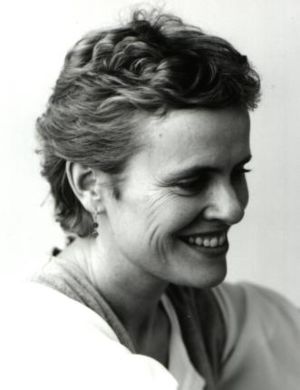
Rachel Portman
Rachel Portman has been writing music for movies since the early eighties. While she’s written for a variety of genres, she seems to be most interested in stories that focus on characters, stories that explore relationships. Her scores are both subtle and complex, and she has a gift for drawing us closer to the people we see on the screen.
John Duigan’s sensuous comedy Sirens tells the story of an Australian pastor and his wife going to call on an iconoclastic painter, who lives in the country with his three female models. The conflict is between upright morality and free-thinking hedonism, and Portman uses these two poles as the basis for her approach. While the thematic material is fairly consistent throughout, the score is based on a shifting back and forth between two textures. The orderly world of the pastor and his wife is represented by a crisp rhythmic figure that occupies the string section while a clarinet plays short, resolute lines above. But then the strings relax into a sultry, sensual shifting of harmonies, and instead of the clarinet we hear a flute floating lazily overhead. Portman also weaves harp and glockenspiel into these sections, giving them an otherworldly feel. At times the strings swell up to give us the feeling that we’re falling helplessly into the seductive beauty of the natural world. While the score includes other elements, folk songs, jigs, and even a piece by Ralph Vaughan-Williams, it’s this simple movement from one texture to another that expresses the basic conflict in the film.
Portman also uses this approach of creating contrasting textures in Beeban Kidron’s Great Moments in Aviation. There’s a jazzy blues theme which appears in various forms, the melody being played first by a sauntering clarinet, then a wistful flute, and finally by a brash cornet. But there is also a soaring gospel theme that takes us outside of the real world. Portman does a deft balancing act here, incorporating swift, surprising shifts in tone. I’d love to listen to the whole score some time, but unfortunately the film isn’t available on DVD. I’ve only heard the selections included on a CD compilation of Portman’s work.* Sadly, soundtracks generally don’t get released unless someone considers them marketable.
Ostensibly The Manchurian Candidate is a thriller, but the end result is something far different from the standard Hollywood suspense flick. To start with, Richard Condon’s novel exploits our fear that our lives are controlled by forces we can’t even imagine. Jonathan Demme’s adaptation immerses the viewer in a world of unrelieved paranoia. Instead of pumping the suspense as many composers would, Portman creates a dissonant, oppressive score that heightens the sense of dread and anxiety. A dense string section gives us a background of vague, shifting harmonies that never seem to achieve a resolution. There are no melodies to hang on to. No recognizable themes. This score is all about texture. At times an ethereal chorus rises through the mix, giving a drugged-out sense of drifting through fog. Even at the end, after the main character has found the answers he was looking for, the sense of anxiety is not dispelled completely. The story comes to a close, but the music still gives us the feeling that all is not right with the world.
As a filmmaker Demme seems willing to take risks, to try different things, and Portman’s films with the director have offered her the chance to do the same. The movie version of Toni Morrison’s Beloved is well outside the boundaries that usually define commercial filmmaking. Portman rises to the challenge and delivers a score that is completely unconventional. Instead of using a traditional orchestra, she selects a narrow range of instruments and couples them with voices to create an unusual sound landscape. Beloved is a ghost story, and the music seems to emerge from a darkness filled with mystery. Oumou Sangare’s solo vocals float in a space surrounded by silence. The feeling of deep sadness lingers in sparse passages featuring percussion and the occasional flute. But the darkness seems to lift when a shimmering gospel chorus shines through. At the end of the story the main character has found her way to the light.
In order to write music for any film, the composer has to figure out what the film is about. They have to find its core. What sets Portman apart is that she doesn’t just settle for expressing what lies at the heart of a movie. Ultimately she tries to express what lies in the human heart.
* A Pyromaniac’s Love Story, Varese Sarabande, 1995
In a Lonely Place (1950)
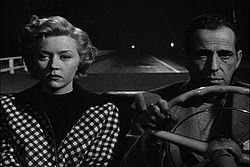
Gloria Grahame and Humphrey Bogart
This is how In a Lonely Place begins. I’m not talking about the film, but the novel written by Dorothy B. Hughes in the late forties. To my mind it’s one of the most radical books of its time. The main character, Dix Steele, is a serial killer, and the focus is on him throughout the entire book. Though Hughes writes in the third person, she takes us inside Dix’s mind so that we can understand this angry, lonely, complicated man.* The title could refer to Los Angeles, the city of the alienated and the displaced, but more importantly it describes this man’s absolute isolation from the world around him. He is desperately lonely and wants to be loved. When he meets Laurel Gray, a young woman who lives in his apartment building, he feels she’s the one who could rescue him. But Dix’s fantasies have no basis in reality. He pursues Laurel, but he’s so disconnected from the world around him that he’s doomed to failure. He’s a lost man.
Nicholas Ray’s film of In a Lonely Place is completely different from the book. Back in 1950, no Hollywood studio would consider making a movie in which the central character was a WWII vet stalking and killing young women. So Ray and his collaborators took a few elements from the book and reworked it into a very different, but still very interesting, story. In the film, Dix Steele is a middle-aged screenwriter who hasn’t had a success in years. He’s intelligent and creative, but he carries an explosive anger within him. When it erupts, which is often, he sometimes lashes out at his closest friends. He can also turn violent. When a young woman he knew slightly is murdered, the police see Dix as the prime suspect.
While the entire cast is solid, the movie really belongs to Bogart. It’s one of his most intense, complex performances. It’s hard to imagine any of his contemporaries going as far with this part. As Dix, Bogart can be arrogant, charming, aggressive, tender, insolent. He freely heaps abuse on his Hollywood colleagues, and at times even turns on his closest friends. But he is also terribly lonely. As in the book, he meets Laurel, a young woman who lives in his building, and he is immediately drawn to her. And as in the book, the relationship is doomed from the start. Laurel loves Dix, but after witnessing his violent outbursts she begins to wonder if he is the killer. What started out as an idyllic romance is quickly poisoned. When the police finally call to say that Dix has been exonerated, it’s too late. Laurel can’t go on with the relationship. It’s over.
Both Bernard Eisenschitz and Patrick McGilligan have suggested that in some ways Dix resembles Nicholas Ray. The director made several films about angry, violent men, including On Dangerous Ground and Bigger than Life. Ray’s characters often come into conflict with the world around them. Sometimes this is because the world is unjust, but often it’s because the characters themselves are deeply troubled. Ray himself had a hard time fitting in. He was intelligent, iconoclastic and impatient with hypocrisy. In a Lonely Place could be seen as an expression of his views on Hollywood. It is certainly one of the most cynical, scathing movies ever made about the movie capitol. And there are elements of the film that have a direct personal connection to Ray’s life. The courtyard apartment where much of the action takes place is a reconstruction of a building the director had lived in. But the most obvious connection is the casting of Gloria Grahame, Ray’s wife, as Laurel.
Ray takes care to capture the feel of LA. Appropriately, the first shot gives us Dix’s point of view as he drives along the streets at night, his anxious eyes reflected in the rearview mirror.** Later in the film, after an angry outburst, we see him driving maniacally along a winding road that looks like Mulholland Drive. The building that Dix and Laurel live in is typical of the courtyard apartments constructed in the twenties and thirties. The settings that create the background for the story may not seem completely “real”, but they do capture the feel of the city. Ray understands architecture, and he understands space. While most of the film was shot on soundstages, the director includes location shots that help to define the city.
Andrew Solt’s screenplay, based on an adaptation by Edmund H. North, is tightly constructed and bristling with tension. Burnett Guffey’s cinematography vividly captures the violent contrasts of the drama. I’m not crazy about George Antheil’s score, which seems intent on dragging this startling, original film back into the realm of Hollywood melodrama.
In many ways the film is much more conventional than the book. But by Hollywood standards, it is very much outside the norm for a commercial feature of the time. Ray and Bogart and their collaborators deserve a lot of credit for making a drama that really delves into a character who is the antithesis of the standard movie protagonist. Dix Steele rages against the world, struggles desperately to hang on to the woman he loves, and in the end still finds himself in a lonely place.
_________________________________________________________
*
I don’t know of any other book from the period that invites us to share a serial killer’s point of view. I’m not a pulp expert, but the only other novel I can think of from the era that does something similar is Jim Thompson’s The Killer inside Me, published five years after In a Lonely Place.
**
Could this have been an inspiration for a similar shot at the end of Taxi Driver where we see Travis’ eyes reflected in his rear view mirror? I’ve never heard Scorsese mention it, but it seems likely he was familiar with the film.
Taking a Break
With the holidays coming on I realize there’s no chance of me posting anything in the near future. Just too much happening. I was hoping at least to share a cool Christmas cartoon with you all, but I spent a while digging around on YouTube and couldn’t find anything that knocked me out. So I will just wish you all happy holidays. I expect to get back to blogging around the middle of January. See you then.
Digital Cinema
Like it or not, digital cinema is fast becoming the standard for commercial production and exhibition. While I have a number of reservations about the process, there’s really no way of turning back the tide. The studios are aggressively pushing digital, and exhibitors are climbing on board.
I’m not in the film industry, and I don’t have the technical background to understand all the aspects of the debate. I just like to watch movies. But while studio execs spout hype about digital superiority, it’s important to understand that the conversion is complex and there are still competing technologies. This is the biggest change to hit movies since sound came in. The repercussions are going to be huge.

A still from Timecode, Mike Figgis’ groundbreaking movie, shot on digital video in 2000.
But like I said, I’m no expert. Rather than rattle off my ideas on the subject, I’d rather steer you toward some people who actually know what they’re talking about. The link below will take you to John Bailey’s blog at the American Society of Cinematographers web site. Bailey asked several people in the industry how they feel about the conversion to digital, and he got some interesting answers.
John Bailey at the American Society of Cinematographers Web Site
The second link is to an article about digital cinema on Wikipedia. I warn you that there’s a lot of information, and it’s not very well organized. But when I scanned the article myself I learned a lot about how complex the issues are. We’ve still got a long way to go.
Article on Digital Cinema at Wikipedia
Those of us who care about movies really need to inform ourselves about what’s at stake here. Digital is going to transform the industry. It’s also going to transform cinema. I have no illusions that getting a few thousand movie lovers to sign a petition is going to make the studio heads hit the brakes. But I do believe that informed, persistent advocacy can make a difference. It’s happened before.
Mildred Pierce (1945)

Jack Carson and Joan Crawford
When producer Jerry Wald read Mildred Pierce shortly after it was published in 1941, he knew it could make a good movie. He also knew it would be an uphill battle to turn it into a screenplay that would be acceptable by Production Code standards. Mildred’s divorce, her fling with a charming playboy, her daughter’s sexual escapades were just a few items that would be troubling for censors. And possibly more troubling than all the rest would be the fact that the author, James M. Cain, tells Mildred’s story without moralizing. He does not condemn her. He merely follows Mildred’s progress, presenting a detailed and convincing portrait of a woman fighting for success, while also exploring the reasons for her ambition.
The Production Code demanded that Hollywood films adhere to strictly defined standards of morality. So to satisfy the censors, Wald injected a murder into the story, and reshaped the ending to assure the audience that justice was served. According to Thomas Schatz’s book The Genius of the System, the producer struggled long and hard with the script. In order to achieve the right tone for a “woman’s” picture, he first assigned Catherine Turney to the project. But to get the tension he needed for a thriller, he had Albert Maltz work Turney’s material over. Other writers also took a shot at the script, but Ranald MacDougall received sole credit for his extensive work on the final version.
The film was directed with smooth precision by Michael Curtiz. By this point in his career Curtiz had refined his approach to the point where his films had a fluid, compelling visual style. He often follows the characters with his camera, using long takes and careful lighting to define space and create atmosphere. On Mildred Pierce he was aided by art director Anton Grot, who had worked on many films with the director. Cinematographer Ernest Haller also played an important part, giving the film the gloss the studio demanded, but still doing justice to the story’s grittier aspects.
The movie is also interesting for the way it portrays Los Angeles in the mid-forties. Cain had written the book as the Depression was ending, and his portrait of the city makes vivid the bitterness and despair of those times. Since Curtiz and his collaborators were shooting the movie a few years later, they captured a different Los Angeles. Granted, the studio would certainly not have allowed them to dwell too much on the city’s seamier side, but the war brought the economy roaring back to life and the film reflects the vitality that was in the air. Curtiz gives us a fascinating, if skewed, picture of Los Angeles as WWII was winding down. Customers eat in their cars in the drive-in dining area at Mildred’s restaurant. Sailors whistle at Veda as she sings at a seedy dive on the Santa Monica pier. Monty shows Mildred his house at the beach, revealing an interesting mix of rustic and modern.
Joan Crawford is excellent as Mildred, and the supporting cast is amazing. Jack Carson combines his usual energy with overbearing arrogance to make the lawyer/hustler Wally thoroughly repulsive. Eve Arden’s impeccable sense of timing and inflection make Ida a joy to watch. Zachary Scott is both seductive and appalling as Monte. And just as impressive as all these seasoned pros is the young Ann Blyth, who gives a chilling performance as Veda.
Cain’s novel is unsparing in its depiction of the characters, while the movie tends to smooth away the scarier edges. This wasn’t just the Production Code. A star like Joan Crawford would probably not want to play a character if it meant crossing certain boundaries. Even if they did, the studio would probably not allow them to play a part that might damage their image. In the film Mildred may be weak, may be fearful, but she is never pathetic or awkward as she was in Cain’s book. When Mildred looks for work in the movie, her voiceover narration accompanies a quick montage in which she rises to the challenge. In the book we accompany Mildred as she learns how difficult and humiliating it can be to work for a living. In the movie Mildred shows her anger at Veda with a sharp slap. In the book’s climax, Mildred is so consumed with anger she tries to strangle her own daughter. Most tellingly, in the final scenes of the movie Mildred acknowledges her mistake in divorcing Bert and they walk off together as the music swells. The book ends with the two of them clinging to each other in the depths of despair.
Jungle Fever (1991)

Spike Lee (center) talking to Annabella Sciorra and Wesley Snipes
Jungle Fever takes place in New York in the nineties. Flipper, a black architect who is married and has a young daughter, has a brief affair with Angie, his white secretary. When the relationship is discovered their friends and families are outraged. The consequences are devastating for both of them.
But this is not your typical Hollywood drama. Writer/director Spike Lee doesn’t make simple movies with tidy resolutions. His characters are not isolated individuals living in a Hollywood fantasy. They are flesh and blood people who live in real places, and their lives are inextricably linked to the world that’s spinning around them. Even though the lovers meet in an office in Manhattan, the film really revolves around the communities they live in. Flipper’s home is in a middle-class neighborhood in Harlem, where he enjoys a happy, stable life with his wife and daughter. Angie lives in Bensonhurst, a working class Italian-American community. On top of her job as a temp, she also cooks and cleans for her father and brothers.
In Guess Who’s Coming to Dinner, the message is that an interracial relationship can work, that love conquers all. Not in Jungle Fever. However much Flipper and Angie may care about each other, they can’t escape the worlds they live in. For Flipper’s wife Drew, it’s not just that he cheated on her with any woman. Being biracial herself, the fact that he slept with a white woman awakens a deep, complicated anger that Drew has held inside her for years. Flipper is also the target of withering scorn from his father, a fundamentalist preacher. On Angie’s side, she ends up suffering terribly for awakening the violent hatred toward blacks that is deeply ingrained in her working class neighborhood.
For most filmmakers, all this would be enough. But Lee steps back from the love story to give us the bigger picture. We get a good, long look at Flipper’s family. His brother, Gator, is a crack addict. Gator shows up at his parents’ house looking for cash. The mother doesn’t have the strength to deal with her wayward son. The father is only interested in passing judgment. Flipper would like to just forget about Gator, but later in the film the mother insists that her successful son go find his addict brother. This forces Flipper to leave the comfortable world of Manhattan professionals, and to face a side of the city that frightens him. Some people may feel that all this is an unnecessary distraction. In fact, I think this context is crucial. The film isn’t just about Flipper and Angie. It’s also about the world they inhabit.
The offices in Manhattan, the crash pad for crack addicts, Harlem, Bensonhurst, Soho. These are all part of Spike Lee’s New York. Though some of the scenes he shows us are brutal to watch, Lee’s love for the city he lives in illuminates the film. Working with cinematographer Ernest Dickerson, he frames and lights the various neighborhoods to capture the character of each. And you can tell how deeply he loves his city by the fact that he’s willing to embrace both the beauty and the horror. If at times his images are bathed in a sentimental glow, there are other times where he brings us face to face with the city’s darker side, and his gaze is unflinching.
In the end, Flipper and Angie decide they have no choice but to return to their neighborhoods, return to their homes, and try to rebuild their lives. This is not a fairy tale. They can’t escape the world they live in.
Experiencing Movies
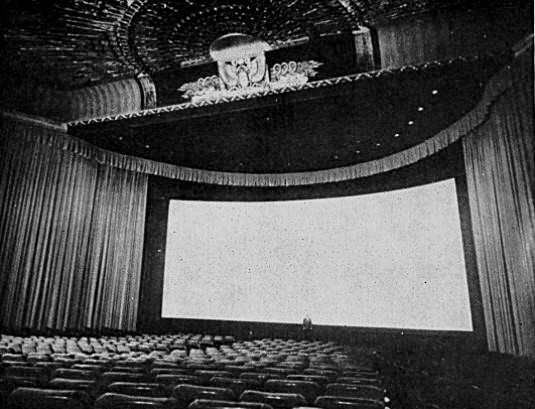
I think I was twelve years old when I saw 2001 at the Egyptian in Hollywood. It blew my mind. The movie took me from the dawn of man, to the depths of outer space and beyond the infinite. I’d never experienced anything like it.
That was when I started really paying attention to films. I’d already spent a lot of time in movie theatres, but nothing had ever had that kind of impact on me. By the time I was in my teens I was heading out to see films with my friends as often as I could. This was the seventies. Not only was it a great time for movies, it was also a great time for movie theatres. Aside from the Egyptian, in Hollywood alone you had the Chinese, the Paramount, the Pacific and the Pantages. In Century City there was the Plitt, and out in Westwood you had several more. The screens were bigger than ever, and innovations in recording and playback were making sound better than ever.
These days I spend a lot of time watching DVDs. I still go to movies, but the convenience of DVDs is hard to resist. You can watch a film any time you want, pause it as often as you want, and if you want to look at something again you just play it over. You also have a huge selection to choose from, whether you’re buying or renting, and some day you may have just as much to choose from via download. We’ve gained a lot in terms of convenience and accessibility.
But we’ve also lost something. In fact, we’ve lost quite a lot….
When we’re watching a movie in a theatre, it has our complete attention. We’re sitting in a darkened auditorium facing the screen. Ideally, there are no distractions. At home we’re well aware of our surroundings and there are endless distractions. The phone may ring, somebody may walk into the room, or we may decide to just take a break and raid the fridge. We may or may not be focussed on the film, and we’re entirely in control. We can start and stop any time we like.
More important, we’re not experiencing the film the way we would in a theatre. With some exceptions, watching a film in a theatre is very different from watching it on TV, even if your TV is huge and your sound system is killer. At least until recently, most films were made to be seen on a big screen. Watching 2001 all those years ago, I felt like I was inside the movie. The Searchers is an epic where the landscape plays a major part, and that can only be really felt watching it in a theatre. Even with older films shot in standard format, scale is still important. Stars like Bette Davis and James Cagney were larger than life. Their personalities were powerful enough to fill the big screen. A few more examples….
Part of the beauty of watching Sunrise is being pulled into the swirling expressionist poetry created by Murnau and his collaborators. The film was designed to dazzle the viewer’s senses, to make you feel what the characters are feeling, to make you experience the world through their eyes. This effect can only be diminished by watching it on a small screen.
I’ll never forget seeing Bladerunner in Pasadena at the Hastings when it first came out. The film’s vision of twenty-first century Los Angeles was breathtaking, frightening, overwhelming. Skyscrapers towered above me, the city stretched to the horizon, and neon flickered through the haze. Ridley Scott, Jordan Cronenweth and dozens of others knocked themselves out to create those dense, detailed images. Even if you watch it on the largest home screen, you’re getting about eight percent of what you would on the smallest movie screen.
P.T. Anderson has gotten a lot of praise for the way The Master looks, but the sound is just as impressive. Footsteps echoing in department stores. Conversations mingling at a posh dinner party. The buzzing of a motorcycle as it cuts through the desert air. Hearing the movie in a theatre, the sound creates space vividly, and much of that will be lost viewing it on your iPad.
I’m not arguing that we should give up our TVs, or toss our DVDs and Blu-rays in the trash. What I’m saying is that people who love cinema should not get lazy about seeing movies in theatres. When you watch a film on a small screen you can still enjoy it, you can still be moved by it. But when you watch a film on a big screen in a dark theatre, you can really surrender to it. You let go, and allow it to take you somewhere else. That’s what it means to really experience a movie.
 Reality Is Scary