Corner in Wheat (1909)
These days the name D. W. Griffith is not widely known. For most of the people who are aware of him, he has become one of those figures whose life is defined by a single act. Birth of a Nation is notorious, and rightly so, for its horrifying racism, and that one film has come to define Griffith’s image in the public arena. Because of the director’s reputation as a racist, and because the audience for silent films has shrunk to almost nothing, there’s little awareness of his importance as a filmmaker, his stature as an artist and his place in American history.
If somebody tells me they don’t want to watch Griffith’s films because of the racist attitudes they promote, I can understand that. But if somebody who cares about film says they don’t want to watch Griffith, it’s comparable to an English lit major saying they don’t want to read Shakespeare. They both occupy a similar place in their respective realms. Like Shakespeare’s plays, Griffith’s films do contain ugly racist propaganda, and like Shakespeare’s plays, Griffith’s films also speak powerfully of compassion, forgiveness and justice. How do we reconcile these competing tendencies, whether we’re talking about Griffith or Shakespeare? The answer is we can’t. Both were great artists. Both allowed prejudice to mar their work. And both men were a product of their time, just as we are a product of ours.
If people want to cross Griffith off their list for the way he portrayed African-Americans, that’s their right. That does, however, mean ignoring one of the greatest artists ever to work in film, and a central player in twentieth century American culture. It’s probably impossible to understand the development of American cinema (and maybe world cinema) without looking at the director’s work. Also, while Griffith’s films contain many insulting portrayals of Blacks, his attitude toward other groups could be surprisingly progressive. He made a number of shorts dealing with the violence inflicted on Native Americans by Anglos. Broken Blossoms may seem dated now in its portrayal of chaste love between an Asian man and an Anglo woman, but it was extremely daring for its time. And social justice was a major theme in his films, where he often showed the rich and powerful exploiting the poor and helpless.
Corner in Wheat is a prime example of his concern for those who struggled just to put food on the table. The film is under fourteen minutes long, but Griffith manages to pack a lot into this one-reel drama. Most of the movies made in the first decade of the twentieth century feature straightforward narratives laid out with blunt simplicity, and you could pretty much count on a happy ending. Not so with Corner in Wheat. Griffith attempts a multi-layered approach to telling the story. We have the poor family living on a farm, the ruthless businessman on the commodities exchange, and the market where people come to buy bread. There is no direct connection between any of these elements. The characters in these three scenes don’t interact, they’re just different aspects of the same system. I don’t know of another film from the period that shows a cross section of society in this way.
Most filmmakers of the time used the camera to record the action and connect the scenes so that the audience could follow the story easily. But even in this early effort Griffith was moving away from a strict narrative approach, and beginning to use images as poetry. To start with, the film is bookended by scenes of a farmer and his family. We first see the farmer sticking his hand into a bag of seed, letting it run through his fingers. His wife and daughter look on with stoic faces. Then the farmer and an older man (his father?) go into the fields to sow the wheat, scattering seeds as they move back and forth across the empty plain.
Cut to the businessman who plans to corner the market in wheat. Wound tight with ambition and impatience, he gives instructions to his traders. Next we see them on the floor of the exchange, where the entire crowd is caught up in a mounting frenzy of elation and desperation. The businessman’s plan works, he corners the market and makes a fortune. At a lavish party attended by society’s elite, everyone raises their glass to toast his success. But then Griffith shows us the impact this has on the common folk. A store that sells bread must raise its prices to cover the high cost of flour. Some can pay, but some can’t. The hungry poor invade the shop demanding bread. The police are called, first using batons to force the crowd back, and then pulling their guns.
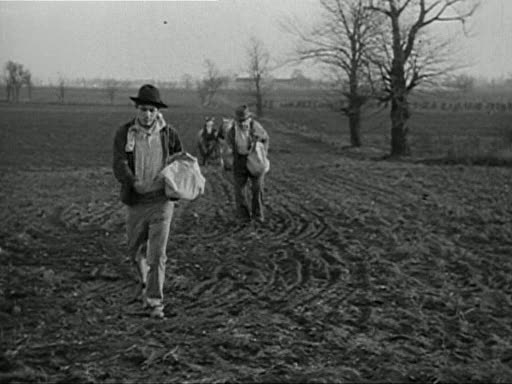
Griffith tells his story with simple but powerful contrasts like these, and his images have a potency you won’t find in other films from the time. We see the affluent society crowd enjoying their party without a care in the world. We see the farmer holding out his empty hands to let his wife know that they have no money. And we see the businessman, having fallen inside a grain elevator, struggling for life as the wheat comes pouring down on him, until only his writhing hand is visible.
And the film’s final image sums up the bitter despair brought on by the businessman’s scheme. We see the farmer again sowing seed, now by himself on the lonely plain. Going down one row he nears the camera, then he turns, walks back in the opposite direction, and the image fades from the screen.
Corner in Wheat is one of many shorts that Griffith made for Biograph between nineteen eight and nineteen fourteen. During this time the director was constantly experimenting, constantly testing the boundaries of the new medium. These one and two reel movies show him searching for new ways to use the language of film, and the techniques he developed at Biograph would form the basis for his later features. Eventually Griffith’s work would change cinema forever. Corner in Wheat is one of his first steps along that path.
Watch the film by clicking on the title below.
Danzón (1991)
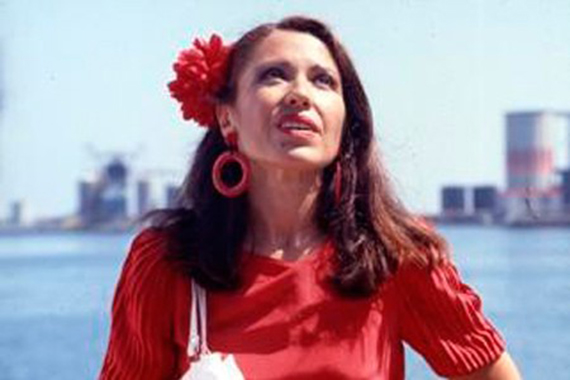
María Rojo
In the first frames we see a woman’s feet, clad in silver high-heel shoes, moving slowly across a dance floor as a band plays. The camera pulls back to reveal a large nightclub filled with couples, their arms posed in respectful embraces, their feet tracing short, precise movements in time to the music. This is el danzón. Originally from Cuba, this style of dance migrated to Mexico about a hundred years ago and has enjoyed huge popularity there. It is a very elegant, very formal ritual, and its devotees even adhere to a fairly strict dress code.
Every Wednesday night Julia comes to the Salon Colonia to dance with Carmelo. This is what she lives for. Julia is a single, middle-aged woman with a daughter who lives in Mexico City. During the day she works for the phone company as an operator. But she lives for el danzón. Her long-time partner, Carmelo, is a quiet, courtly man who seems to be at least ten years her senior. Though they’ve been dancing together for years, apparently their relationship doesn’t go beyond that. Then one day Carmelo disappears. Julia becomes depressed, frustrated, angry. Finally she decides to go looking for him in Veracruz, a port city on the Gulf of Mexico.
When Julia arrives in Veracruz the movie’s tone shifts. In Mexico City, a massive metropolis, everything is concrete and plaster, fluorescent and neon. In Veracruz we can feel the breeze rustling the trees, the sunlight warming the pavement. Novaro and cinematographer Rodrigo García make Julia’s wanderings in this port city a sensual experience. On the night of her arrival, one of the first things she does is walk down to the water. She smiles as the surf gently rolls around her feet. The pace of life seems to be slower in Veracruz. People seem to spend their days outdoors. Julia is still intent on finding Carmelo, but we can see her gradually relaxing in her new surroundings.
For the most part Novaro keeps the film firmly rooted in reality, but there is one extraordinary sequence that feels strangely unreal. Julia decides to go down to the port to ask about Carmelo. On her friend Susy’s advice, she’s wearing a sheer red dress, red earrings and a red flower in her hair. As she strolls past the workers, men turn to stare at her and she feels self-conscious. But then Julia comes to the docks, and her attention turns to the ships floating by. They bear names like Puras Ilusiones (Only Illusions), Lagrimas Negras (Black Tears), and Amor Perdido (Lost Love). A wistful song plays on the soundtrack, but there is no dialogue. Julia walks slowly along the docks as these massive ships drift past, and it’s almost as though her fantasies of love have taken shape in the gigantic vessels gliding across the water.
In playing Julia, Maria Rojo’s face is so open, so expressive, so naked that you feel like you can read every thought, every emotion. Julia is fragile and easily hurt, so she goes to great lengths to hide her feelings, and yet Rojo always allows us to see beneath the surface. At times it’s maddening to watch this woman pursuing her quest for a man she barely knows, but Rojo always keeps us on the character’s side, making sure we can relate to her.
As I said before, Novaro’s films are about people, and she fills the movie with a number of memorable performances. Margarita Isabel, Carmen Salinas and Víctor Carpinteiro all seem to live inside the characters they’re playing. Tito Vasconcelos is especially interesting as Susy, a man who dresses as a woman. Susy is excited by Julia’s romantic quest, but at times seems attracted to Julia herself. Rhapsodizing about love one minute, bitterly cynical the next, Susy appears to be intoxicated both by the joy and the sadness of life.
At the end, Julia returns to Mexico City, and Carmelo magically reappears. He doesn’t say where he was or why he went away. They simply start dancing again, and Julia is radiant with happiness. Nothing has been explained, nothing has been resolved. There’s no dramatic climax, no message to be gleaned from our heroine’s adventures. Life just goes on. And life is what Novaro is interested in. The director and her sister Beatriz, who co-wrote the screenplay, achieve something very close to what Vittorio De Sica and Cesare Zavatinni created in films like Bicycle Thieves and Shoeshine. They don’t create drama, they just dive into life. It’s enough for them to explore the joys and frustrations of friendship, the unpredictability of daily living, the beauty of the world around us.
Would You Buy a Digital Camera from This Man?
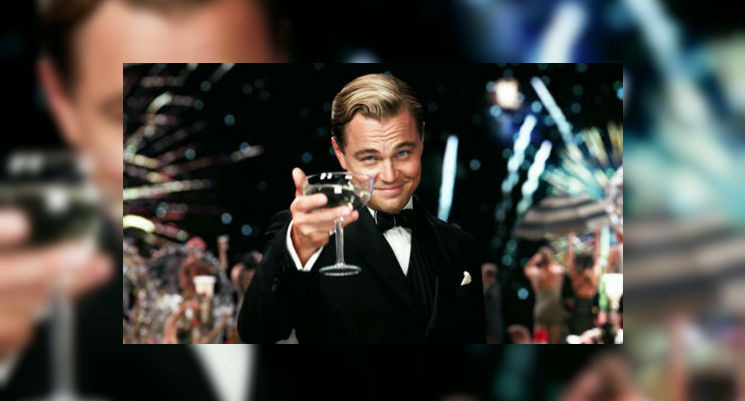
Okay. Digital production, digital projection are now pretty much the norm. Most everything I’ve seen in a theatre lately, except for revival theatres, is presented in one digital format or another. While the quality is mostly good, I have to say I’m still not a total convert. But to be honest, I’m having a hard time figuring out exactly what I’m seeing.
First, let’s talk about The Great Gatsby, which I have to say I loved. Not sure why the critics had such a hard time with it. Fitzgerald is my favorite author, and I thought Luhrmann, DiCaprio and all the rest did an amazing job of bringing his vision to the screen. Anyway, to get back to the digital thing, I saw the film twice. The first time was at the Arclight, Sherman Oaks, and I was totally overwhelmed by the experience. It was one of those times where the images and the sound just washed over me and I was enthralled. I didn’t notice any problems with the image. I was just swept off my feet.
The second time, however, was a little different. Part of the reason I went back again was to pay more attention to the quality of the digital projection. This time I saw it at the Arclight, Hollywood. I still loved the movie, but watching it a second time I had some problems with the image. In the first place, it seemed just slightly fuzzy, as though the resolution was not quite adequate. I also felt that the colors were a little too soft, which I’ve noticed in other cases with films shot and projected in digital. It didn’t seem to have the richness or depth of color that you’d get with film. The blacks just weren’t black enough, and the image in general looked faintly washed out.
I went to IMDB, where I found that the film was shot with Red Epic cameras using Zeiss Ultra Prime lenses. Under “Cinematographic Process”, it said the master format was digital intermediate (2K), and the source format was Redcode RAW (5K) (dual-strip 3-D). I won’t pretend this all makes sense to me. In the reading I’ve done about digital, I understand that even though there’s a lot of talk about 4K, most films we see are not coming from 4K masters. And I’m wondering why the master format for Gatsby was digital intermediate.
Not long after Gatsby I saw Sarah Polley’s Stories We Tell at the Laemmle, North Hollywood. Just briefly I’ll say that it knocked me out, and I recommend it highly. As opposed to a big budget commercial feature like Gatsby, this is a small scale documentary. My guess is that it probably cost a few million to make. Like Gatsby, it was shot on digital, though the equipment and process were different. It’s important to say, too, that the finished film is a mix of processes, assembled from both digital footage and Super 8. But I thought it looked great. Where there is a deliberately bleached, grainy quality to the Super 8 work, the interviews (shot with a Sony CineAlta HDW-F900R) look crisp and there is a richness and texture to the image that seemed to me superior to Gatsby.
There could be a number of reasons for the difference in image quality in the two movies. It could be the cameras that were used in shooting. It could be the type of files that the content was transferred to. It could be the projectors. And I wonder if the size of the screen could be a factor, since the screens at the Laemmle are much smaller than those at the Arclight. Also, in reading about 2K and 4K, I’m learning that often people on the exhibition end don’t worry too much about the difference. Films can be shot in 4K, but then distributed as 2K files. Apparently it’s not uncommon for a film to be shot in 4K, distributed in 4K, but shown in 2K, since some projectors need to be switched over manually, and some projectionists don’t give a damn.
As you can probably tell, I’m confused. I know that with any new technology there’s going to be a certain amount of chaos, since you’ve got different companies with different technologies competing for a share of the market. But with digital I’m having a hard time figuring out exactly what I’m seeing. If there’s anybody out there who can make this clearer, please feel free post a comment. I need help.
Eve’s Bayou (1997)
A lot of movies have been made about families, but not many honest ones. Most of the time, even if the film digs into some of the more difficult issues that arise between husbands and wives, brothers and sisters, everything is resolved before the fade out. We may see anger, envy, cruelty, betrayal, but generally speaking it’s all explained away by the end of the story. Everybody has their reasons, everybody has their issues, and everybody ends up burying their problems to join in a big, warm group hug before the final fade-out.
And so a film that really examines the toll that lies, jealousy, desire take on a family is rare. Eve’s Bayou deals with all those things, bringing us into the world of a prosperous Southern family, gradually revealing the dynamics that both keep them together and tear them apart. And in spite of the brutal emotional conflicts, the overwhelming sadness, the film is infused with a radiant beauty. This movie is not about despair. It’s about life.

Like The Magnificent Ambersons, Eve’s Bayou isn’t just about a family, it’s about where they live. Writer/director Kasi Lemmons opens the film by telling us that the bayou was named after a slave who was freed by her master. She then bore him sixteen children. Their descendants, the Batistes, are the focus of the story. Their large, comfortable home is at the center of the film, but Lemmons also takes the time to show us the town, its people, its market, its cemetery. The family is well-respected, and proud of their standing in the community. In fact the father, Louis, is more than proud. He’s arrogant, cocky, and his brash confidence will be his undoing.
Another thing the film has in common with The Magnificent Ambersons is the way the director uses a party to bring us into the world of this family and to lay out the relationships. After a brief prologue, we find ourselves in the bayou at night, drifting across the dark water, floating past the heavy trees until we find ourselves in front of the brightly lit Batiste home. Inside there’s music playing, people are dancing, and everybody seems to be having a great time. But Lemmons gradually takes us deeper, allowing us to catch the careless gestures, the whispered gossip, the hurt glances that nobody notices. And before the end of the party, the main character, a young girl who worships her father, has had her eyes opened to an ugly truth that shakes her to the core.
This is the moment that sets everything else in motion. The realization by Eve that her father is not the hero she thought. She shares the secret with her older sister, Cisely, who is shocked at first, and then insists that nothing happened. Cisely tells Eve she just imagined it. That there’s nothing to worry about. Which is what children often do when confronted with their parents’ sins. You have to bury the knowledge, forget about it, go on as if nothing happened. And then maybe spend years or decades trying to keep the memory from rising back to the surface.
Starting with the opening shots of the bayou, Lemmons gradually draws us into the life of this small Southern town. She seems to favor long takes, slow tracking shots, allowing us to drink in the serenity and stillness of this melancholy world. The sunlight undulates slowly across the dark, smooth water of the bayou. The dense, green foliage seems to embrace life and death at the same time. In the audio commentary we hear Lemmons talk about her close collaboration with cinematographer Amy Vincent and editor Terilyn Shropshire. I was especially interested in what they had to say about finding “organic” solutions, which I took to mean finding simple, direct ways of expressing the story’s themes. Terence Blanchard’s score also plays a crucial role. His subtle orchestral textures, complemented by harmonica and guitar, perfectly match the emotional tone of the film.
As visually rich as the movie is, it wouldn’t mean a thing if the actors didn’t deliver. But not only does Lemmons get great performances out of the individual cast members, they work beautifully as an ensemble, making us believe that they’ve known each other all their lives. Samuel Jackson is smoothly confident as the philandering father who gets offended when anyone questions why he’s never home. Lynn Whitfield plays the beautiful, loving wife, who struggles to raise her children while the knowledge that her husband is cheating eats away at her. Meagan Good has all the poise and authority of a confident, radiant older sister who knows she’s her father’s favorite.
And at the center of the movie is Jurnee Smollett as Eve. It’s one of the most remarkable performances I’ve ever seen a young actor give. She has all the trusting sweetness and all the bitter anger of a girl on the verge of adolescence. Her mood changes in an instant, projecting smug confidence one minute and absolute despair the next. She’s full of love and hate at the same time, torn apart by emotions she doesn’t even understand. Lemmons says she spent a long time looking for a girl to play Eve, but on seeing Smollett immediately knew she was perfect for the role. It’s hard to imagine anyone else in the part.
Eve’s Bayou is one of the few movies that really captures families as they are, diving deep into the currents of love and jealousy, bitterness and loyalty that bear mothers and fathers, sons and daughters relentlessly forward. It doesn’t tell us that everything’s going to be all right. All of this will go on forever, and all of this will fade into the past.
The Private Lives of Elizabeth and Essex (1939)

Bette Davis
It’s important to start by saying that Anderson’s version of events was not historically accurate, and that Warners’ took further liberties with the facts. What makes the play so compelling is the way the author digs into the two central characters, ripping away the layers of pride and pretense as Elizabeth and Essex battle for control of the relationship and control of England. The screenplay, by Norman Reilly Raine and Aeneas MacKenzie, discards much of Anderson’s dialogue and completely alters the structure, but actually ends up being nearly as complex and involving as the original play. The film is surprisingly literate for Hollywood, and what’s even more surprising is that the screenwriters manage to create a historical love story that is lively and interesting.
The film goes far beyond the narrow emotional range of most Hollywood films, and Curtiz is up to the challenge. He understands the possibilities in the material and uses his considerable gifts as a filmmaker to dramatize the screenplay. While the background is brimming with pomp and pageantry, in the foreground we see two people who are intelligent and passionate, vain and insecure, struggling to come to terms with each other. Art director Anton Grot creates spaces both vast and intimate, using vibrant color to set the emotional tone for each scene. Cinematographer Sol Polito finishes the job beautifully with his fluent use of light and shadow.
The heart of the film is Davis’ performance, and she is amazing. She was clearly fascinated by Elizabeth, and her commitment to the part is obvious. Her performance has nothing to do with Hollywood’s standard notions of romance. Her Elizabeth is not attractive or seductive. She does not try to ingratiate herself to us in any way. Davis plays the queen as a brilliant and neurotic woman, desperately wanting to be loved and absolutely determined not to show it.
Flynn, on the other hand, plays Errol Flynn. It’s not that he’s bad, but his performance isn’t in the same league as his co-star’s. He brings the same level of commitment to this role as he did to Captain Blood or Robin Hood, but the script demands more. He handles the dialogue well enough, but his performance is all on the surface. It’s possible that at this point in his career Flynn couldn’t dig any deeper. But the rest of the cast is solid, and there are a few standouts. Apparently the experience of making the film was traumatic for Olivia de Havilland, but she is excellent as Penelope. The role gives her a chance to step away from the wholesome, good girl image that Warners had forced on her. And Donald Crisp plays Francis Bacon with impressive skill and subtlety.
The adventure films that Flynn and Curtiz made all have simple, clear stories that outline a basic struggle between good and evil. Though they’re ostensibly about heroism, for the most part they’re really about exploiting our childish desire for reassurance. The leadership at Warners made an effort to fit Elizabeth and Essex into that mold, but the basic premise of the film defied that kind of simplification. Though not historically accurate, it’s a real story about real people and real human failings. We are made to see that the brave and dashing Essex is a vain, impetuous egotist who understands little about the realities of running a country. And we can’t even fully sympathize with Elizabeth, who is a jealous, neurotic egotist willing to sacrifice the man she loves to retain her power. It’s the antithesis of the standard formula, because it shows how empires are really built. And there’s nothing reassuring in the outcome.
*
I’ve been interested in art director Anton Grot’s work for a while. He worked on many films with Curtiz, and is credited on numerous other Warner features in the thirties and forties. It’s been really hard to find information on Grot, but I did come across a blog which features several of his drawings. As far as I can tell, most of them were done for Captain Blood, but it looks like at least one was for Mildred Pierce, and the last one is probably for Elizabeth and Essex or The Sea Hawk (the two films share a number of sets). If you’d like to check the drawings out, click here.
Fahrenheit 451 (1966)

When a director sets out to turn a book into a movie, they have to make it their own. There is no way to take words on a page and translate them literally into images and sounds. Even if a filmmaker didn’t have to deal with the time constraints of a commercial feature and had the freedom to include every event, every episode described in a novel, there’s no way to replicate the experience of reading a book on the screen. They’re two different mediums, and to make a successful adaptation, you have to transform the book into a film.
So I can’t really fault Francois Truffaut for not capturing the feeling of Ray Bradbury’s Fahrenheit 451 in the film he made of the novel. Bradbury’s work is so much about the experience of words, and the resonance that words have, there’s no way you could replicate what he does in a movie. But I still have to say that the film doesn’t work for me. I’ve never been able to connect with it.
Which is not to say that it isn’t worth watching. In many ways I think the film is kind of brilliant. The world Truffaut creates and the visual language that he uses have a striking immediacy. While his earlier features were shot largely on location, Fahrenheit 451 was made in a studio. Truffaut uses this to his advantage by emphasizing the artificiality of the environment that Montag, the fireman, lives in. Art director Syd Cain (aided by Tony Walton, uncredited) gives an eerily bright, hard-edged look to this future society where TV controls all information and conformity is the key to survival.
The brilliant reds and solid blacks of the fireman’s world contrast effectively with the earth tones of the natural landscapes and the homes inhabited by the book people. Cinematographer Nicolas Roeg takes full advantage of these extremes. He is amazingly sensitive to the various qualities of light, using it to define the stark, modern interior of the firehouse, and to paint the subtle, ghostly beauty of the English countryside. Working with editor Thom Noble, Truffaut finds a rhythm to suit each sequence. Jump cuts give urgency to a scene where a man is warned he’s about to be busted. The firemen’s raids crackle with a scary energy. Long, uninterrupted takes emphasize the arid, sterile atmosphere of a suburban home.
But in spite of all that, I have to say I just don’t connect with the film on an emotional level. There’s something strangely detached about it. You might say that the movie’s polished, impersonal feel would be totally appropriate for this cold future world, but if we can’t connect with Montag as he struggles to break free, then there’s no dramatic impact. As creative as Truffaut and his team are in giving the film a look and a feel, for me the finished product is emotionally flat.
Pauline Kael felt Truffaut’s approach was too restrained, and she may have a point. Fahrenheit 451 was one of Bradbury’s early novels, and it clearly comes out of his roots as a pulp writer. Apparently the book was the author’s response to the chilling oppression of the McCarthy era, and the theme of an individual struggling against a totalitarian government could hardly be stated more bluntly. Montag has to choose between good and evil. Truffaut may not have been comfortable with such a clear-cut moral choice, and he seems unwilling to play it to the melodramatic hilt. There is a reserve in his approach which makes the actors seem strangely distant. It’s also possible that, since this was his first film in English, the language was a barrier he couldn’t quite overcome. And it’s important to mention that the director’s relationship with Oskar Werner was strained during the making of the film, which may have affected the way Montag comes across, or doesn’t come across.
Then again, a good deal of what makes the book memorable is the language, and that’s something you can’t put on screen. I started to re-read Fahrenheit 451 recently after watching the film. I have to say that the story does seem naive and melodramatic. I definitely feel like it’s the work of a young writer, and it doesn’t have the depth or the subtlety of the author’s later work. But the way he writes is totally compelling. Bradbury’s language is dense, rich, intoxicating. His prose is so close to poetry that the line between the two disappears. There’s poetry in Truffaut, too, but it’s a different kind. As a filmmaker he seemed to be seeking clarity, simplicity. Often his best films, such as The Wild Child and The Story of Adele H., have a brusque directness, a naked honesty that allows us to get very close, often uncomfortably close, to the characters. The poetry is held in check, never being allowed to overwhelm the story. Bradbury, on the other hand, wants to overwhelm the reader. He plunges us into his own sensual dimension, a world of experiences he describes so vividly we can touch them, taste them.
While Truffaut’s sensibility is different from Bradbury’s, composer Bernard Herrmann is very much on the writer’s wavelength. His score has a rapturous intensity that is completely in tune with Bradbury’s world. Herrmann sets the tone with the first cue. As a narrator recites the credits over images of TV antennas, strings playing ethereal, shifting harmonies with no resolution, preparing us for the film’s chilling vision of the future. Immediately after we’re assaulted by the bracing, dissonant music that accompanies the firemen’s raids. Throughout the film, Herrmann’s eerie, otherworldly score keeps us off balance with its strange harmonies and unusual rhythms. It’s only at the very end, when we’re in the forest with the book people, snowflakes drifting from above, that the composer introduces a lovely, lilting melody, letting us know that Montag has finally found safety. The tension and anxiety that have dominated the score are gone, and the final, resounding chords reassure us that there is hope.
So while I’ve got some serious problems with the film Truffaut made from Fahrenheit 451, I also find a lot to like in it. I get the feeling that the director was trying to challenge himself by taking this project, a far cry from Shoot the Piano Player or Jules and Jim. It also seems like he was trying to assimilate what he’d learned from Hitchcock, not just in this film but in others like The Soft Skin and The Bride Wore Black. While I’m not crazy about his work from this period, I think it was important for him to explore this approach. Artists have to make mistakes to grow. We all do. As Buckminster Fuller said…,
“How often I found out where I should be going only by setting out for somewhere else.”
The Exiles (1961)
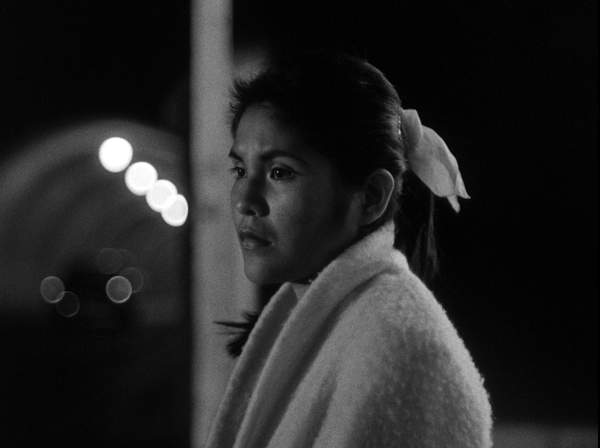
Yvonne Williams
Before that happened, Kent MacKenzie made two films about Bunker Hill. The first is a fairly conventional documentary short in which residents give their views on the city’s plans to bulldoze the area. The second is a dazzling, poetic ramble in which we spend the night with three Native Americans who have left the reservation and made Bunker Hill their home.
It’s not exactly a documentary, but it’s not exactly fiction either. The film focusses on three people, Yvonne, Homer and Tommy, who play themselves. MacKenzie interviewed the three to learn about their lives, and then wrote the script based on what they had told him. As we watch the characters roaming through the neon lit streets of downtown, we hear them talking in their own voices about who they are and what they feel. Yes, everything we see is staged, but the three protagonists seem completely unselfconscious. They seem to be giving us an honest account of their lives.
The word documentary is kind of problematic to begin with. We tend to think the term describes a factual account of the world as it is. In reality, most documentaries are staged to some degree, and the filmmakers can’t help but organize the material from their own perspective. Robert Flaherty had his subjects act out scenes for the camera to achieve the effects he wanted. John Grierson believed that film should be a tool to bring about greater awareness and social change, and advocated using the medium to achieve that end. It may seem that Frederick Wiseman is an impartial observer who stands back and lets the world unfold before the camera, but Wiseman himself rejects that view. He insists that his documentaries are not objective, but rather an account of his experience making the film.
And in talking about a movie as vivid and original as The Exiles, why worry about definitions. The film may not be a documentary, but it is a document. It shows a neighborhood, Bunker Hill, once an elite enclave for the wealthy, now a bustling, lower-income community where the streets are brimming with life. It shows people, Native Americans who left the dead-end reservations they grew up on and came to LA looking for something different. It shows places and spaces, streets, bars, juke joints, hotels, tunnels and hilltops. The images are real, even if the scenes may have been staged.
Though the film doesn’t have a score, it’s filled with music. We hear songs jumping out of radios and jukeboxes (including some by the Revels). We also hear Native American chants which take us outside the amped-up sound of city life. Toward the end a group Indians drive to the top of a hill overlooking Los Angeles for a gathering. It’s a place where they can be themselves, where they can drink and talk and sing. We may not understand the words, but it’s clear the music brings them together. It reminds them of their kinship.
Certainly MacKenzie shaped the material, but it feels as though Yvonne, Homer and Tommy are taking us through their world. The Exiles is an invitation to see life from someone else’s perspective. As a pretty square guy living a pretty straight life, it blows my mind to hear Tommy talk about being in jail. “Time is just time to me. I’m doin it outside so I can do it inside.” MacKenzie’s great gift is that he gets people to open up, and then just lets them be who they are.
The Breaking Point (1950)
Anybody who’s a fan of movies from the studio era probably has a soft spot for Howard Hawks’ To Have and Have Not. It’s hard to beat for sheer entertainment, taking full advantage of its charismatic stars and a top-notch supporting cast. It’s also totally superficial. We know from the start that the good guys are going to win and that Bogart is going to walk off with Bacall. It’s a classic example of the way the studios would take a book and transform it into something almost unrecognizable. In the case of Hemingway’s novel To Have and Have Not, Hawks took the premise of a guy on a boat in the Carribean and dumped everything else.
Really, he had to, because the original novel is extremely unusual and brutally cynical. Actually, I think the book is pretty interesting, but its fragmented narrative and strange digressions pretty much defy all the conventions of commercial filmmaking. On top of that, it was wartime, and the studios were determined to keep everything upbeat and positive.
But by nineteen fifty things had changed. There was a strong undercurrent of cynicism running beneath Hollywood’s glamorous surface. People were making films that not only questioned the status quo, but suggested that we were living in a world where the deck was stacked against us. That’s pretty much the thrust of Hemingway’s novel. The book is about those who have money and those who don’t. And the conclusion that the main character reaches by the end is “A man don’t stand a chance.”
According to Eddie Muller, it was John Garfield who suggested doing a remake. Screenwriter Ranald MacDougall was brought on board to do the adaptation. Though he moved the story into the present and changed the location to Long Beach, it’s much closer to both to the letter and the spirit of the book than the Hawks version. Harry Morgan is a fisherman struggling to support his family and hang on to his boat. The story shows how he’s driven to ever more desperate measures to make money, finally agreeing to take part in a robbery.

Juano Hernandez and John Garfield
Garfield’s gripping, lively performance is the heart of the movie. Harry starts out as a fairly easygoing guy who just wants to make a living, but as he feels the screws tighten we can feel him tighten up as well. Garfield had a gift for playing average guys, and did it without sentimentalizing his characters. He doesn’t ask for our sympathy, he just plays the role as honestly as he can.
Harry loves his wife, and he works hard to provide for her and the kids. Lucy Morgan loves her husband but she’s slowly getting ground down by the stress of making do with almost nothing. Phyllis Thaxter plays the part with admirable simplicity and sublety. The one character that’s borrowed from the Hawks version is the sexy drifter, who in this case tests Harry’s commitment to his wife. The role was probably created to make the movie more commercial, but Patricia Neal is so good that it’s hard to complain. She’s tough, smooth, cynical, and still vulnerable in a way that makes her seem human.
Those who are mostly familiar with Curtiz’ polished films of the forties might be surprised by the gritty intensity of The Breaking Point. It has the energy and the tension you can find in some of his thirties melodramas, but here the characters are more complex. Curtiz keeps his camera close to the actors, and MacDougall’s script allows them to dig into their roles. We have no trouble believing that they inhabit this world, that their lives are rooted in this small seaside town. Cinematographer Ted McCord is amazingly sensitive to the ways in which light can define a location and the subtle nuances of mood it creates. He makes a working class kitchen and a waterfront bar equally real and vivid. Whether he’s shooting on location or on a soundstage the images have the same attention to texture and the same vibrant immediacy.
At the end of the film Harry has survived a shootout with the robbers, but it looks like he’s going to lose his arm. Delirious, he rambles on about how “a man don’t stand a chance”, but calms down when his wife arrives. She convinces Harry to let the doctor amputate, and she’s with him as they carry him to the ambulance. Not the happiest of endings, but we feel a sense of hope. Then the camera pulls back and we’re left with the final startling image. Harry’s sometime partner Wesley was killed in the shootout. As Harry and his wife, the police and the doctors exit the frame, we’re left with a shot of Wesley’s young son standing by himself on the pier. This image of a child, alone and forgotten, is the film’s most powerful moment. It’s totally unexpected, and the movie is over before we can absorb it, but it lingers in the memory. Hollywood movies generally end with the promise that everything’s going to be all right. The Breaking Point does not, and it’s all the more powerful because of its honesty. It tells us that everything is not going to be all right.
The Tell-Tale Heart (1953)
 Back in the fifties, most cartoons were about funny animals doing crazy things. While some of them included humor directed at adults, animated shorts were intended to be family fare. Cartoon characters might fall off a building or get blown to smithereens, but nobody ever got hurt. The tone was always breezy, lighthearted, upbeat.
So UPA’s decision to produce a short based on Edgar Allen Poe’s The Tell-Tale Heart was a pretty startling move. But this wasn’t the first time the studio flouted the status quo. Though little known today, UPA was one of the most innovative studios in the history of animation, and it had a tremendous impact on the medium. Most importantly, the studio’s artists embraced a radical simplification of figures and backgrounds, and drew on the language of abstraction. They didn’t care about imitating life. Their goal was to create vivid, expressive images.
Poe’s story is a disturbing descent into the mind of a madman, who tells us how he came to murder the old man he had been living with. The opening paragraph gives us a vivid picture of the narrator’s state of mind.
TRUE! –nervous –very, very dreadfully nervous I had been and am; but why will you say that I am mad? The disease had sharpened my senses –not destroyed –not dulled them. Above all was the sense of hearing acute. I heard all things in the heaven and in the earth. I heard many things in hell. How, then, am I mad? Hearken! and observe how healthily –how calmly I can tell you the whole story.
The tale is incredibly compact, with our narrator giving a harrowing account of the crime in about four pages. At just under eight minutes, the cartoon maintains the same single-minded focus. Screenwriters Bill Scott and Fred Grable do away with the obsessive precision of Poe’s language and go for a simpler, more direct approach. They also eliminate the killer’s explanations of his complex, conflicting emotions. In the film the narration is fairly straightforward, and James Mason’s delivery is both effective and affecting.
In the film, just as in Poe’s story, we experience everything from our narrator’s point of view. Director Ted Parmalee, designer Paul Julian and animator Pat Matthews conjure up a series of unnerving images that bring us right into the oppressive gloom of the old house. Drawing on both expressionism and surrealism, the style of the film makes us feel that we are indeed seeing all this through the eyes of a madman. Spiky shadows stretch across the floorboards. The moon decays and crumbles before our eyes. When the old man is murdered we see his face disappear in a violent swirl of yellow and black.
The film would not be as powerful or as disturbing without Boris Kremenliev’s eerie modern score. Kremenliev did very little work in film, which is a shame because the dissonant harmonies and jagged rhythms he uses for The Tell-Tale Heart complement the images perfectly. His style was completely in synch with the kind of music that was being performed in concert halls at the time, but it was a bold approach for a short that was being released by a major studio. While David Raksin and Bronislau Kaper had subtly woven new compositional techniques into their work, I don’t know of any Hollywood score up to that time that was so aggressively modern.
Though UPA existed as a company into the seventies, it really only maintained its position as an innovator from the late forties into the mid-fifties. But its influence on animation has been felt ever since.
If you want to know more about UPA, you can access the Wikipedia article by clicking here.
And if you want to watch The Tell-Tale Heart, click here.
Zoot Suit (1981)
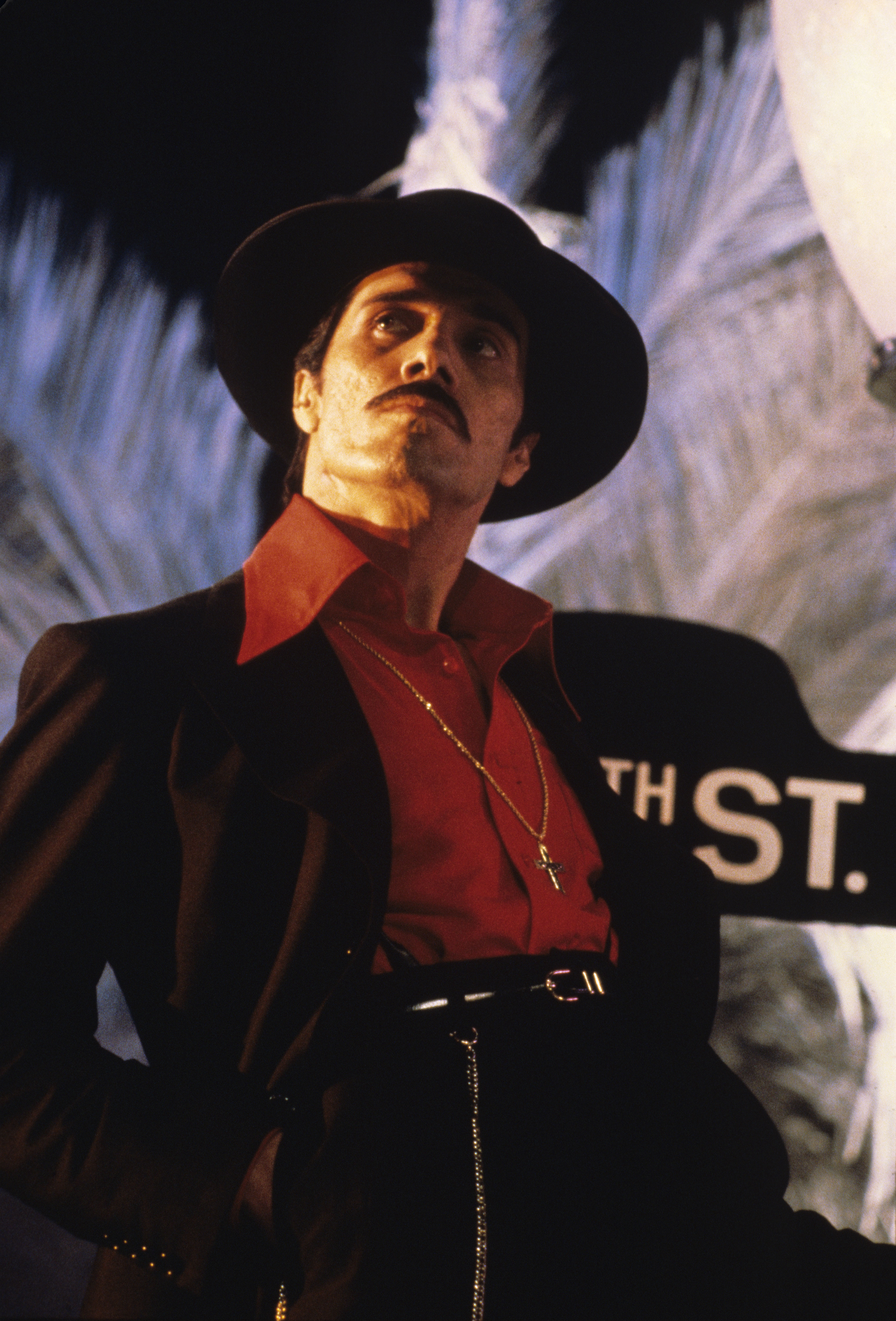
Edward James Olmos
In 1978 Luis Valdez’ musical Zoot Suit premiered at the Mark Taper Forum in LA. The production opened a door on a chapter of Los Angeles history that many had forgotten. During the early forties, as the US was fighting WWII, the city was rocked for months by racial violence, sparked by the death of a young man that may have been the result of a gang rumble. Though there was no proof that it was a homicide, hundreds of Latinos were detained in connection with the case, seventeen were tried as a group for the “crime”, and twelve were sent to prison. The trial, which was a sham, inflamed racial tensions in LA, and led to a series of violent clashes between Latinos and servicemen that went on for months. The conflict peaked with an incident in which thousands of white servicemen and civilians descended on East LA, assaulting the people who lived there at random.
Who the hell would have the nerve to take this gritty slice of LA history and turn it into a musical? But that’s exactly what writer/director Luis Valdez does, and he pulls it off with sharp wit and smooth grace. Valdez changes the names and condenses the action, reduces the defendants from seventeen to four and focusses on a semi-fictional character named Hank Reyna. We see the story unfold through Hank’s eyes, experiencing his struggle with a world where the deck is stacked against him. More importantly, we are privy to his inner struggle to figure out who he is. Throughout the play Hank is visited by El Pachuco, a mythic figure dressed in high style, who keeps pressing the same question. Is Hank going to live by somebody else’s rules and let society define him? Or is he going to define his own identity? But this slick hipster in the broad-brimmed hat and baggy pants doesn’t just play the part of Hank’s conscience. He sings, he dances, and he serves as a cross between narrator and ringmaster. Clearly Valdez is not interested in realism. This is not a historical reenactmant. “But relax,” El Pachuco purrs to us as the play opens. “Weigh the facts, and enjoy the pretense.” And then he adds, “Our pachuco realities will only make sense if you grasp their stylization.” Valdez doesn’t see artifice as just a convention necessary to staging a musical. It’s central to what Zoot Suit is about. The brash style and broad gestures come from the lives of the people being portrayed. In making the film, Valdez uses the musical as it was staged, but takes advantage of the language of cinema. Though there are a few instances where I had problems with this approach, for the most part it works well. The artifice of the theatre is completely in keeping with Valdez’ “fantasy”.
The story begins the day before Hank is set to join the Navy. He’s anxious to go off and fight in the war, but first he’s just going to have one last night out. Hank gets dressed up in his “zoot suit”, much to the chagrin of his father, a hardworking Mexican immigrant who gets even more upset when his kids refer to themselves as Chicanos. But dad calms down, and Hank goes off with his brother and sister to party at a local nightspot. A run in at the club leads to a rumble in the Sleepy Lagoon. Hank is arrested and thrown in jail. We see him quickly stripped of everything he has, his freedom, his family, his girlfriend, his pride. The trial is also a piece of theatre, in which the prosecution and the judge insist on defining the defendants on their own terms. Hank and his friends are not convicted of committing murder. They’re convicted of being pachucos.
Racism is a major issue in Zoot Suit, but Valdez doesn’t allow his story to fall into a simple us-versus-them dynamic. He knows that things are more complex than that. One of the young men sentenced to jail is an anglo kid who has grown up in Hank’s neighborhood and accepts the local culture as his own. He dresses the way his friends dress, talks the way his friends talk, and when his friends are sent to prison by a racist legal system, he suffers along with them. Is he Mexican? Is he American? Does it matter? And when Hank accuses Alice, who’s been fighting to get him released, of exploiting the case for political purposes, he learns that as a woman and a Jew she’s subjected to discrimination just as he is.
This all sounds pretty downbeat, and certainly the play deals with some ugly realities. But there’s also a lot of joy in Zoot Suit. The action is punctuated by a series of lively, raucous musical numbers that sometimes serve as a mocking counterpoint to the drama, and at other times show the vibrant joy that people can feel even in the worst of times. Valdez obviously loves the music of the forties. He revels in the chance to conjure up the spirit of Latin American swing and resurrect a number of choice songs from the era. Zoot Suit is a lament, but it’s also a celebration.
 Reality Is Scary