Blog Archives
Jean-Luc Godard
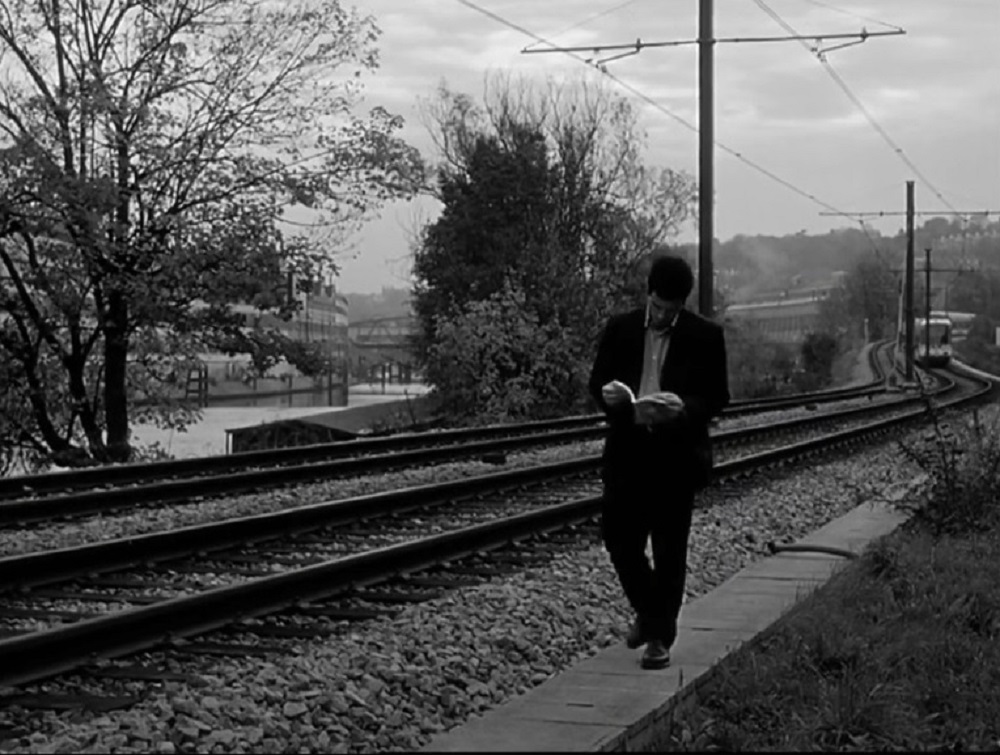
Jean-Luc Godard died on September 13, 2022. At the time, I felt I needed to write something about him, but it took a lot longer than I expected. I went back and watched some films I’d seen before, and took the time to watch others I’d never seen. I would never pretend to understand Godard, but I feel a deep connection to him and his work. Having spent over a year watching his movies and reading about his life, I feel closer to him than ever.
I’m not sure what I want to say about Jean-Luc Godard, except that I’ll miss him terribly. There are other people who are better qualified to talk about his work, and I doubt Godard would want anyone to bother with a eulogy. It’s hard to explain why I feel so sad at his passing. He lived to be more than ninety years old, and made scores of films during his lifetime. I should be glad that he had such a long, productive career, and I am, but I’ll still miss him.
I didn’t like his work to start with. I probably saw À bout de souffle for the first time when I was around twenty, and it left me cold. Une femme mariée bored the hell out me. I didn’t know what to make of Pierrot le fou. It took a few years for me to find my way into his films. I remember I loved Une femme est une femme. Masculin féminin was really compelling. And I was knocked out the first time I saw Le mépris on a big screen. This last film is definitely an outlier, an attempt by Godard to make a commercial movie with known stars, and it is, in part, a self-conscious (and at times very funny) rumination on the tension between art and commerce. But it’s also breathtakingly beautiful, with stunning cinematography by Raoul Coutard and a melancholy score by Georges Delerue.

You could say Le mépris was an early expression of the tensions that Godard would be dealing with for the rest of his life. He loved Hollywood films, but he was also deeply suspicious, often contemptuous, of commercial cinema. Le mépris follows the individuals involved in making a movie out of the Odyssey, a mythic tale, but the producer is putting the screws on the director (Fritz Lang, playing himself) to make sure it sells lots of tickets. An ancient legend becomes another commodity that must compete for attention on the open market. And of course, as in so many Godard films, there’s the main character’s struggle to maintain his relationship with the woman (he says) he loves. The movie is a critique of storytelling, a critique of commercial cinema, and a critique of relationships.
Godard is always questioning everything. In his films, a good part of the dialogue usually involves questions and answers, or questions and evasions, or questions followed by uncomfortable silence. His films question the audience. His films question themselves. He may have been the most self-conscious of filmmakers. Prenom Carmen is a riff on Prosper Mérimée’s tale of obsessive love, adapted by Anne-Marie Miéville. In this version, Carmen claims to be making a movie, and seeks help from her uncle, a filmmaker played by Godard. When she comes to visit him in the hospital, she asks, “Don’t you want to know why I came?”, to which Godard responds, “Sure. That would make for good dialogue.”

Unlike a commercial film, Prenom Carmen makes no effort to convince the audience that what they’re seeing is “real”. The bank robbery where the lovers first meet is as absurd and over-the-top as a Monty Python sketch. While gunshots are still ringing out, a cleaning lady appears with a mop and a bucket and starts wiping up the blood. At the end of the film, Carmen’s gang attempts a kidnapping, using a movie crew to make it look as though the whole thing is being staged for the camera. The director makes it clear that the story is complete fiction. What is real in a film by Godard? The ideas are real. The emotions are real.
Some people may ask what kind of “emotions” I’m talking about in Godard’s work. He generally tends to observe his characters with a cool detachment, a dispassionate gaze. But actually, Godard is one of the most passionate artists ever to work in films. The most obvious expression of this is his obsessive exploration of relationships, generally focussing on desperate, confused men who are trying to connect with women who are mostly inaccessible. In À bout de souffle, Masculin féminin and Prénom Carmen we see lovesick men obsessively pursuing women who remain largely out or reach. Hélas pour moi tells the story of a god who assumes human form to make love to a woman he desires.
Godard was passionate about music, and music plays an important role in his films. Composers Georges Delerue and Antoine Duhamel wrote achingly beautiful scores for the director, giving expression to the feelings that his characters struggled to express. Godard also used existing music, often drawing on baroque and romantic composers like Bach, Beethoven and Dvorák, and he sometimes turned to works by 20th century composers like Dmitri Shostakovich and Giya Kancheli. (He was also fond of truncating his soundtrack, abruptly cutting the music off in mid-cadence. Remember, you’re not here to listen to music. Don’t ever forget you’re watching a movie.)
Godard was passionate about movies. He dedicated his first feature to Monogram Pictures, the low-budget studio that churned out cheap gangster flicks in the 30s and 40s. Une femme est une femme is a giddy to salute to, and riotous riff on, Hollywood musicals. His 8-part series Histoire(s) du cinema is an essay on film and its interaction with society. I think in many ways you could see Godard’s career as an obsessive exploration of the possibilities in film. He believed it had the potential to change the world, but he always seemed to feel that his own efforts failed to live up to that potential.
But I think more than anything else, Godard was passionate about ideas. He was a voracious reader, burning through fiction and non-fiction. He was fascinated by history, philosophy, sociology. His films are full of ideas, but even as he states his ideas he can’t help questioning them, and in some cases he then asks if he’s asking the right questions. Godard spent his life searching for truth, but he couldn’t accept anything as true until he’d looked at it from every angle. He seemed deathly afraid of becoming complacent on any level.
There’s no better example of this than the work he produced in his collaborative/collective period of the late 60s and early 70s. By the late 60s, Godard was feeling increasingly dissatisfied with his own efforts to create a truly revolutionary cinema, and decided that it was necessary to relinquish his control as an individual director/author. The view of the director as the author of a film was in conflict with Godard’s embrace of Communism. He first tried making movies in collaboration with individual filmmakers, and then became a part of the Dziga Vertov Group, a collective dedicated to bringing about a new political consciousness through a new political cinema.
Godard appears to have thought he was suppressing his own identity in order to participate as a co-worker in the collective, but honestly, I don’t buy it. To my mind, films like British Sounds/See You At Mao, Le Vent d’est and Tout va bien, all seem to flow directly from Godard’s work of the mid to late 60s. The static compositions, text inserts, and extended tracking shots that are so much a part of these movies can all be found in films like Weekend, La Chinoise and One + One. One of the few things that does separate the work he did with the Dziga Vertov Group from his earlier work, unfortunately, is that there’s nothing to laugh at in these overtly political films. They’re grindingly serious. You can find a number of wickedly funny moments in his 60s features, but as Godard came to be increasingly contemptuous of anything that might be perceived as “entertainment”, he seems to have felt it was necessary to drain these films of spontaneity, beauty and humor.
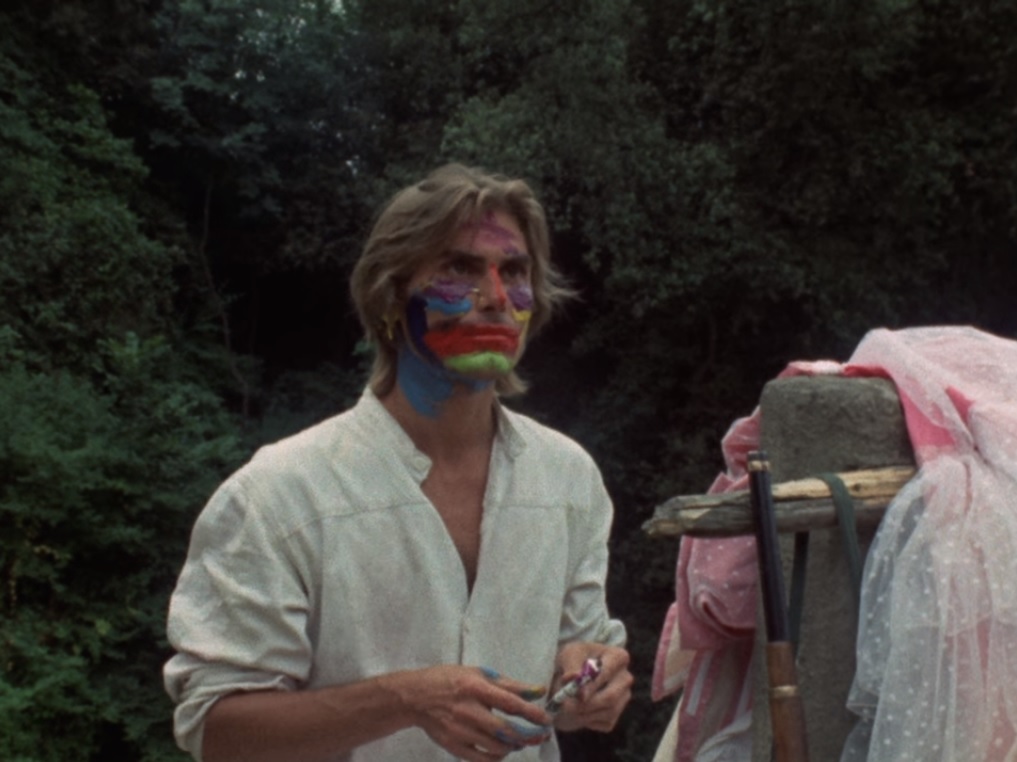
Not to say that there’s nothing interesting about these movies. In some ways I think they are truly revolutionary. Godard was trying to cut away everything that was false in movies, to get rid of phony narratives, seductive images and cheap manipulation. Instead of trying to recreate or represent reality, in these films Godard tries to put us in direct contact with the images and sounds that we encounter in the world around us. He was horrified by the “bourgeois” cinema produced by the film industry, and I think even more horrified by the possibility that he had become a participant in that industry. Unfortunately, I feel his work with the Dziga Vertov Group is often terribly dull and oppressive. The lack of visual dynamics, the absence of rhythm and the droning voiceovers would probably make them tough going for all but the most devoted admirers of Godard’s work. I respect his intentions, but I can’t follow him down this road.
Not surprisingly, Godard himself apparently became dissatisfied with this approach. As the 70s came to a close, Godard left off making overtly political films and started a new phase. Released in 1980, Sauve Qui Peut (la vie) tells the story of a filmmaker named Paul Godard who finds himself alone and afraid as his marriage falls apart. It’s a bitter, melancholy film, and it’s hard not to see it as at least partly autobiographical. But creating this new movie seemed to energize Godard, and he worked hard to promote it. He even referred to it as his “second first film”, and it seems to have been the beginning of another phase of his career.
In a way, you could say Godard had returned to the spirit of restless exploration that made his early work so exciting. He made feature and shorts, worked in film and TV, switched back and forth between fiction and non-fiction, sometimes mingling the two. He began exploring stories, sometimes recent ones, sometimes ancient ones. I want to emphasize that I’m using the word “exploring”, not “telling”, because the last thing Godard was interested in was unfolding a straightforward narrative. He wanted to take these stories apart and see what was inside them. He wanted to ponder the human needs, desires, frailties that gave rise to these stories in the first place. He wanted to see how they might relate to the world we live in. Anyone who watched Godard’s King Lear expecting an adaptation of Shakespeare’s play would be completely disappointed. Instead of adapting the play, Godard uses it as a starting point for a complex meditation on stories and the role they play in the modern world. He makes this clear in the opening sequence, where he juxtaposes “King Lear” with the words “A Study”, “An Approach”, and “A Clearing”. We follow William Shakespeare Junior the Fifth, a contemporary descendant of the playwright, as he tries to rediscover/reinvent stories in the world after the nuclear disaster at Chernobyl. The film does incorporate some quotes from Shakespeare, but it also draws on other sources, including Robert Bresson, Jean Genet, Viviane Forrester and Virginia Woolf. If you can let go of the original play, it’s a beautiful, allusive contemplation of primal mysteries. The images sketch a lovely, irrational poetry. The soundtrack is densely layered with voices, snatches of music, clattering plates and the cries of seagulls.
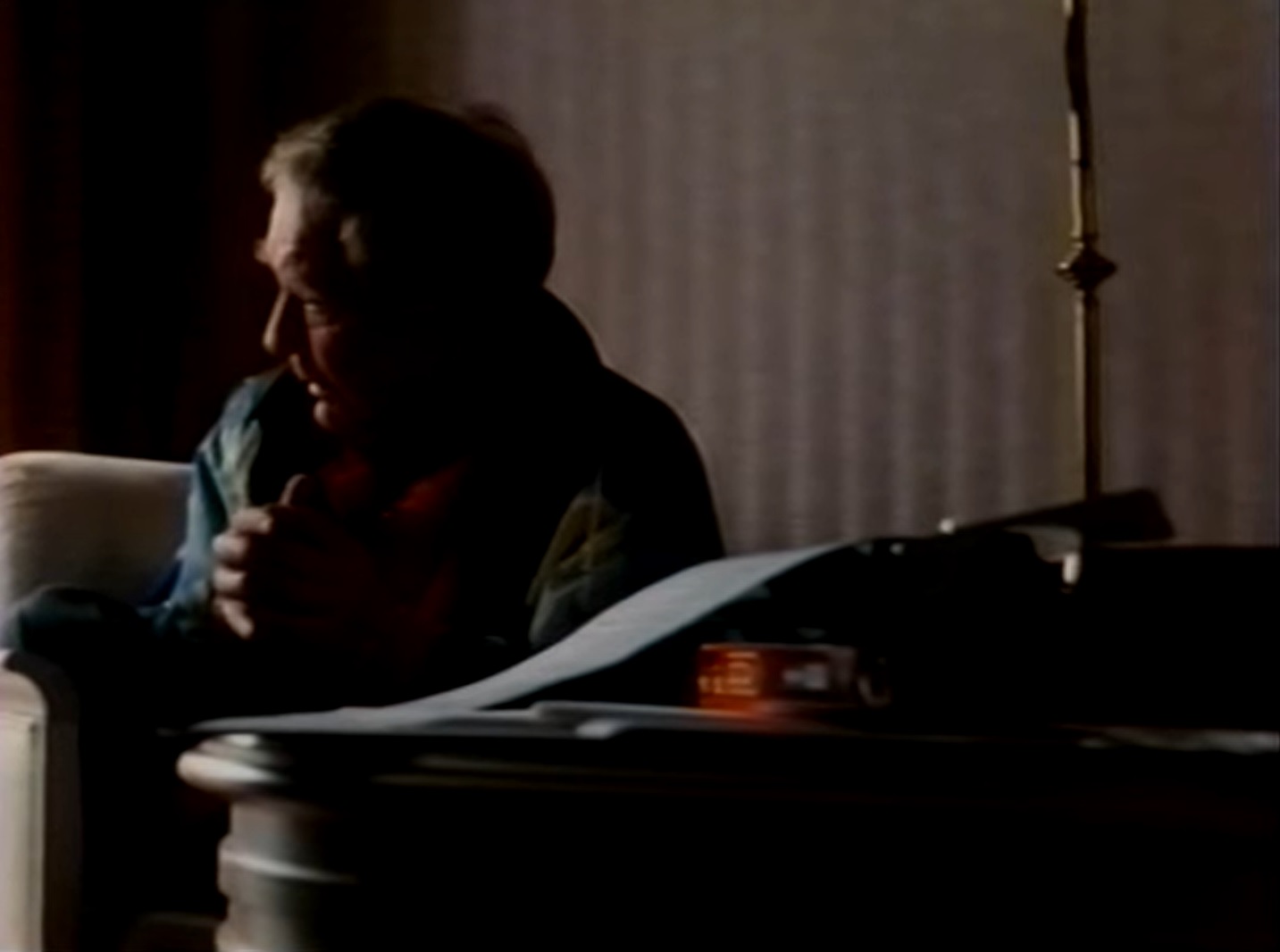
Godard’s King Lear also returns to, and expands on, the issues he explored over 20 years earlier in Le mépris. As it begins, we hear an audio recording where the film’s producer, Menahem Golan of the Cannon Group, is complaining to Godard about how long the production is taking. There apparently were a number of disruptions. Initially Norman Mailer was going to play the character based on King Lear, and he had written a script for the film. But Godard and Mailer had a falling out early on, and the author walked out on the project. Nevertheless, Godard includes a brief scene featuring Mailer, and a voice-over delivers a mocking commentary on the difficulties of dealing with “the great writer”. Apparently the screenplay was re-written by Tom Luddy and theatre director Peter Sellars, who also plays William Shakespeare Junior the Fifth. So we have a director playing the descendent of a playwright, whose mission is to rediscover stories in the modern world. In a voice-over Junior the Fifth explains that he’s working for the Cannon Cultural Division, a reference to the film’s producers. Just like Le mépris, Godard’s King Lear examines the tension between art and commerce, the problems in interpreting a text, and the relationship between a timeless story and the modern world. But in the later film, Godard piles on layer after layer of commentary, criticism and caustic wit. At this point in his career, the director seems to have given up on finding any answers, but he can’t help ruminating on the same issues that have fascinated him since the beginning of his career.
I think it’s safe to say that Godard’s later films are challenging for most viewers. They’re certainly challenging for me. Fragmented and elliptical, poetic and polemical, the later movies plunge you into situations with no explanation and overwhelm you with readings, recitations and rants. I saw Éloge de l’amour when it first came out, and while it struck me as very beautiful, I really had no idea what it was about. But watching it again recently, I found it was much easier for me to grasp the threads that Godard was weaving together. The film is a relentless exploration of the complexities of relationships, somehow merciless and tender at the same time. I was deeply moved.

Godard’s later films didn’t get widely distributed in the US, and I assume that’s at least in part because they could be so difficult for audiences. Take a look at the comments on IMDB for Godard’s later films and you’ll see that the viewers are mostly at opposite ends of the spectrum. You have the devoted fans who think his films are rich and compelling, and you have the other viewers who think the director is a pompous fraud who has nothing to say.
It’s hard to talk about “the audience” for films, because it’s not really a homogenous group of people all looking for the same thing. There are a million different audiences out there, and their tastes are constantly changing. But the films that have the greatest commercial success often seem to have two things in common: First, they’re fundamentally reassuring in some way; Second, they try to provoke a strong emotional response. Both of these things were anathema to Godard. I think he desperately wanted to connect with audiences, but he wasn’t going to tell them comforting stories and he wasn’t going to manipulate them. By refusing to play that game, he rejected the things that draw most people to movies, and made himself an eternal outsider.
We shouldn’t praise him or criticize him for this. It’s just who he was. I just said that he refused to play the game, but really, I don’t think he was capable of playing it. If you look at the writing he did before he even started making films, when he was contributing to Cahiers du Cinéma, it was clear even then that he was a stone iconoclast. As much as he loved films, he thought most of the people making them were clueless fools. I think it’s safe to say he felt that way to the very end. And as critical as he was of others, he could also be harshly critical of his own work. He didn’t cut himself any slack.
In the course of writing this, I watched a number of Godard’s movies, some that I knew well and others that I’d never seen. More than ever before, I was struck by the richness of his films and the range of ideas they explore. At times they seemed impossibly confusing and oblique. At other times they seemed incredibly beautiful and resonant. But they always impressed me as the work of an artist who was passionately in love with the medium. I think they’re also the work of a man who was obsessed with exploring the world he lived in, and who desperately needed to share what he’d found in the course of his explorations.
Like I said at the beginning, I’m glad he had a long life and that he made so many movies. But I’ll still miss him.

Bande à part [Band of Outsiders] (1964)
Not too long ago I saw Bande à part at the Arclight, Hollywood. I’d already seen the film a couple of times and liked it, but this time I connected with it in a way I hadn’t before. The best word to describe what I felt is euphoria. I was swept up in the whirl of images and sounds, I was completely involved in the performances, I was overwhelmed by the audacity of it all. The movie was totally intoxicating.
I think Godard is one of the most gifted filmmakers ever, but I’ve often had trouble relating to his work. I know I’m not alone. Many critics have written about Godard with a mix of admiration and frustration. Audiences have never flocked to his films, though he does have a small, passionate following. His movies are amazingly inventive and imaginative. But they can also be difficult, didactic, and even dull. I think in part this is because Godard has a complicated relationship with the medium. He’s spent a good part of his career trying to figure out what role film should play, and what role he should play as a filmmaker. While he grew up watching American films, and has spoken of his respect for some Hollywood filmmakers, he’s definitely conflicted about the impact commercial cinema has had on the world. Like many of us, as a young man he fell under the spell of Hollywood’s magic, but as an adult he finds himself horrified by Hollywood’s madness.

Anna Karina, Claude Brasseur and Sami Frey
Many of Godard’s early films were based on Hollywood genre formulas, and movies about criminals seem to have had a special hold on him. Bande à part falls into that category, but rather than just make a crime film, the director ended up making, as he often did, an essay on crime films. He doesn’t want us to just sit back and enjoy the ride, letting ourselves get pulled along by the narrative. As much as he loves Hollywood movies, he also knows you can’t trust Hollywood movies, and that makes him want to question the form, to twist it, to turn it inside-out. Anything to keep himself and us from sliding into complacency.
It’s Godard’s irreverent, anarchic approach to the material that makes the film such a thrilling, dizzying experience. As soon as the credits begin we’re assaulted by raucous music as close-ups of the three leads flash before us. Bande à part is full of abrupt transitions and sudden changes in tone. The restless energy of the three would-be thieves drives the film. The visual style is amazingly alive and vibrant. And the sound is just as important as the images, catching both the din of the city and the intimacy of quiet conversations. Rather than trying to clean up the audio, bringing down the ambient noise, looping the dialogue, Godard lets us hear the world as it is. We hear feet scuffling along the street, music bouncing off the walls, traffic droning in the background. And when we get to the house where Odile lives we’re suddenly surrounded by an unsettling calm. The silence somehow feels strangely sinister.
The film is based on the novel Fools’ Gold by Dolores Hitchens, though apparently Godard took a lot of liberties in adapting it. The story follows Odile, Franz and Arthur, three young people in Paris who are planning to steal some money. Though the trio wants to pull a heist, they seem to have no idea how to proceed, and when it comes to committing the crime they’re hopelessly inept. Arthur takes charge, giving orders and acting tough to impress Odile, but he’s really just as clueless as his friends. Franz goes along, seemingly because he doesn’t have the nerve to challenge Arthur. And Odile is a naïve young girl who just wants to get away from her home and have fun.
One of the main differences between Bande à part and the crime films of the studio era is the way the main characters are portrayed. If we were watching a movie with Humphrey Bogart or James Cagney (later on maybe John Garfield or Robert Ryan), for the most part the star would be tough, confident, assured. As the tension built, as the pressure mounted, we’d get to a point where that confident surface would start to crack, revealing the tough guy’s vulnerable side. Often the heart of the film would lie in the moments where we saw how frail the hero was beneath his hard exterior. That conflict between the tough and the tender was one of the linchpins of Hollywood melodrama. But Godard takes a totally different approach. In Bande à part, it’s obvious from the beginning how vulnerable these three are. It’s clear that Arthur and Franz are doing their best to mask their insecurity by acting cool, and Odile is trying as hard as she can not to let them see how scared she is. These three are not crooks. They’re playing at being crooks. At times we see Arthur and Franz literally acting out scenes from movies.
Bande à part has an ending, but it doesn’t have a resolution. It couldn’t, because Godard doesn’t believe in tying things up neatly. Rather than trying to find order in chaos, Godard lets us experience the world as it is. My sense is that he’s a romantic who feels he should be a realist. His work is formed by the tension between these two perspectives. In his films he seems to be offering us an invitation to explore with him the massive contradictions that make up our lives, the sorrow and the violence, but also the joy and the beauty
How can you turn down an invitation like that?
 Reality Is Scary