Blog Archives
Iré a Santiago [I’ll Go to Santiago] (1964)
In 1959, rebel forces led by Fidel Castro overthrew Fulgencio Batista and the revolutionary government took control. The new government immediately began its efforts to transform Cuba, with the goal of rebuilding it as a Communist nation. One of the government’s key initiatives was the creation of the Instituto Cubano del Arte e Industria Cinematográficos (ICAIC). Film was seen as an important way to educate and animate the public as the country was entering a period of rapid change.
Just like the first decade of Soviet cinema, the first decade of Cuban cinema after the revolution was a time of exploration and innovation. A number of talented filmmakers came out of ICAIC, but unfortunately few of them are remembered today. One of the most gifted was Sara Gómez. Her body of work isn’t large. During the 60s and early 70s she made a number of short films. She died in 1974 before completing her only feature, De cierta manera. But the work Gómez left behind is well worth looking at.

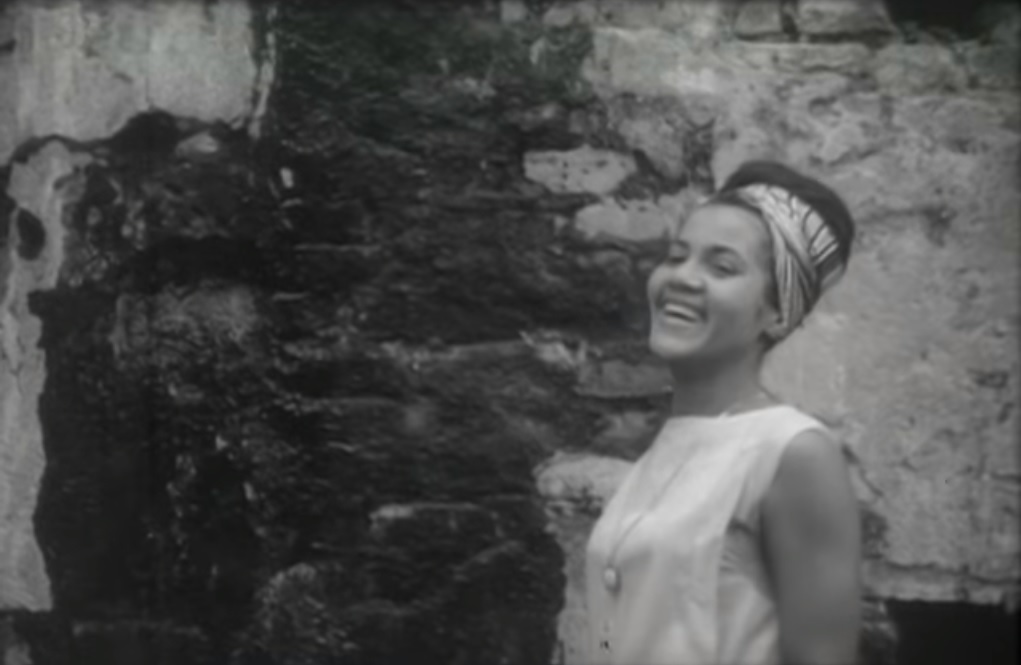
Iré a Santiago is a joyous short celebrating the people and the culture of the city named in the title. It’s loose, energetic and spontaneous, with the camera wandering through bustling neighborhoods, pausing in a street market, spying on people in a café. The photography and editing are rough, but the images Gómez captures are lively and dynamic. Unlike other documentary filmmakers, she doesn’t try to pretend that she’s standing outside of the world she’s shooting, observing it all objectively. Some people wave at the camera, others try to avoid it. One boy starts dancing when he realizes he’s being filmed. Gómez doesn’t cut these shots out. They show that the filmmakers are part of the life that’s swirling around them.
The film doesn’t have a tight structure. Gómez is interested in wandering around to see what she can find. After spending some time watching people in the streets, she moves on to the bay, and the narrator gives us some brief notes on its history, from the arrival of the Spanish to the beginning of the revolution. Then we get a quick rundown on places of interest, and end up in the middle of the carnival.

Aside from the cinematography, the other thing that energizes the movie is the music on the soundtrack. It’s an eclectic mix of sweet melodies and dense percussion. And the people move to the music. In the carnival scene at the end, we see a row of men playing congas, a horn section blowing brassy punctuation, and dancers swaying to the driving rhythms. This isn’t just a documentary, it’s a celebration.
…..
The web site ReMezcla offers a short piece on Sara Gómez. In addition to a brief bio, it has links to some of the director’s films, including Iré a Santiago. You should know that the print doesn’t have subtitles, but please don’t let stop you. If you look at the images and listen to the sounds, you’ll be getting most of what the filmmaker is trying to say.
Among the films offered is Gómez’ only feature, De cierta manera. It’s an original and complex movie, and a marvelous piece of filmmaking, but I hesitate to tell you to click the link because the print is terrible. Really what we need is to have somebody track down whatever elements still exist and do a real restoration. This is the only feature we have from one of Cuba’s most gifted filmmakers. It deserves to be seen the way Gómez envisioned it.
Dogtown and Z-Boys (2001)

I was a teenager through most of the seventies, and I spent a fair amount of time in Santa Monica, but I had no idea that a revolution was going on there. While I was catching as many local bands as I could, and camping out at revival theatres that showed stuff by Welles and Godard, there was a whole other scene happening that eventually would change the world. I missed it completely. I’d never even ridden a skateboard.
Dogtown and Z-Boys doesn’t just document a sport. It captures a cultural shift. Using footage from the seventies along with an explosive collage of music from the time, the film shows how a rowdy band of kids living in an urban wasteland ended up becoming heroes to a generation. Skateboarding became a vehicle that would carry art, style and attitude to kids all over the world. Dogtown and Z-Boys is an exhilarating look back at how it all happened.
This movie has incredible energy. While it uses the standard talking head format for the interviews that tell the movement’s story, the footage from the past gives us a swirling, kaleidoscopic view of the seventies. If you’ve seen video of skateboarders doing their stuff, you know movement is everything, and I’m not just talking about the kids riding the boards. The camera leaps, jerks, swoops, trying to capture whatever’s happening. The images careen across the screen, sometimes flashing past so quickly it’s hard to say exactly what we’ve seen. The filmmakers splice it all together in inventive and expressive ways, capturing the energy of a movement that was all about movement. They also do an excellent job of using the present day interviews to provide context without slowing the film down or turning it into a lecture.
The film begins by giving us a sketch of the surfing scene in Santa Monica, Venice and Ocean Park back in the early seventies. The area had gone from oceanside suburb to urban wasteland in the space of about a decade. The guys riding the waves in that part of town had an aggressive style and were openly hostile to outsiders. Jeff Ho, Skip Engblom and Craig Stecyk opened up a surf shop where young surfers would gather to work and hang out. But somewhere along the way these kids turned from surfing to skateboarding, and the rowdy, crazy energy they’d shown riding the waves got channeled into their moves on concrete. Ho, Engblom and Stecyk acted as godfathers and midwives to the movement, creating the Zephyr Team, which was the tightly bound and tightly wound unit that was soon shaking up the skateboarding world.
While the film may appear chaotic, it’s actually very carefully constructed to give us not just the stories of the individuals or the history of the team, but also to give us the necessary context to understand what was actually going down. The film deftly weaves together observations about society, technology, commerce and culture to give us a well-rounded picture of the time and the place these kids grew up in, and to explain why their brash style connected with teens all across the country.
The one gripe I have with Dogtown and Z-Boys is that the makers don’t fully acknowledge their involvement in creating the story they’re telling. Sure, if you look at the credits you’ll see that it was written and directed by Craig Stecyk and Stacy Peralta. And in watching the movie you’ll make the connection that Stecyk’s work for Skateboard magazine garnered a lot of attention for the Z-Boys, while Peralta was one of the sport’s first stars. These two played a huge role not just in creating the initial scene, but in publicizing it and shaping the perception of it. I’m not bothered by the fact that they’re writing and directing the movie. Certainly they’re well qualified to tell the story, and as a piece of filmmaking Dogtown and Z-Boys is outstanding. But if you set out to make skateboarding a phenomenon, and then you make a documentary that shows how skateboarding became a phenomenon, you really have to acknowledge your dual role as subject and storyteller. Not just by putting your name on the credits, but by allowing that to be part of the fabric of the film. While I don’t distrust Peralta and Stecyk, I don’t think they’re being completely honest. In other words, I have no problem with them giving me a subjective account of what went down. I just want them to acknowledge that it is a subjective account.
Aside from that, I totally love this movie. These guys are smart and funny, and they have some great stories to tell. The footage from the seventies takes me back to the days when LA seemed like a vast, decaying paradise that you could wander through forever. And the score, featuring Jimi Hendrix, Alice Cooper, Pretenders and many others, matches the searing energy of the images.
Dogtown and Z-Boys is a joy to watch.
 Reality Is Scary