The Departed (2006)

Leonardo DiCaprio and Jack Nicholson
When the history of America is told, it’s often portrayed as a series of movements, driven by the people, pushing this country slowly toward an ideal of justice and equality for all. I’d like to believe it was true. But really, that version doesn’t begin to tell the whole story.
At the beginning of The Departed, we see images of the violence that erupted in Boston in the seventies when the courts ordered desegregation of the city’s schools. As scenes of chaotic street clashes flash past, we hear a voice telling us how the Irish and the Italians fought to get their piece of America. The narrator’s advice to the Black community is simple.
“No one gives it to you. You have to take it.”
We may not like to think of America this way, but much of the country’s history was written by various warring factions taking power any way they could. This is how the great factories of the industrial era grew. This is how the unions got the factory owners to make concessions. It’s how the country expanded its territory from coast to coast. It’s how our cities were built. It’s nice to think that the US became a world power because of our belief in principles like freedom and democracy, but usually those principles take a back seat to ruthless self-interest.
Director Martin Scorsese has explored this territory before. While morality is crucial to his vision, he knows that high principles often get trampled underfoot in the day to day rat race. He’s fascinated by characters who struggle to survive in a corrupt world, and he doesn’t offer those characters easy choices. The issues aren’t laid out in black and white. It’s not that simple. While The Departed could be described as a story about cops and robbers, the relationship between the two is so complex and incestuous that it makes it difficult to tell the good guys from the bad guys. They’re all rolling around in the mud together.
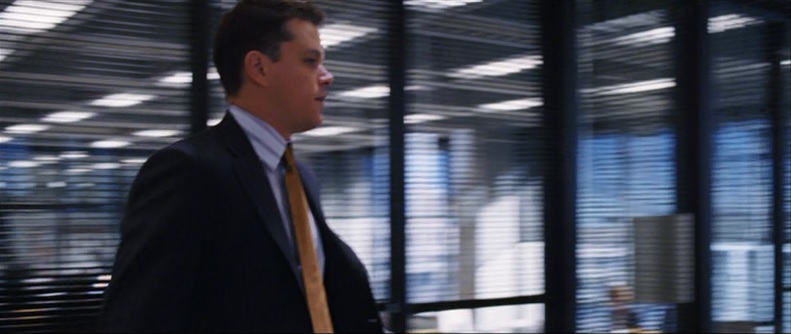
Matt Damon
It’s been widely reported that The Departed was inspired by a thriller from Hong Kong called Infernal Affairs, but there’s another source that’s also important. Much of the story is based on the real life career of crime boss Whitey Bulger, who ran most of the illegal activity in Boston for years. Being from Boston himself, screenwriter William Monohan was the perfect choice to take the earlier film’s outline and work it into this new context. And this isn’t just a matter of being familiar with the city. Monahan knows the people, he knows the culture, he knows the life.
Like any city, Boston is made up of various overlapping groups. The Irish have a long history there. And as with any ethnic group, the Irish are divided into different sub-groups. You’ve got the working class guys who live on the south side and cling ferociously to their customs and their culture. Then you’ve got the upper class guys who want to climb into the cozy world of high-end condos and pricey restaurants. And then you’ve got the guys who are stuck in between.

Determined to serve.
That’s the crux of the conflict in The Departed. It starts with two young men brought up on the south side, both of them desperate to get out. Their escape route takes them to the state police academy, where they both graduate with high marks, but the paths they follow put them on opposite sides of the law. Colin is a mole working for crime boss Frank Costello. Bill is a straight arrow cop assigned to infiltrate Costello’s gang. This symmetrical pairing, the crook playing cop and the cop playing crook, could’ve ended up being a simplistic gimmick. But Monahan reaches deep into these characters, pulling away layer after layer, showing us what makes these two “southies” tick.
Colin is picked up by crime boss Frank Costello as a kid and groomed for the role he’s going to play. Frank is no simpleminded thug. He knows that to stay ahead of the law he needs to have inside information, so he sends Colin to school knowing that he’ll rise quickly in the state police. And Colin has no qualms about playing the role, using his intelligence and his education to build the kind of life he’s always wanted. He dresses well, dines at fine restaurants, and buys a condo that has a view of the Massachusetts State House. Colin gazes out the window at the gold dome that caps the dignified, classical structure. It symbolizes everything he wants, and he’s certain that he can have it all, if he just plays his cards right.
Bill, on the other hand, is an honest man who spends his days with thieves and murderers. He’s chosen for the job, in part, because he learned early on how to adapt to different environments. His parents’ separation meant that even as a kid he led a double life, playing the good student and dutiful son when he was with his mother, then playing the roughneck southie when he hung out with his dad. Bill joined the state police hoping to put all that behind him. He has no family and he wants to start a new life. Unfortunately, his background makes him the perfect choice to infiltrate Costello’s gang.
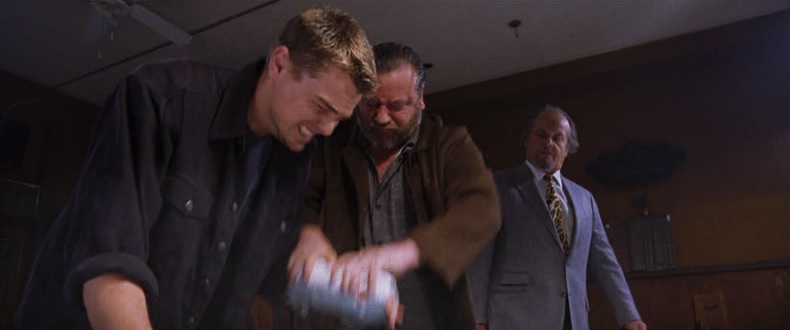
Leonardo DiCaprio, Ray Winstone and Jack Nicholson
Thrust into this role, the lawman/thug, means the conflict that’s always troubled him is now at the center of his life. Bill thinks he can handle it, he wants to do the job, but really he’s falling apart. Being from Boston, being Irish, being a man, he tries to play it tough, insisting he has nerves of steel. When he’s by himself, though, he’s popping pills to numb the pain. He has no family. No friends. Even his identity is a question mark. Only his two superiors know who he really is. When one of them dies and the other disappears, Bill is completely isolated.

Unsure about his identity.
Questions about identity are at the heart of The Departed. The two main characters are both living a lie. Bill does it from a sense of duty, but Colin does it to get what he wants. He has carefully constructed the persona he presents to the world. Smart and ambitious, he knows that he can rise through the ranks if he maintains the proper image. His boss tells him marriage is one of the keys to success, and Colin, already understanding that, zeros in on a psychologist who works with law enforcement. Does he care for her? Maybe. Will she be useful? Absolutely.
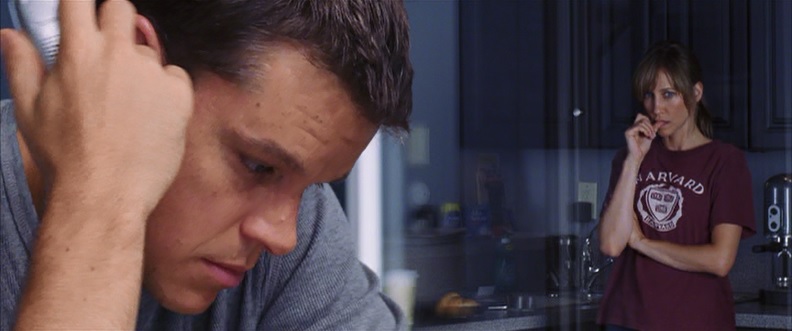
Matt Damon and Vera Farmiga
Scorsese has made gangster movies before, but The Departed is very different from Mean Streets or Goodfellas. In those earlier films he used vivid color and kinetic camerawork to pull us into the mobsters’ world. The Departed is much more subdued. Obviously, the look and feel of Boston sets the tone to a degree, but production designer Kristi Zea and art director Terri Carriker-Thayer use the city to create a world of muted colors and subtle hues. The dark wood and weathered brick of the south side is contrasted with the clean, conservative blues and greys that define the offices of the state police. This is carried further by costume designer Sandy Powell. Colin’s crisp suits show that he’s dressing for success, while Bill’s denim jackets and work boots make him fit right in on the south side. In addition, we see all the characters wearing a variety of baseball caps and sweatshirts to let us know whose side they’re taking. Cinematographer Michael Ballhaus, a veteran of several Scorsese films, seamlessly weaves all this into a coherent, unobtrusive visual fabric. Ballhaus’ cinematography is impressive in its simplicity and directness. He always finds the right tone without ever calling attention to his work.
The movie is called The Departed, and when death isn’t in the foreground it’s hovering in the background. Aside from the parade of corpses and caskets, the characters often talk about those who’ve passed away. Frank asks a man in a bar how his mother’s doing, and the man answers that she’s on her way out. “We all are,” Frank responds jovially. “Act accordingly.” In the final scenes, bodies pile up left and right. At times the killings happen so quickly it takes a minute to figure out what went down. This is one of Scorsese’s most cynical films. There are no winners. By the end of the movie, almost all of the principals are among the departed. In the final shot, the director gives us an image of a golden dome rising in the background as a rat scurries across a railing in the foreground. A symbol of human aspiration side by side with a symbol of human frailty. And in the end, it all adds up to the same thing.

Una familia de tantas (1949) [One Family of Many]
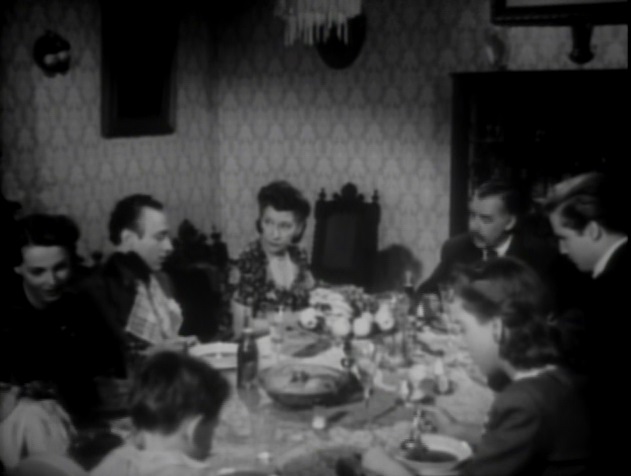
In the late forties Mexico was changing rapidly. Industrial growth fueled the economy. Thousands abandoned their farms for manufacturing jobs in the city, where construction was booming and mass media was becoming a part of daily life. Of course, all of this meant that the culture was changing, too, and the family was a central part of Mexican culture.
Buoyed by the booming economy, the Mexican film industry was riding high, and family dramas were a popular genre. A number of movies were made about the pressures that drove mothers and fathers, sons and daughters apart, but generally everything came together in a happy ending that reinforced the importance of traditional values. This was a Catholic nation, after all. If a son strayed from the straight and narrow, he had to repent. If a daughter disrespected her parents, she had to beg forgiveness. No matter how bad things got, order had to be restored before the music swelled up and the credits rolled.
It was unusual in this era for a Mexican filmmaker to question those traditional beliefs that supposedly held society together, but that’s exactly what Alejandro Galindo does in Una familia de tantas. In this film Galindo presents a portrait of a middle-class family living a comfortable life in Mexico City. He shows us first the rigid discipline that holds the family together, and then he shows us how that same rigid discipline tears the family apart.
The Cataños are a typical middle-class family of the period. The five children and their parents live in a large house which is run with an iron hand by Sr. Cataño. He dominates the household, insisting that all the proprieties be observed. A child is not to leave the room without permission. No one sits down at the dinner table without saying a prayer. When he gives a command the children scamper to obey.
And this rigid order is overthrown by a young man selling vacuum cleaners. This smooth-talking salesman with an answer for everything belongs to a new breed. Roberto is hard-working and ambitious, and smart enough to see the potential in the household appliances which are now becoming available to anyone with money to spend. He goes door to door, speaking with such glib assurance that his customers don’t know quite how to respond. He invites himself into the Cataño house when one of the daughters, Maru, is home alone, never thinking that this would be improper. He is only focussed on selling her a vacuum cleaner.
When Sr. Cataño finds out that Maru was alone in the house with a stranger he’s furious. After learning that this brash young man is coming back in the evening to seal the deal, Sr. Cataño can hardly wait for the encounter so he can overwhelm the intruder with outraged indignation. And when Roberto arrives, the self-righteous patriarch lays into him with an angry lecture. But he’s met his match. Roberto at first tries to politely calm the outraged father, but when it’s suggested his motives for entering the house were improper, he becomes outraged himself. And when he mentions that he’s supporting his widowed mother, Sr. Cataño is taken aback. The stern patriarch’s own values make him suddenly docile. Being a devout Catholic, he understands that respect for motherhood trumps everything.
And of course, he ends up buying the vacuum cleaner.
It’s important to say that Sr. Cataño isn’t fundamentally bad. He loves his children and wants the best for them. It’s just that he’s so completely immersed in the rigid culture that shaped him, he sees any deviation as a sin that must be corrected. Because his children are afraid of him, there’s a wall between them. When he talks, they listen. When he asks them a question, he will only accept the response he considers correct. As a result, he’s completely isolated from his own family. He has no idea what’s going on in their lives.
The story is centered on Maru, the young woman who was unfortunate enough to let a salesman in the house. She’s fifteen years old, and her family is her whole world. That world is dominated by her father. She would never think of challenging him. But then Roberto enters Maru’s life and her world starts to change. Roberto talks to her about his ambitions, his hopes, his fears, and she has no idea how to respond. No man has ever talked to her this way before. She’s completely stunned when he asks her what she thinks. No one has ever asked for her opinion.
Maru’s quinceañera, the celebration of her fifteenth birthday, is a hugely important event. As is traditional, Sr. Cataño throws an elaborate party to mark his daughter’s passage to womanhood. He dances the first dance with her, stiff and stately, but obviously proud of Maru. Afterward, he makes a dignified speech about the importance of this moment in a young woman’s life, and the responsibilities that she must fulfill. In his mind, her future is completely settled. He’s got it all figured out.
Unfortunately, this is where everything starts to fall apart. Maru is already is in love with Roberto, and deeply unhappy about the fact that Sr. Cataño has already chosen another suitor for her. But she’s shaken to the core when her father beats her older sister savagely over a suspected breach of propriety. From this point on she gradually realizes that she has two choices. She can go on living in fear, or she can run for freedom.*

Martha Roth, Eugenia Galindo and Fernando Soler
As Maru, Martha Roth gives a remarkable performance. Her transition from obedient child to defiant woman takes place in a very short time, but Roth makes it completely believable. Maru is riding an emotional rollercoaster, and we have to ride it with her. There are many moments when the film could veer off into melodrama, but Roth always keeps it real. David Silva seems completely at home on the screen, but without the self-consciousness that some stars betray. He has a presence that makes him the center of attention, and at the same time he’s completely absorbed in the role he’s playing. Roberto may be a fast talking salesman, but Silva shows us that he also has other sides. Eugenia Galindo plays Sra. Cataño expertly. She knows better than anyone the price for confronting Sr. Cataño, and the actress shows us the struggle that goes on within her as she slowly realizes the cost of her husband’s authoritarian attitudes. The director was fortunate to have Fernando Soler playing the father. In the hands of a less gifted actor, Sr. Cataño could have become nothing more than a monster. Soler plays the role forcefully, and at times he’s terrifying, but he also brings depth to the character, allowing us to see the moments of doubt and uncertainty that make him human.
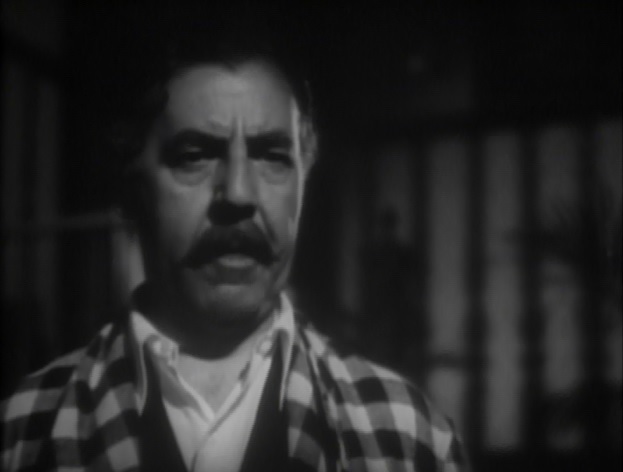
Fernando Soler
Honestly, the entire cast is excellent. Galindo shows his skill with actors, not only eliciting fine individual performances, but making the ensemble feel like a real family. The morning chaos in the bathroom, the subtle glances at the dinner table, the whispered conversations behind closed doors, all add up to a richly detailed portrayal of life in a middle class household. As for the visuals, Galindo’s style is simple and straightforward. He often lets the camera hold a master shot, observing the actors as they play out a scene, cutting only when necessary. He seems to know intuitively where to place the camera, allowing it to serve the actors, telling the story with a fluid, unpretentious ease.
You may be asking why the screenshots I’m using to illustrate this post look so fuzzy. It’s because I was working from a cheap DVD where the source material looks like it was 16 mm and the transfer is less than stellar. Sadly, this is currently the only way you can view this movie. I posted on another Galindo film a while ago, and complained about the fact that his work was only available in sub-standard releases with no subtitles. Really, this is true of the vast majority of Mexico’s cinematic output, and it’s a terrible shame.
I was encouraged recently when I heard that MOMA was showing a Mexican noir series. Hopefully this will encourage more people to explore the country’s cinema. Una familia de tantas is just one of many remarkable movies waiting to be discovered by English-speaking audiences.
*
I’m sure many readers will be startled to learn that the central character is a fifteen year old girl who’s being groomed for marriage. These days we see this as deplorable, but in post-war Mexico it was an accepted part of the culture. We can condemn it, but we should be keep in mind that American cinema from the studio era is filled with attitudes that seem pretty shocking today.
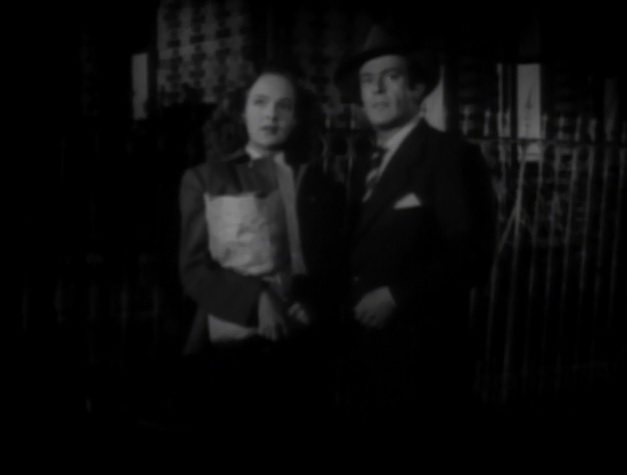
Martha Roth and David Silva
Lightning Over Water (1980)

Nicholas Ray
The generation of filmmakers who grew up after WWII came to revere the directors of the studio era. Scorsese, Bogdanovich, Fassbinder, Godard, all had tremendous respect for the guys who worked under contract, took the scripts that got handed to them, and still managed to turn out movies that were personal and passionate.
The director who has probably gone farthest in exploring his relationship to that older generation is Wim Wenders. It’s not uncommon in films made from the 70s on to see cameos by the studio veterans. But Wenders didn’t just have these guys do walk-ons. He made them a part of his cinematic world. For him, putting Sam Fuller in The State of Things wasn’t just a nod to a mentor. It was a sign of friendship, and a statement about the continuity from one generation to the next.
Another filmmaker that Wenders was close to was Nicholas Ray. The older director had already appeared in Wenders’ The American Friend. They had not known each other long when Ray was diagnosed with cancer. Within a year his health had deteriorated to the point where it was clear he didn’t have long to live. And that was when they decided to make a film together.
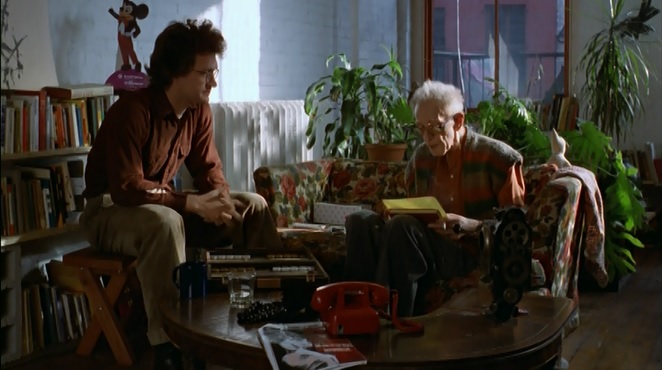
Wim Wenders and Nicholas Ray
Lightning Over Water isn’t really a documentary, though it is a document. It’s not fiction either, though the people who appear in it do act out scenes. It doesn’t fall into any category, and it’s about many different things. You could say it’s a film about filmmaking, and also about art. Fear pervades the atmosphere throughout, but love is just as present. And death is always just beyond the horizon.
While both men are credited as directors, it’s clear that Wenders is leading the way. Ray is so weak that it’s sometimes hard for him to finish a sentence. He’s wracked by coughing fits. Just lying down in bed is so painful it makes him cry out. And because Wenders realizes that he’s the one in control, he’s overwhelmed by the responsibility. At the very beginning he tells Ray that he’s afraid of exploiting him. Ray dismisses the idea, but it’s clear that Wenders is extremely uncomfortable with this project.
He shouldn’t have been. You can hear the joy in Ray’s voice when he first greets Wenders. This frail old man shouts from his bed, “I’m ready to start work again.” Even if the line was written out in advance, it’s clear that Ray means it. Toward the end of his career he turned to teaching because Hollywood wouldn’t give him backing to make another movie. While he kept himself busy with other projects, he always wanted to get back in the game. Now, when he knows he’s dying, he’s got one more opportunity to make a film, and he’s determined to seize it no matter what the cost.

Ray enjoying his first cigarette of the day.
Ray seems completely at home on the screen. In spite of his weakened, wasted frame, he shows no sign of self-consciousness. He allows the camera to see him at his worst, and never shies away. There’s a strange beauty in this “performance”. He’s confident, even defiant. We can see where many of his onscreen protagonists got their swagger from. This is a man who’s dying of cancer, and the first thing he does on waking up is light a cigarette. You want to grab it out of his hand and throw it away, but you also know that would be pointless. He’d just light another one.

Wenders voicing his concerns to Ray.
Wenders, on the other hand, is extremely uncomfortable in front of the camera. Aside from the fact that he seems stiff and awkward, you can tell that making this movie was an awful ordeal for him. It’s bad enough that his close friend is obviously very near to death. On top of that, Wenders is constantly concerned about invading Ray’s privacy and sapping his strength. The younger man wants to stop the whole crazy thing. The older man keeps insisting that they forge ahead.
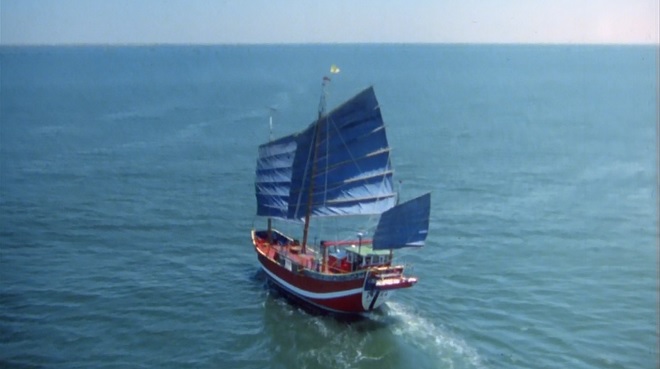
Then Ray dies. And we find ourselves at a wake on a Chinese junk in the waters off Manhattan. The dread that permeated the film up til now is gone. The cast and crew trade stories, share their views the experience, and drink a toast to their dear, departed friend. One of the crew speculates that dying was his final act as a director. “He made us finish it. And the only way he could do it was to die.”
As I write this, I realize that the audience for this film is very small. Only the people who know Ray’s work, or know Wender’s work, could possibly be interested. It doesn’t have a story, it doesn’t offer a clear-cut resolution. The film jumps unpredictably between reality, fantasy and the hazy netherworld inhabited by the people who stand behind the camera. On top of that, it’s a very intense, very painful look at a man who’s dying before your eyes. But it’s also a testament to a friendship that was stronger than death. And a moving portrait of two men who loved each other very much.
The Southerner (1945)
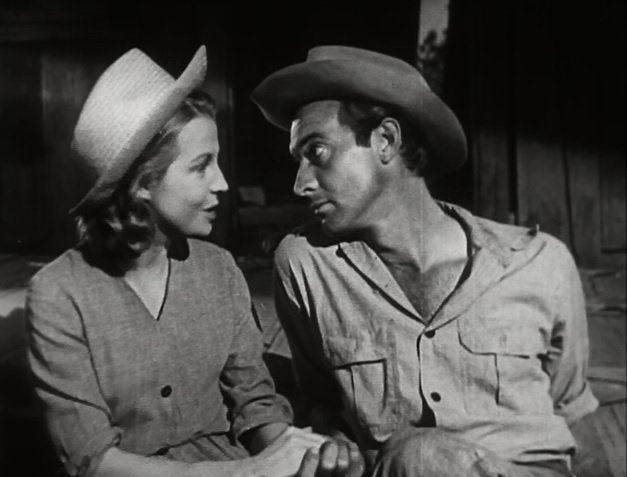
Betty Field and Zachary Scott
Jean Renoir was not cut out for Hollywood. Like many European directors fleeing the Nazis, he landed in LA around the beginning of WWII. And like many European directors fleeing the Nazis, he found himself faced with a choice between working on genre films or hardly working at all. He made a few movies that more or less fit the standard Hollywood mold, but that wasn’t really what he was interested in. The studios wanted movies about gangsters, dancers, cowboys and comedians. Renoir just wanted to make movies about people.
In 1944 he got his chance, but it didn’t come easy. According to the AFI web site, Renoir was not interested when he first read Hugo Butler’s screenplay based on the novel Hold Autumn in Your Hand by George Perry Sessions. But he must have seen possibilities in the project, because he ended up rewriting the script himself. Having signed Joel McCrea and Frances Dee for the leads, producers David Loew and Robert Hakim arranged distribution for the film through United Artists. But when McCrea bailed out because of creative differences, UA wanted to bail, too. Loew got them to reconsider by threatening to withhold other productions that the distributor was interested in. Zachary Scott and Betty Field stepped in to replace McCrea and Dee. And Renoir began shooting the film that was eventually titled The Southerner.
You can find a few different stories in The Southerner, but really it’s just about a family trying to scrape by living on the land. At the start of the film, Sam and Nona are picking cotton on a plantation, barely making enough to get by. Sam makes a deal with the boss to take over a nearby farm that’s been lying fallow for years. The film follows the Tuckers as they clear the land, plow it and plant it, always struggling to overcome the obstacles that life puts in their way. Instead of inventing an artificial plot to give the film structure, Renoir allows the passing of the seasons to give The Southerner its rhythm.
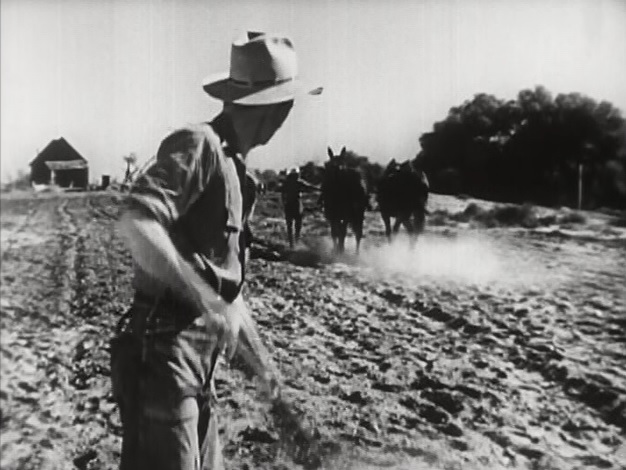
Husband and wife working the land.
Apparently the director had wanted to shoot in Texas, but ended up having to find the locations he needed in California. Cinematographer Lucien Andriot’s handling of the natural light shows both sensitivity and subtlety. We can feel the heat beating down on Sam and Nona as they’re sweating in the dusty fields. We can see the sky reflected in a placid lake as Jot goes wading by the shore. And while there’s a fair amount of studio work, the sets blend almost seamlessly with the real locations. Production designer Eugène Lourié, a longtime collaborator of the director’s, not only makes the Tuckers’ scraggly house seem a natural part of the landscape, it also feels completely lived in.
The film has a wonderful ensemble cast. Charles Kemper disappears into the role of Sam’s amiable friend Tim. Veteran character actor Beulah Bondi is in fine form as Granny. If she’s cranky and difficult, it’s because life hasn’t been easy. Her face and her body appear to have been worn away by the elements. The child actors here don’t seem to be acting at all. Jay Gilpin and Jean Vanderwilt are surprisingly unselfconscious as the Tucker children, Jot and Daisy.
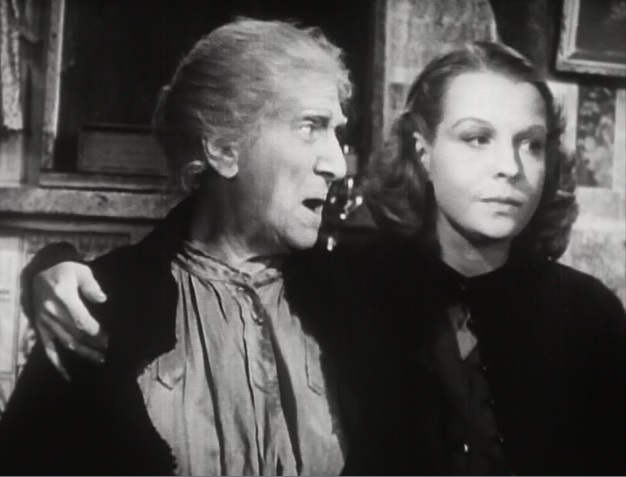
Beulah Bondi and Betty Field
But the movie is centered on Sam and Nona, played by Zachary Scott and Betty Field. They’re an idealized vision of rural Americans, simple, hardworking people who just keep moving forward no matter how hard things get. Usually Hollywood turns characters like these into tedious clichés. Here Renoir uses his gentle, unforced approach to put this humble couple at the center of his poem about the rural South. Betty Field plays Nona with a straightforward simplicity that’s easy to take for granted. I’ve seen the film a number of times, but it’s only recently that I began to appreciate how good her performance is. Field had a long career on stage, screen and TV, but she never called attention to herself or her work. As a result, she was overlooked during her lifetime and now she’s pretty much forgotten. As Sam, Zachary Scott seems like an agreeable, easygoing guy, but there’s a toughness beneath the surface that gives the character strength. Scott was an intelligent, versatile actor, who, like Field, seems to have faded into obscurity. It’s too bad. They both deserve more attention.
While Renoir felt that The Southerner was the best of his American films, it’s never gotten the attention that his earlier work received. These days it’s fallen into the public domain. It’s available on DVD, but the quality isn’t great. My guess is that the distributor started with a faded sixteen millimeter print. This movie deserves better. I have no idea how many prints are out there, or what condition they’re in, and I know restoring and remastering a film can be costly, but I wish somebody would put together a quality re-release of this movie. The Southerner has been neglected for far too long. Won’t somebody adopt this beautiful orphan?

Cabaret (1972)

Liza Minnelli
Since the beginning of commercial cinema, filmmakers have been adapting stories that were successful in other forms. There are a few different reasons for this. Sometimes it’s just because producers feel safer investing in a property that’s made money for somebody else. But it may also be that a writer or director sees the possibility of bringing something new to a story, a way to reimagine it in another medium. And this is really crucial. If all you want to do is create a faithful adaptation, what’s the point? Making a movie just to illustrate somebody else’s work is a waste of time. A novel is an experience in words, and you can’t recreate that on the screen. It has to become an experience in image and sound.
Of course some stories migrate through many different forms before they reach the screen. Christopher Isherwood’s Goodbye to Berlin was published at the end of the thirties. It was an autobiographical novel based on his experiences living in Germany in the early thirties, when the country was falling apart and the Nazis were rising to power. Isherwood kept a journal during those years, and later used the material to create the novel. In it, he compares himself to a camera, passively recording what he sees, storing it for later, when he’ll have the time to develop and print the images. This is key to the way Isherwood approached his work. His novels are generally episodic, undramatic. Rather than trying to force life into a fictional framework, Isherwood was more interested in allowing life to unfold on its own.
This is an aspect of the author’s work that John Van Druten intended to highlight when he adapted Goodbye to Berlin for the stage and called it I Am a Camera. Actually, he focussed mainly on one part of the book, the chapter entitled Sally Bowles. Sally was a young English woman that Isherwood roomed with in Berlin. In most ways they were complete opposites, but for a while they became close friends. Sally was desperately searching for a rich man to marry while she halfheartedly pursued a career on the stage. In writing the play, Van Druten eliminated much of the book’s detail and gave it more structure, but he was faithful to the tone of the original. The passive young man at the center of the story is always slightly detached from whatever’s happening in front of him, always a little aloof from the hurly burly of life.
In the sixties, Harold Prince obtained the rights to both the book and the play with the idea of creating a Broadway musical. Joe Masteroff wrote a show that was loosely based on Van Druten’s play, with songs by John Kander and Fred Ebb. Cabaret opened in 1966, and was a solid success. It had even less to do with Isherwood’s book than Van Druten’s play did, but audiences loved it. A road show version toured the US, and in 1968 the musical opened in London.
It was only natural that Hollywood producers would take notice. And by the time Cabaret appeared on the screen it would be transformed again, moving even further from the book that Isherwood had written as a young man. Interestingly, the film version deleted some of the elements that made the show so successful on stage, and reached deeper into the characters. Jay Presson Allen’s screenplay fleshes out the relationships and spends a good deal of time exploring the decadence and violence that defined Berlin in the early thirties.
Looking at the film today, it seems like Bob Fosse is the only person who could have made it. At the time, the producers had other candidates in mind. Fosse had only directed one movie, Sweet Charity, which tanked at the box office, and he didn’t have much credibility in Hollywood. To their credit, the producers took a chance, and Fosse showed everybody how far he could go as a director. The film he made of Cabaret was a sharp break with tradition, and it had to be. The lavish song and dance spectaculars made by MGM in the forties and fifties had set the standard for the genre, but times had changed. Throughout the sixties the studios had been throwing money at bloated productions of Broadway musicals that sank at the box office. Somehow they didn’t understand that the audiences flocking to see M*A*S*H and Easy Rider didn’t care about Lerner and Loewe.
It wasn’t just Fosse’s skill that made him the right choice for the movie. The director was the son of a vaudeville entertainer, and grew up performing in burlesque. He’d made his way up the ladder, working in Hollywood musicals as a dancer and then as a choreographer. All his life, Fosse was immersed in show business, and show business was the lens he used to look at the world. Much of what makes Cabaret so thrilling is its unabashed theatricality. The numbers that take place at the Kit Kat Club grow out of what’s happening in the characters’ lives. In the novel and the play, we’re told that Sally sings in a cabaret, but we barely get a sense of who she is as a performer. In the musical and the film, her performances at the club become crucial, and, especially in the film, they comment on what’s happening in the world outside. This wasn’t a new idea, but in the past this device was almost always used to serve a romantic comedy plot. The people who brought Cabaret to Broadway used the songs as a mocking commentary on the corruption and the violence of the world outside, and Fosse pushed that even further.

Michael York
The film Cabaret could have ended up being a brutally cynical spectacle that alienated audiences, who might easily have been offended by the way it turned musical conventions inside out. Instead, the film became a huge success, in large part because of its showbiz energy and its spectacular cast. Certainly Liza Minnelli was a big part of the equation. The role seems to have been written for her, and she plays it with a startling combination of vivaciousness and vulnerability. Offstage she has a capricious charm that wins us over. Onstage she has an energy and power that are overwhelming. Minnelli herself is a showbiz creature, and to a degree the role seemed an expression of who she was. While she’s been impressive in other films, Sally Bowles is still the part she’s most closely associated with.
As Brian, Michael York is at the opposite end of the spectrum, a mild-mannered young Brit who wants to write but for the time being supports himself teaching English. York’s low-key intelligence is the perfect foil to Sally’s over the top theatricality. And in spite of the chasm between them, the two actors make the relationship convincing. These two people are miles apart, but they still care about each other.
Joel Grey had played the role of the MC on Broadway to great acclaim, and it’s hard to imagine anyone else in the film. Strangely, Fosse resisted casting Grey and reluctantly agreed when the producers insisted. Grey’s performance isn’t just energetic, it’s ferocious. He gleefully throws himself into every number, unabashedly working the audience over, going as far as it takes to get a laugh or a round of applause. His intensity is scary, especially in the later part of the film as we see the threat of violence becoming a part of daily life in Berlin. The MC goes on grinning maniacally as the Nazis grow more bold, the brutality taking place on the streets slowly bleeding into the shows on the stage.

Joel Grey
Fosse wasn’t the first director to pry movie musicals away from the traditional stagebound approach, but he uses cinematic devices in provocative new ways. He resorts to parallel editing a number of times, and each time with striking effect. Cross cutting from a knockabout stage show to a brutal beating on the streets makes the violence doubly frightening by underscoring the fact that the show just goes on even as innocent people are being assaulted. One of the most daring sequences is built around the song Maybe this Time. We see Sally alone on the stage under a spotlight, the accompaniment playing quietly in the background, and she begins to sing. But after the first line, Fosse cuts to a brief scene between her and Brian. Then back to Sally on stage, another line of the song, and then back to another short vignette. You’d think that interrupting the song would ruin the scene, but in fact Fosse’s approach heightens the tension and makes Minnelli’s performance even more powerful. Though you wouldn’t call Cabaret fast-paced, each scene flows seamlessly into the next. Editor David Bretherton shows a sharp sense of rhythm, and handles the complex dance sequences beautifully.
The film is visually dazzling, and no doubt a good deal of credit goes to cinematographer Geoffrey Unsworth. Throughout his career, one of Unsworth’s trademarks was his sophisticated handling of light. We see the cheap boarding houses and the dingy cabarets through a sensual, erotic haze. But even as we’re being seduced by this divine decadence, the film will shove us up against the ugly realities of pre-war Berlin. In fact, one of the most interesting things about the movie is the way it keeps pulling us in, and then, without warning, punches us in the face.
Cabaret is very different from the novel that Christopher Isherwood had written thirty years before. But it had to be. Fosse and his collaborators looked at the book and the play and the musical, and borrowed from all of them, but created something new. It may be a story about Berlin in the thirties, but it became a success because it resonated with audiences in the seventies. And even if you’ve seen it before, it’s well worth watching again, because it still reflects the world we live in today.
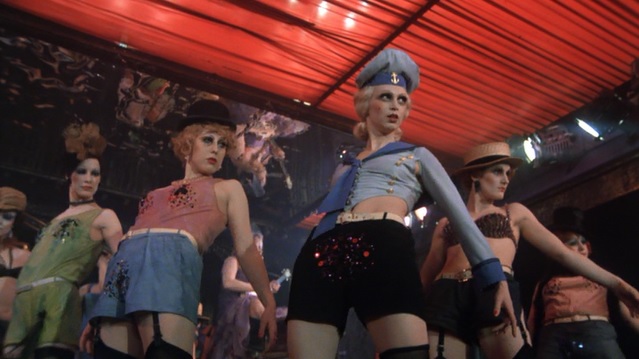
Life is a cabaret.
News from home (1977)

In the seventies Chantal Akerman spent a lot of time looking at things. In her films she often sets the camera in one place so that it can record whatever’s in front of it. Without actors, stories, or music to distract us, she lets us just observe the world. Lets us feel the light and the space and the unforced rhythm of life as it unfolds in its own haphazard way. This may seem simple enough, but it’s a radical departure from what we’re used to. In commercial cinema the world we see is artificial, even when the film is shot on real locations. The fictions that commercial filmmakers create inevitably shape our perception. A street, a store, a subway, they all become backdrops. But in Akerman’s work from the seventies, they are just a street, a store, a subway. She lets them be what they are. A lot of people won’t have the patience for her approach, and that’s understandable. Most of us look to movies for entertainment, to take us out of the world. But if you’re willing to invest the time, Akerman offers a different way of experiencing the world.

“Business is still slow, and father’s worried because he took out a loan.”
In News from home, Akerman continues to let her camera stand back and watch life unfold, but she adds another layer. As images of New York in the seventies appear on the screen, we hear a woman’s voice reading to us, and we soon realize that these are letters from the filmmaker’s mother. On the one hand, we have scenes of a vast urban landscape. The grinding anonymity of the city. Nameless people wandering down endless sidewalks. Busses lumbering past. Subway trains thundering in and out of stations. On the other hand, we have a mother writing to her daughter. Setting down the mundane details of family life. Reporting the relationship problems that relatives are dealing with. Complaining about the ups and downs of the family business. And above all, begging for more letters. The mother constantly reminds the daughter that her happiness depends on finding something in the mailbox.

“I know you’re busy, but try and write. It’s all I have left.”
The contrast between the overwhelmingly impersonal and the painfully intimate gives the film a strange tension. There’s a calm detachment to Akerman’s approach, and in a way it seems to be a rejection of her mother’s pleas for contact. The distance between the images and the words appears to reflect the distance between the two women. Mention is made of the fact that Akerman left home without a word of explanation, and we don’t get an explanation, either. The mother reproaches her daughter, offers gifts of money, fills up pages with random bits of news, but we never hear a response from the filmmaker. She keeps her distance from us, too.

“You never write about how you’re really doing.”
Aside from everything else, News from home is a remarkable document of New York in the seventies. Having just crossed the Atlantic and landed in America, Akerman seems eager to absorb everything she sees. The camera captures kids playing in a fire hydrant’s spray, crowds of people pushing their way down a city sidewalk, cars gliding slowly down empty avenues. She lets us wander with her through the bright urban night, brimming with warm neon and diamond streetlights. We ride trains filled with tired commuters sitting silently in a cold flourescent haze.
It’s not hard to imagine Akerman wandering the streets of New York in the seventies. A young woman far from home, losing herself in the immensity of the landscape, letting herself be overwhelmed by the city’s grinding brilliance. I’m sure it was rough, and I’m sure it was lonely, but I’m also sure that it was totally intoxicating. As frightening as it may have been at times, she had to make the trip. She had to leave her family behind to see what the world was like.

Ed Wood (1994)
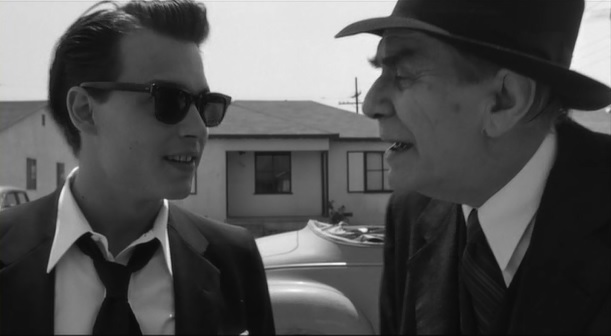
Johnny Depp and Martin Landau
Biopics can be a problem. Most peoples’ lives are so complex that it’s hard to boil them down to a sizeable book, let alone a two hour movie. On top of that, you’ve got the pressures of commercial filmmaking, which demand that stories follow certain accepted formats. And you’re also relying on screenwriters, actors and directors, all of whom have their own perspectives or agendas, to present an unvarnished account of somebody’s life. So you can see where problems might arise.
Back in the studio era, critics and audiences weren’t as demanding when it came to biopics. In some cases they just accepted the film version as being more or less true, even when there was plenty of evidence to the contrary. And on those occasions where the inaccuracies were really glaring, people would often shrug it off. The attitude was something like, “What do you expect? It’s Hollywood.” Nowadays movies about real people come under much greater scrutiny. Just in the last year extensive debates have played out in the media over the accuracy of films based on or “inspired by” actual events. Writers and directors who even seem to bend the truth can become a target for intense criticism.
So if we’re talking about Ed Wood, the low-budget filmmaker best known for Plan 9 from Outer Space, how important is it to tell the truth? Wood didn’t play a major part in shaping American history. He didn’t even play a significant role in Hollywood history. His shoestring productions have gained a cult following among those who wander down some of the darker alleys of American pop culture, but I’ve never heard anyone claim he was a major filmmaker. If somebody makes a movie about him that really doesn’t tell the truth, does it even matter?
Yeah, I think it does. But I still love the movie that Tim Burton made about Ed Wood. It does follow the general outline of the director’s life. Everyone who knew him agrees, Wood was passionate about making movies. Screenwriters Scott Alexander and Larry Karaszewski make Wood an innocent optimist who’s so obsessed with his vision that reality fades into the background. The humor arises out of the distance between his ambitions and his abilities, but the point they make is that it doesn’t matter how talented he was. The important thing is that he knocked himself out to make the best films he could. This is a great premise, and they develop it beautifully.

Bill Murray, Sarah Jessica Parker and Johnny Depp
You can see why Tim Burton wanted to shoot the script. Not only does it deal with the low-budget horror films he cherishes, but the hero is a director who’s fighting the system to do things his way. Burton handles this offbeat biopic with impressive style and grace. Production designer Tom Duffield lovingly recreates Hollywood in the mid-fifties, the tacky, tawdry urban wasteland that remained after the ephemeral glamour of the studio era had evaporated. Cinematographer Stefan Czapsky captures the bland cheapness of stucco bungalows and low-budget sets, and still imbues it all with a fairy tale innocence. And composer Howard Shore somehow manages to create a blend of cheesy macabre, pop exotica and sinister soundtrack music that’s tongue in cheek without being condescending. He’s having fun exploring all these genres, but he’s not making fun of them.
Johnny Depp is absolutely wonderful in the title role. With a winning combination of charm, tenacity and absurd optimisim, he makes you want to believe in Wood’s madcap visions. It’s a highly stylized performance in a highly stylized film, and Depp pulls it off with incredible elan. He’s helped by an unusually strong supporting cast. Patricia Arquette is completely believable as Kathy Wood, just as innocent as Ed and willing to stand by him to the very end. Bill Murray brings a sense of melancholy resignation to the role of Bunny, the director’s long-suffering friend. Jeffrey Jones plays the Amazing Criswell with marvelous swagger. He’s an unabashed fraud who seems to always be ready for anything.
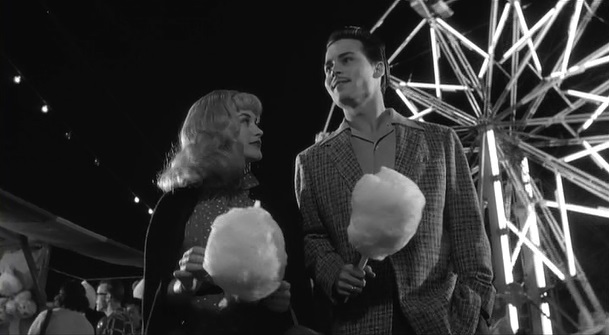
Patricia Arquette and Johnny Depp
And of course, there’s Martin Landau’s remarkable performance as Bela Lugosi. While the other characters are essentially comic, there’s much more depth in this portrait of the aging horror star. The studios are through with him, he’s hooked on morphine, and he’s desperate enough for work that he’s willing to take a chance on a charming hustler like Wood. This is the emotional center of the movie. Wood may be exploiting Lugosi, but he also reveres him. Lugosi may harbor doubts about Wood’s talent, but he’s genuinely grateful that somebody still shows him some respect. For the most part the movie is gleefully superficial, but the bond between the two men is genuine, and you can feel the love between them.
Unfortunately, this is one of the areas where the facts are in question. When the movie was first released, Bela Lugosi’s son went public with a scathing critique, saying the filmmakers had misrepresented his father’s life in numerous ways. We can argue about how important the individual facts are, but Lugosi’s son asked why the filmmakers had never bothered to talk to him. He was practicing law in LA. It would have been easy for them to track him down and give him a call. If they really wanted to respect Lugosi’s memory, couldn’t they have spent a few hours interviewing his son?
Beyond that, the film’s portrayal of Wood is an idealized fantasy that only resembles the real man in its general outlines. It keeps us on his side by presenting him as a grown up kid. He may be a hustler, but he’s still innocent at heart. The reality is a lot more complicated, and not so appealing. They don’t show that Wood was a stone alcoholic. They don’t show him joyriding with a bottle in the car. They don’t show him staggering around a set, too wasted to direct anybody. And the supporting characters in Wood’s real life were a lot less wholesome than the amusing band of eccentrics we see in the movie. The real Ed Wood and his buddies were all hanging on to the bottom rung of the Hollywood ladder, and they lived out some pretty twisted scenes.

George Steele and Jeffrey Jones
Who knows who made the decision to clean things up. It may be that Alexander and Karaszewski felt they needed to maintain an air of innocence to give the film a fairy tale quality. Or maybe that was Burton’s choice. Or maybe they all wanted to do something grittier, and the studio told them to scrape away the grime to make it more marketable. As much as I love the movie, I wish they’d just invented a fictional character to hang their story on. You may be wondering why it’s such a big deal for me. If the world isn’t getting the whole truth about Ed Wood, does it really matter?
Again, I think it does. If you care enough about somebody to make a movie about them, you need to really make a movie about them. If not, then stick with fiction. That way you can make up whatever you want.
But if Alexander, Karaszewski and Burton don’t tell the literal truth about Ed Wood, the story they do tell is a beautiful parable with an important moral for all those who are struggling to do what they love. I’ve seen the film many times, and I still get emotional during the scene when Wood runs into Orson Welles at Musso & Frank’s. We may think of them as coming from completely different worlds, but Welles immediately understands the difficulties Wood is facing, and utters these immortal words.
“Ed, visions are worth fighting for.”
Whatever you may think about the movies he made, Ed Wood fought hard to make them. His trials and tribulations on the fringes of Hollywood led him to some pretty strange places, and I’m sure there are many things he did that he wasn’t proud of. We’re all flawed, and we all get beaten down by reality. But those who struggle to do the things they’re passionate about should never let reality get in their way.
*
If you’re interested in learning more about this absolutely unique man, there are a couple of good resources for further study. First, I highly recommend Nightmare of Ecstasy, an oral biography by Rudolph Grey, which the movie was based on. The author talked to many of Wood’s closest associates, and weaves the interviews together into a mind-boggling account of the director’s life and times. Some of the stories are shocking, and the details of Wood’s last days are terribly depressing, but the book offers a convincing, complex portrait of this man. On top of that, the book paints a fascinating panorama of the world the director lived in. This isn’t the fantasy Hollywood that the media promotes. This is the actual, physical place called Hollywood, where people struggle in poverty for years hoping to some day hit it big. It’s not a pretty picture, but it is true to life.
I’d also recommend The Haunted World of Edward D. Wood Jr., an excellent, imaginative documentary. It, too, features interviews with many of Wood’s associates, and doesn’t shy away from his critics. Some people complain that the views are contradictory and don’t offer a clear picture of the director. I think this approach is more compelling, because the filmmakers allow for ambiguity instead of trying to reconcile the contradictions. There were people who loved him and people who hated him, and others who just didn’t know what to make of him.

On their way to a premiere.
Clocking Out
I’ve got a lot going on over the next few weeks, so I’m going to take a break. I’ll be posting again toward the end of June.
A note to those of you who are into Orson Welles. You’ve probably heard that a number of Welles’ friends and fans are mounting an effort to finish his last movie, The Other Side of the Wind. You may not have heard that they’ve started an Indiegogo campaign to raise funding. Here’s the link.
The Other Side of the Wind on Indiegogo
If you’re as anxious to see this movie as I am, I recommend you throw a few bucks their way. The footage has been sitting in cans for decades. If this effort fails, who knows if we’ll ever see Welles’ final film.
Wild Bill (1995)

Jeff Bridges
Most of us know very little about the history of the American West. The realities of the westward expansion that started in the nineteenth century were overwhelmed by the fantasies from the very beginning. Looking to extend its reach across the continent, the US government encouraged settlers to make the trek with promises of fabulous wealth and unbounded freedom. Pulp novelists spun tall tales about heroic cowboys and bloodthirsty Indians. Later on movies took it even further by recreating these stories on a grand scale. Popular stars rode their horses across the screen, their epic battles for justice set against spectacular landscapes. The truth was overwhlemed by the myth.
Walter Hill’s Wild Bill is about the way myth and reality can become hopelessly tangled. Taking as his subject the soldier, sheriff, gambler, gunfighter James Butler Hickok, Hill shows us a man who can no longer separate himself from his legend. The film starts with Bill’s funeral, then takes us back to his arrival in the wild frontier town of Deadwood, and we follow him through his last few days on earth. Bill is a man adrift, passing the time by drinking and playing cards, haunted by his past, wondering where his life went wrong.

Ellen Barkin and John Hurt
The film is a deliberate mix of fact and fiction. Hill based his script on Pete Dexter’s book Deadwood and Thomas Babe’s play Fathers and Sons. In recreating Bill’s past, the film relies on real accounts of the gunfighter’s life, showing us how he earned his reputation. But the story of the callow young man who haunts Bill’s final days is fiction. Jack McCall is an awkward, angry youth who announces to the world that he’s going to kill the famous gunfighter. No one takes him seriously. In spite of his bravado, it’s clear that he’s troubled and confused. Jack is angry not just because Bill seduced his mother, but also because he promised to be a father, and then abandoned both mother and son. The story has no basis in fact, but by framing it this way Hill takes us into the realm of primal poetry. The film becomes more than just a study of the distance between truth and fiction. It’s also about the distance between fathers and sons.
Bill’s whole life has been defined by violence. A soldier in the Civil War. A hunter fighting for his life on the plains. A lawman with a reputation as a crack shot. He’s survived in a violent world because he’s better at killing than his enemies. But after accidentally killing his own deputy in Abilene, he loses his sense of direction. He drifts from town to town, downing whisky and playing cards. Everywhere he goes, his reputation precedes him. He’s revered as a hero and reviled as a murderer. Bill goes on playing the part of the legendary gunslinger, but more and more he seems to be wondering why.

Karen Huie
It’s hard to imagine anyone other than Jeff Bridges playing the role. Bridges has a presence that fills the screen, and he’s completely believable as a mythic figure, but he also has the skill to let us know what’s going on inside Bill’s head. He gives us a man who’s proud of his reputation and at the same time uncomfortable with it. A man who displays unflinching self-confidence and at the same time is filled with doubts. The cast in general is remarkable. John Hurt brings a world weary melancholy to the role of Charley Prince, Bill’s best friend. Ellen Barkin plays Calamity Jane with both toughness and tenderness. As Susannah Moore, the woman Bill loved and left behind, Diane Lane has a touching fragility. She knows he’s going to move on and tries to be strong, but inside she’s falling apart. As Jack, David Arquette is a tangle of conflicting emotions. It sometimes seems as though his repeated attempts to kill Bill are actually just his way of trying to get Bill’s attention. Even the small parts are well cast and well played. Karen Huie brings an interesting tension to her role as the proprietor of an opium den. Christina Applegate convincingly plays the hard as nails prostitute who finds herself drawn to the weak and indecisive Jack. And Pato Hoffman displays a fierce pride as the leader of a band of Cheyenne.

Pato Hoffmann
Visually the film is rich with shifting textures, moving seamlessly from past to present and back again. It’s easy to see why Hill has chosen to work with cinematographer Lloyd Aherne over and over again. Aherne seems less interested in capturing reality than in creating a visual landscape that grows out of the drama. The saloons are filled with rich, smoky color, Bill’s opium induced hallucinations are shot in stark black and white, and the frontier streets are often bleached into dusty sepia tones.
The score is by Van Dyke Parks, one of the great oddballs of American music. Parks has had a long, eccentric career, working with everyone from the Beach Boys to Grizzly Bear. Here he uses his considerable gifts as an arranger to weave together a tapestry of well worn traditionals, sometimes tapping into the raw vitality of the the Old West and at other times singing a lament for a time that may have only existed in our imagination. Paying close attention to mood and texture, Parks’ music complements the film’s shifting visual tone beautifully.
Wild Bill bombed at the box office and most critics wrote it off as a failure. This isn’t surprising. In fact, it’s happened over and over again to directors who stray from the standard formulas and try to do something unique. Since Wild Bill, Hill has continued to work, but he hasn’t attempted anything nearly as ambitious. Which is understandable. He put his heart and soul into this movie. Audiences and critics rejected it. Sometimes people ask why gifted filmmakers spend their time making routine thrillers. But what’s the point of knocking yourself out when you know you’ll probably get kicked in the teeth?

Reverie in an opium den.
The Trial (1962)

Anthony Perkins
Orson Welles’ film of The Trial has never had a lot of fans. Many of his most ardent admirers have a hard time with it. Even Peter Bogdanovich, a champion of Welles’ work, has said he doesn’t like it. Aside from The Stranger, which the director himself dismissed, it’s the least popular of his movies.
Honestly, I’ve never understood why. The first time I saw The Trial I was completely drawn into it. It has a haunting, hypnotic quality. Watching the film gives me the feeling of being pulled slowly into another world, a strange, irrational world. No question the mood is oppressive, but to me this seems completely in keeping with the novel.
I disagree with the critics who say that Welles’ style is wrong for Kafka, but I understand what they’re talking about. Kafka’s prose is quiet, measured, precise. No matter what setting the stories took place in, to me his world always seemed small and claustrophobic. But in the film Welles’ creates vast, echoing spaces, and long, twisting corridors. The characters have a different presence, too. Kafka sketches the people who populate his world in a very few, deft strokes. Welles, on the other hand, draws them in vivid detail.

Suzanne Flon and Anthony Perkins
But while the two men’s styles are totally different, I think the film comes very close to capturing the essence of the novel. The writer and the director may seem like polar opposites, but they’re not. In Welles’ films the heroes are often brash and arrogant, fighting to impose their vision on the world. In Kafka’s stories we wouldn’t even use the word hero to describe the protagonists, because his anxious, insecure young men are constantly struggling just to keep moving forward. Still, if we look deeper, we might find that the two have a lot in common.
When I first read Welles’ comment that The Trial was his most autobiographical movie, I was surprised. How could this man, who seemed so much larger than life, identify with the weak, petty Joseph K.? But anyone familiar with Welles’ career knows that he worked very hard to create the magnificent mythology that defined his public persona. In fact, for the most part his work is about exposing the lies behind the myths, showing us that these “great” men are deeply flawed.
Behind all the bravado, Welles was terribly insecure. Ignored by the mainstream audience, frequently attacked by critics, begging for money from backers, acting in films he knew were beneath him, he must have often felt very lost and very lonely. And if we look at the comments he made throughout his life about the injustices perpetrated by our governments and the growing tyranny of bureaucracy, his concerns begin to seem much closer to Kafka’s. He begins to seem like a man who feels completely overwhelmed, living in a world that’s indifferent to his existence.
After the prologue that starts the movie, the first image we see is disorienting. Joseph K.’s face upside down as he lies asleep. Waking up, he finds strange men in his room. Angry and confused, he demands an explanation, which they give him. He’s been accused of a crime. They’ve come to investigate. K.’s anger and confusion turn to fear and anxiety. Welles thrusts us into this bizarre, uncomfortable situation at the very beginning, and for the rest of the movie he just keeps pulling us deeper and deeper.
The Trial sounds different from any other film I can think of. Much of it is very quiet. Sometimes the actors’ voices seem to sink into the silence. At other times they resonate in space, echoing off surfaces of concrete and metal. Welles often used post-synched sound, and while this could sometimes be a handicap, here it’s eerily right. It feels as though there’s a slight distance between the actors and their voices, adding to the sense of disorientation. Throughout the film, Welles uses sound to keep us on edge. From the deafening din of a thousand typewriters to the silence of an empty street at twilight. From the nasty chatter of a crowd of wild girls to the frantic clatter of footsteps careening down a corridor.
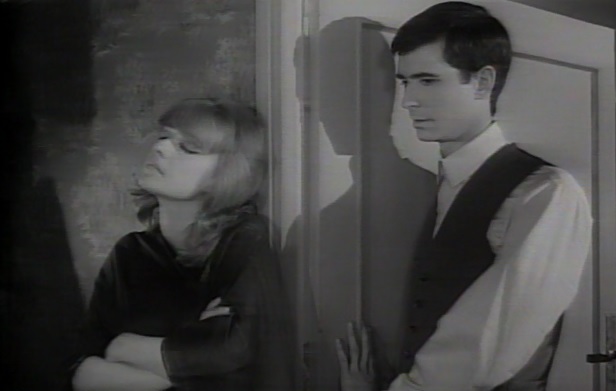
Jeanne Moreau and Anthony Perkins
Anthony Perkins is perfectly cast in the leading role. K.’s rapid shifts from arrogance to anxiety could easily make the character tiresome, but Perkins brings a vulnerability to the role that makes him seem human. I guess a lot of people have trouble relating to the character, but I can totally identify. Is there anyone out there who hasn’t felt like they were battling to stay sane in a crazy world? Jeanne Moreau is stunning in the small role of Fräulein Bürstner, a world-weary bar hostess who shuts K. down with her icy indifference. As Leni, Romy Schneider vibrates with a kinky erotic charge. She’s both seductive and scary. With his usual consummate skill, Akim Tamiroff disappears completely into the role of Block, a pathetic, fawning businessman whose life has been consumed by pleading his case. Welles had a high regard for Tamiroff’s talent, putting him in key roles in four films. And, of course, there’s Welles himself as the Advocate. Apparently he only took the role because his first choice, Jackie Gleason, dropped out, and he couldn’t come up with a suitable replacement. I can’t imagine anyone else in the part. Welles plays the scenes in the Advocate’s bedroom for chilling comedy. Later, during the final dialogue in the cathedral, he’s just chilling.

Akim Tamiroff and Anthony Perkins
I have to admit, the ending is a problem. The last exchange between K. and the Advocate in the cathedral was mostly written by Welles. This is where the director departs from Kakfa. In the film, K. rejects the idea of a world without meaning, without hope. He insists that he’s a member of society, and that implies responsibility. He won’t accept the madness imposed by the system. This is the complete opposite of Kafka’s world, where the author’s characters inevitably submit to their fate. In the book, K. dies at the hands of his executioners.
Welles couldn’t accept that. He said in interviews that he believed Kafka would not have written such an ending if the author had lived to see the Holocaust. After the death of six million Jews, Welles could not allow K. to surrender to the system. He felt it was necessary to make a more affirmative statement.
But that left him with a huge problem. Welles knew that he couldn’t give the film a “happy” ending. It wouldn’t have been true to Kafka, or to his own world view. Welles has K. take a stand against the system that’s working so hard to grind him down, but to end the film with some simple triumph would be too easy. And so he gives us an ambiguous conclusion, which doesn’t really work.
Even with my reservations about the end, I still think the film is pretty astonishing. Welles conjures up a frightening vision of the modern world, dominated by an endless bureaucratic maze. He follows K. through the grim landscape of Cold War era Europe, the arid modern apartment blocks and the voluptuous ruins of the past. It may be difficult to watch because it shows a side of the director we’re not used to, a side that maybe we’d rather not see. We’re used to seeing Welles play the supremely confident showman, a larger than life figure who dominates every situation. But if Welles was being honest when he called The Trial his most autobiographical film, then maybe he’s offering us a different, more candid, self-portrait. A portrait of a frightened, insecure little man who’s afraid the world will swallow him completely.
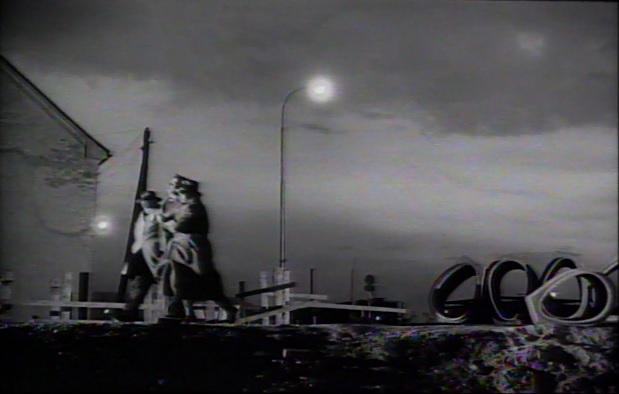
K.’s executioners walk him to the quarry.
 Reality Is Scary