El bruto [The Brute] (1953)
El Bruto is not one of Luis Bunuel’s better known movies. Maybe this is because it’s more conventional than critically acclaimed films like Belle de Jour and The Exterminating Angel. In many ways it’s a standard melodrama with a social justice theme. But even if it isn’t as challenging as some of Bunuel’s other work, it’s still a powerful and disturbing piece of filmmaking.
Pedro Armendariz plays Pedro, a simple man who works in a slaughterhouse. His boss, Cabrera, asks him to leave the slaughterhouse to take on a special job. Cabrera owns an apartment building and wants to evict the tenants to clear the way for a profitable deal. He decides to have someone lean on the tenants to scare them off. The tough, naive Pedro seems perfect for the job, but things don’t go quite as planned.
Pedro is a brute, but it’s hard not to have some sympathy for him. He doesn’t think, he just acts, and things quickly go from bad to worse. Because he doesn’t understand what’s going on around him, he’s easily manipulated by just about anybody who wants to use him.
The film shows how Mexican society revolves around the few people with money, and these are the people who have all the power. Cabrera is called ‘patron’ by everybody who works for him. The word could be translated as ‘boss’, but it also shows respect and deference. Cabrera acts like a paternal figure, and he does look out for those who work for him. But his generosity only extends as far as his business interests permit. He appears to treat Pedro well. Then we find out that Pedro is probably his illegitimate son. With this revelation, Bunuel makes an incisive comment on the relationship between power and pretense in the Mexican class structure.
Armendariz and Soler are both excellent, as is most of the cast. Katy Jurado is especially seductive and disturbing as Cabrera’s young wife, Paloma. Bunuel’s direction is typically simple and straightforward. Agustin Jimenez’ cinematography vividly captures the contrasts of urban Mexico. The title is perfect. It’s a brutal film, and one you won’t quickly forget.
Cuando los hijos se van [When the Children Go Away] (1941)
This post was revised on February 3, 2015.
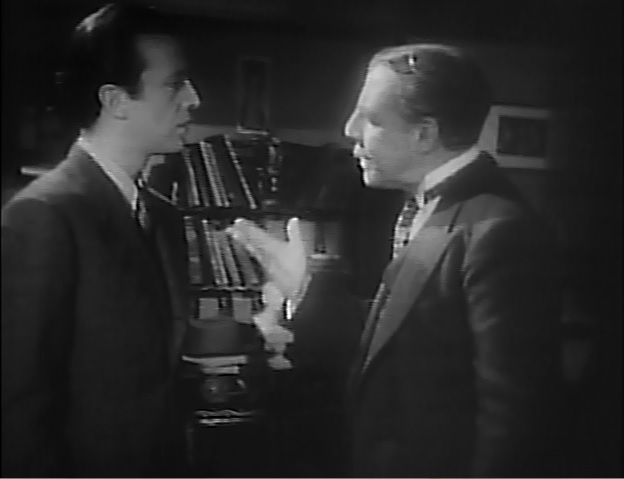
Emilio Tuero and Fernando Soler
Cuando los hijos se van is very much a product of the time and place it was made. Released in 1941, it shows a middle-class family being torn apart by tensions between the parents and the children. In many ways it’s a steadfastly conventional melodrama from the Mexican studio era. But beyond that, it’s also a reflection of the changes that were taking place in Mexico at the time. The government was pushing the economy towards rapid industrialization, and people were abandoning their small towns and villages to go to the city.
The film opens with a slow tracking shot that takes us into the home of the Rosales family, as a narrator sets the scene for us. It’s Christmas Eve. The mother, Lupita, is busy preparing the table for dinner. The father, Don José, is occupied in his study. An old friend drops by to pay a visit, laughing and joking with the family. But the festive mood is broken when a neighbor arrives unexpectedly. He complains that money has been stolen from his desk, and he suspects Raymundo, one of Don José’s sons. The father takes the neighbor’s accusation at face value and castigates his son mercilessly. The spirit of harmony is shattered. The Christmas celebration is poisoned. This is only the beginning.
As the story progresses, the children go off one by one to follow their fortunes. José, the father’s favorite, leaves for the city to work in a bank. Amalia, the daughter, runs away to marry a man show thinks she loves. And Raymundo is kicked out of the house when his father comes to believe that he’s been having a fling with a friend’s wife. As before with the stolen money, the guilty party is actually José, but the father is adamant. He’s convinced that Raymundo has disgraced the family and insists that his son leave. Raymundo complies. The two aging parents are left on their own. And as the years go by, we watch as this frail couple is slowly overwhlemed by loneliness.
This is a deeply Christian film. It opens by showing us into the family’s Christmas Eve celebration, and closes the same way. Raymundo is clearly meant to be a Christ figure. The family is broken apart by dishonesty and greed, but the members are brought together again by love and forgiveness. While the Christian symbolism is pretty heavy handed at times, the director’s passionate commitment to his faith makes the film compelling. Bustillo Oro isn’t just going through the motions to manipulate the audience. He’s making a heartfelt statement about the importance of compassion and forgiveness.
The director uses a clear formal framework to tell the story. Each section opens with a shot of the front of the house, and then the camera tracks slowly inside. Each of these shots is accompanied by voiceover narration. The narrator comments on the family and the changes that have taken place as the years pass. As traditional as the film is in some ways, this device gives it an interesting, modern edge. I have no idea if Bustillo Oro was into Brecht, but the stylized camerawork and the narrator’s commentary make us very aware that we’re spectators watching a story unfold, and that the events we’re witnessing are part of a larger design. The repeated use of symbols also gives the film an interesting symmetry. The dinner table, the flowers in the courtyard, and most importantly the star on the Christmas tree are all recurring motifs. Bustillo Oro presents these symbols in a straightforward manner, laying his cards right on the table. You could accuse him of being obvious, but you could also say he’s just being honest.
The camerawork is simple and fluid, with the director often allowing the scenes to play out in long, uninterrupted takes. The results of this approach are mixed. When the dialogue is sharp and the actors are strong, it works well and the film has emotional impact. But when the dialogue becomes tedious, when tiresome comic scenes drag on, the film seems to stop dead. Over all I’d say the first third and last third are strong, but the middle could be a lot tighter. The scene where Lupita listens to her long lost son perform a Mother’s Day song over the radio is especially hard to handle. It seems to drag on interminably, and the maudlin sentimentality is oppressive.
Sara García, who plays the mother, is fine, but she doesn’t deliver any more than you’d expect. Fernando Soler, on the other hand, plays the father beautifully. This is a man who loves his wife and his children deeply, but he’s so bound by the conventions of his time that he can’t see beyond them. He believes that in kicking Raymundo out of the house he’s doing the only thing he can do, but we can also see that it pains him deeply. His transformation from the confident head of the family to the lonely old man, abandoned by his children is heartbreaking. As Raymundo, Emilio Tuero gives a first-rate performance. His love for his parents is palpable, and when his father condemns him it’s obvious that Raymundo is more hurt than angry. It’s not easy to play a part like this, the devoted son who makes the ultimate sacrifice for his family, but Tuero pulls it off nicely, making his devotion to his family believable without getting maudlin.
Some people won’t have patience for this film, and I can’t say I blame them. No question it’s really sentimental. In many ways Bustillo Oro’s approach reminds me of Leo McCarey. And just like McCarey, the thing that makes it work is that the director believes in what he’s doing wholeheartedly. This is not someone trying to wring tears from the audience to make a buck. I don’t doubt Bustillo Oro’s sincerity for a minute. This is a deeply Christian man, who believes that compassion and forgiveness can heal any wound, no matter how deep. When Amalia places the star on the Christmas tree at the end, it’s a simple but sincere way of saying that love conquers all.
Pueblerina (1949)

Columba Dominguez
Pueblerina is one of the purest examples I’ve seen of film as poetry. Director Emilio Fernandez takes a fairly simple story and uses it to present a panorama of rural Mexico. His love for the people, the music, the landscape is evident in every frame.
The opening sequence sets the tone for the film. A man is released from prison and begins his journey home. In most films this would be handled with a few lines of dialogue and a quick succession of shots. But Pueblerina has its own rhythm, and Fernandez wants to do far more than just tell a story. We see the prison. We see the man in his cell. We see him walk out the gate. He hitches a ride with some men on a cart. A song is sung. We see several shots of the cart rolling across the landscape. The song continues. Eventually the man arrives at his destination and gets off the cart. Not a word of dialogue has been spoken. Obviously Fernandez is in no hurry to get anywhere. Beyond just telling the story, he wants to bring the viewer into the experience of rural Mexico.
The story is based on one of the central themes of Mexican popular culture. It tells of a poor farmer who must confront an oppressive landowner. The way Fernandez tells the story transforms it into a poetic myth. He shoots the characters as monumental figures standing against dramatic landscapes. The farmer and his wife are good, decent people, while the landowners are thoroughly corrupt and cruel. The climax takes place as a thunderstorm rages. It’s all bigger than life. It’s all heartbreakingly beautiful.
Part of the reason it’s so beautiful is that Pueblerina was shot mostly on location by Gabriel Figueroa. Much of the film is spent observing people moving across the land, working the land. Figueroa photographs the fields, the mountains, the rivers with the same loving attention that he gives to the characters. Antonio Diaz Conde contributes a dramatic score that emphasizes the grandeur of the landscape and the intensity of the emotions. Since the film is a portrait of Mexican culture, there is a good deal of folk music. A lover’s serenade sung to solo guitar, dance music at the town’s fiesta, a band playing for the bride and groom at a wedding.
The film is a fantasy. Fernandez’ idealized portrait of the Mexican farmer isn’t grounded in reality, but in the country’s mythology. The poor in Mexico have been exploited and oppressed for centuries. Few manage to raise themselves out of poverty, let alone score the kind of spectacular triumph that the main character does here. But in this film the director isn’t making a social drama or a political statement. With Pueblerina Fernandez has created a sweeping poem that says little about his country’s reality, but a great deal about its soul.
Vamonos con Pancho Villa [Let’s Go with Pancho Villa] (1936)
It may not be the most uplifting look at Mexican history, but Vamonos con Pancho Villa (Let’s Go with Pancho Villa) is an effort to puncture destructive myths that have crippled the Mexican people. Director Fernando de Fuentes confronts the tragedy of the “revolution” head on, and comes up with some disturbing observations about his countrymen.
We start with a rancher named Tiburcio, who is appalled at the state of things in his country. Porfirio Diaz and his allies have taken control of most of Mexico’s land and resources, allowing a tiny elite class to live like kings while the ordinary folk scrape by on what’s left. Tiburcio decides that the only course of action is to join the revolutionary Pancho Villa. He leaves his wife and children, riding off with his friends to fight with the rebels.
Tiburcio is an honest man seeking justice, but he is also naive. Still worse, he and his friends believe that being a man means taking on any challenge, no matter how insane. In order to prove how macho they are, Tiburcio and his comrades hurl themselves head first into a whirlpool of violence and destruction. The results are predictable.
While Fuentes doesn’t shy away from the horror and the madness, he always keeps his characters human. The story is a tragedy because it shows how good people can destroy themselves and the country they love, even when they sincerely believe in the cause they’re fighting for.
The script, by Fuentes and Xavier Villarrutia from the novel by Rafael Munoz, stays with the circle of friends as the war rages around them. As the film goes on we get closer and closer to the characters, making it harder to watch as their numbers dwindle. Fuentes’ direction is mostly simple and straightforward. We don’t get the furious poetry or the epic sweep that Pudovkin or Ford might provide. The photography, by Jack Draper and Gabriel Figueroa, catches some lovely moments, but mostly the camera is there to observe the action.
The most frustrating thing about the film is the sound quality. It sucks. This is bad enough when the dialogue is muddled. It’s even worse when Silvestre Revueltas’ score gets mangled. Part of the problem may be the print, but unfortunately Mexican filmmakers of the thirties didn’t have access to state of the art equipment.
The acting is mostly solid. Antonio Frausto is well cast as Tiburcio, a good man whose illusions about the revolution are slowly stripped away. The stand-out performance, though, is Domingo Soler as Pancho Villa. Soler is lively and magnetic. It’s easy to believe that people would be charmed into following him through the gates of hell. And he convincingly shows Villa’s transformation from a defender of the poor into a savage egotist. The “revolution” never really happened, in part because it was driven by charismatic leaders rather than a set of ideals.
Mexican Cinema
The first thing I want to write about is Mexican cinema. There are a few reasons. First, in recent years I’ve been watching a lot of Mexican films and a lot of what I’ve seen is really impressive. Second, I get the sense that most people, even people who see a lot of movies, are completely unaware of the country’s film culture. I sure as hell was.
And third, I feel like this is a good time to say something positive about Mexico. The news has been full of horrible stories about the ongoing drug wars, the country’s economy is in terrible shape, and anti-immigrant sentiment is rising on this side of the border.
All this as the country celebrates a couple of important anniversaries. On September 16, Mexico marked two hundred years of independence. The one hundredth anniversary of the revolution will be observed on November 20. It’s important to say that both of these dates were chosen arbitrarily, and that their real meaning is pretty dubious. Still, they have a lot of symbolic importance, and September 16 looms especially large in the country’s mythology.
So for the next several weeks, I’m going to be posting on Mexican films I’ve seen. This won’t be an exhaustive survey, but hopefully it will give readers a rough idea of what’s out there.
 Reality Is Scary