Category Archives: Adaptation
The Tell-Tale Heart (1953)
 Back in the fifties, most cartoons were about funny animals doing crazy things. While some of them included humor directed at adults, animated shorts were intended to be family fare. Cartoon characters might fall off a building or get blown to smithereens, but nobody ever got hurt. The tone was always breezy, lighthearted, upbeat.
So UPA’s decision to produce a short based on Edgar Allen Poe’s The Tell-Tale Heart was a pretty startling move. But this wasn’t the first time the studio flouted the status quo. Though little known today, UPA was one of the most innovative studios in the history of animation, and it had a tremendous impact on the medium. Most importantly, the studio’s artists embraced a radical simplification of figures and backgrounds, and drew on the language of abstraction. They didn’t care about imitating life. Their goal was to create vivid, expressive images.
Poe’s story is a disturbing descent into the mind of a madman, who tells us how he came to murder the old man he had been living with. The opening paragraph gives us a vivid picture of the narrator’s state of mind.
TRUE! –nervous –very, very dreadfully nervous I had been and am; but why will you say that I am mad? The disease had sharpened my senses –not destroyed –not dulled them. Above all was the sense of hearing acute. I heard all things in the heaven and in the earth. I heard many things in hell. How, then, am I mad? Hearken! and observe how healthily –how calmly I can tell you the whole story.
The tale is incredibly compact, with our narrator giving a harrowing account of the crime in about four pages. At just under eight minutes, the cartoon maintains the same single-minded focus. Screenwriters Bill Scott and Fred Grable do away with the obsessive precision of Poe’s language and go for a simpler, more direct approach. They also eliminate the killer’s explanations of his complex, conflicting emotions. In the film the narration is fairly straightforward, and James Mason’s delivery is both effective and affecting.
In the film, just as in Poe’s story, we experience everything from our narrator’s point of view. Director Ted Parmalee, designer Paul Julian and animator Pat Matthews conjure up a series of unnerving images that bring us right into the oppressive gloom of the old house. Drawing on both expressionism and surrealism, the style of the film makes us feel that we are indeed seeing all this through the eyes of a madman. Spiky shadows stretch across the floorboards. The moon decays and crumbles before our eyes. When the old man is murdered we see his face disappear in a violent swirl of yellow and black.
The film would not be as powerful or as disturbing without Boris Kremenliev’s eerie modern score. Kremenliev did very little work in film, which is a shame because the dissonant harmonies and jagged rhythms he uses for The Tell-Tale Heart complement the images perfectly. His style was completely in synch with the kind of music that was being performed in concert halls at the time, but it was a bold approach for a short that was being released by a major studio. While David Raksin and Bronislau Kaper had subtly woven new compositional techniques into their work, I don’t know of any Hollywood score up to that time that was so aggressively modern.
Though UPA existed as a company into the seventies, it really only maintained its position as an innovator from the late forties into the mid-fifties. But its influence on animation has been felt ever since.
If you want to know more about UPA, you can access the Wikipedia article by clicking here.
And if you want to watch The Tell-Tale Heart, click here.
In a Lonely Place (1950)
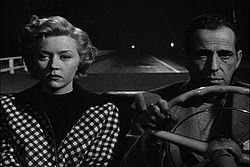
Gloria Grahame and Humphrey Bogart
This is how In a Lonely Place begins. I’m not talking about the film, but the novel written by Dorothy B. Hughes in the late forties. To my mind it’s one of the most radical books of its time. The main character, Dix Steele, is a serial killer, and the focus is on him throughout the entire book. Though Hughes writes in the third person, she takes us inside Dix’s mind so that we can understand this angry, lonely, complicated man.* The title could refer to Los Angeles, the city of the alienated and the displaced, but more importantly it describes this man’s absolute isolation from the world around him. He is desperately lonely and wants to be loved. When he meets Laurel Gray, a young woman who lives in his apartment building, he feels she’s the one who could rescue him. But Dix’s fantasies have no basis in reality. He pursues Laurel, but he’s so disconnected from the world around him that he’s doomed to failure. He’s a lost man.
Nicholas Ray’s film of In a Lonely Place is completely different from the book. Back in 1950, no Hollywood studio would consider making a movie in which the central character was a WWII vet stalking and killing young women. So Ray and his collaborators took a few elements from the book and reworked it into a very different, but still very interesting, story. In the film, Dix Steele is a middle-aged screenwriter who hasn’t had a success in years. He’s intelligent and creative, but he carries an explosive anger within him. When it erupts, which is often, he sometimes lashes out at his closest friends. He can also turn violent. When a young woman he knew slightly is murdered, the police see Dix as the prime suspect.
While the entire cast is solid, the movie really belongs to Bogart. It’s one of his most intense, complex performances. It’s hard to imagine any of his contemporaries going as far with this part. As Dix, Bogart can be arrogant, charming, aggressive, tender, insolent. He freely heaps abuse on his Hollywood colleagues, and at times even turns on his closest friends. But he is also terribly lonely. As in the book, he meets Laurel, a young woman who lives in his building, and he is immediately drawn to her. And as in the book, the relationship is doomed from the start. Laurel loves Dix, but after witnessing his violent outbursts she begins to wonder if he is the killer. What started out as an idyllic romance is quickly poisoned. When the police finally call to say that Dix has been exonerated, it’s too late. Laurel can’t go on with the relationship. It’s over.
Both Bernard Eisenschitz and Patrick McGilligan have suggested that in some ways Dix resembles Nicholas Ray. The director made several films about angry, violent men, including On Dangerous Ground and Bigger than Life. Ray’s characters often come into conflict with the world around them. Sometimes this is because the world is unjust, but often it’s because the characters themselves are deeply troubled. Ray himself had a hard time fitting in. He was intelligent, iconoclastic and impatient with hypocrisy. In a Lonely Place could be seen as an expression of his views on Hollywood. It is certainly one of the most cynical, scathing movies ever made about the movie capitol. And there are elements of the film that have a direct personal connection to Ray’s life. The courtyard apartment where much of the action takes place is a reconstruction of a building the director had lived in. But the most obvious connection is the casting of Gloria Grahame, Ray’s wife, as Laurel.
Ray takes care to capture the feel of LA. Appropriately, the first shot gives us Dix’s point of view as he drives along the streets at night, his anxious eyes reflected in the rearview mirror.** Later in the film, after an angry outburst, we see him driving maniacally along a winding road that looks like Mulholland Drive. The building that Dix and Laurel live in is typical of the courtyard apartments constructed in the twenties and thirties. The settings that create the background for the story may not seem completely “real”, but they do capture the feel of the city. Ray understands architecture, and he understands space. While most of the film was shot on soundstages, the director includes location shots that help to define the city.
Andrew Solt’s screenplay, based on an adaptation by Edmund H. North, is tightly constructed and bristling with tension. Burnett Guffey’s cinematography vividly captures the violent contrasts of the drama. I’m not crazy about George Antheil’s score, which seems intent on dragging this startling, original film back into the realm of Hollywood melodrama.
In many ways the film is much more conventional than the book. But by Hollywood standards, it is very much outside the norm for a commercial feature of the time. Ray and Bogart and their collaborators deserve a lot of credit for making a drama that really delves into a character who is the antithesis of the standard movie protagonist. Dix Steele rages against the world, struggles desperately to hang on to the woman he loves, and in the end still finds himself in a lonely place.
_________________________________________________________
*
I don’t know of any other book from the period that invites us to share a serial killer’s point of view. I’m not a pulp expert, but the only other novel I can think of from the era that does something similar is Jim Thompson’s The Killer inside Me, published five years after In a Lonely Place.
**
Could this have been an inspiration for a similar shot at the end of Taxi Driver where we see Travis’ eyes reflected in his rear view mirror? I’ve never heard Scorsese mention it, but it seems likely he was familiar with the film.
Mildred Pierce (1945)

Jack Carson and Joan Crawford
When producer Jerry Wald read Mildred Pierce shortly after it was published in 1941, he knew it could make a good movie. He also knew it would be an uphill battle to turn it into a screenplay that would be acceptable by Production Code standards. Mildred’s divorce, her fling with a charming playboy, her daughter’s sexual escapades were just a few items that would be troubling for censors. And possibly more troubling than all the rest would be the fact that the author, James M. Cain, tells Mildred’s story without moralizing. He does not condemn her. He merely follows Mildred’s progress, presenting a detailed and convincing portrait of a woman fighting for success, while also exploring the reasons for her ambition.
The Production Code demanded that Hollywood films adhere to strictly defined standards of morality. So to satisfy the censors, Wald injected a murder into the story, and reshaped the ending to assure the audience that justice was served. According to Thomas Schatz’s book The Genius of the System, the producer struggled long and hard with the script. In order to achieve the right tone for a “woman’s” picture, he first assigned Catherine Turney to the project. But to get the tension he needed for a thriller, he had Albert Maltz work Turney’s material over. Other writers also took a shot at the script, but Ranald MacDougall received sole credit for his extensive work on the final version.
The film was directed with smooth precision by Michael Curtiz. By this point in his career Curtiz had refined his approach to the point where his films had a fluid, compelling visual style. He often follows the characters with his camera, using long takes and careful lighting to define space and create atmosphere. On Mildred Pierce he was aided by art director Anton Grot, who had worked on many films with the director. Cinematographer Ernest Haller also played an important part, giving the film the gloss the studio demanded, but still doing justice to the story’s grittier aspects.
The movie is also interesting for the way it portrays Los Angeles in the mid-forties. Cain had written the book as the Depression was ending, and his portrait of the city makes vivid the bitterness and despair of those times. Since Curtiz and his collaborators were shooting the movie a few years later, they captured a different Los Angeles. Granted, the studio would certainly not have allowed them to dwell too much on the city’s seamier side, but the war brought the economy roaring back to life and the film reflects the vitality that was in the air. Curtiz gives us a fascinating, if skewed, picture of Los Angeles as WWII was winding down. Customers eat in their cars in the drive-in dining area at Mildred’s restaurant. Sailors whistle at Veda as she sings at a seedy dive on the Santa Monica pier. Monty shows Mildred his house at the beach, revealing an interesting mix of rustic and modern.
Joan Crawford is excellent as Mildred, and the supporting cast is amazing. Jack Carson combines his usual energy with overbearing arrogance to make the lawyer/hustler Wally thoroughly repulsive. Eve Arden’s impeccable sense of timing and inflection make Ida a joy to watch. Zachary Scott is both seductive and appalling as Monte. And just as impressive as all these seasoned pros is the young Ann Blyth, who gives a chilling performance as Veda.
Cain’s novel is unsparing in its depiction of the characters, while the movie tends to smooth away the scarier edges. This wasn’t just the Production Code. A star like Joan Crawford would probably not want to play a character if it meant crossing certain boundaries. Even if they did, the studio would probably not allow them to play a part that might damage their image. In the film Mildred may be weak, may be fearful, but she is never pathetic or awkward as she was in Cain’s book. When Mildred looks for work in the movie, her voiceover narration accompanies a quick montage in which she rises to the challenge. In the book we accompany Mildred as she learns how difficult and humiliating it can be to work for a living. In the movie Mildred shows her anger at Veda with a sharp slap. In the book’s climax, Mildred is so consumed with anger she tries to strangle her own daughter. Most tellingly, in the final scenes of the movie Mildred acknowledges her mistake in divorcing Bert and they walk off together as the music swells. The book ends with the two of them clinging to each other in the depths of despair.
 Reality Is Scary